


By Mahnaz Imdad
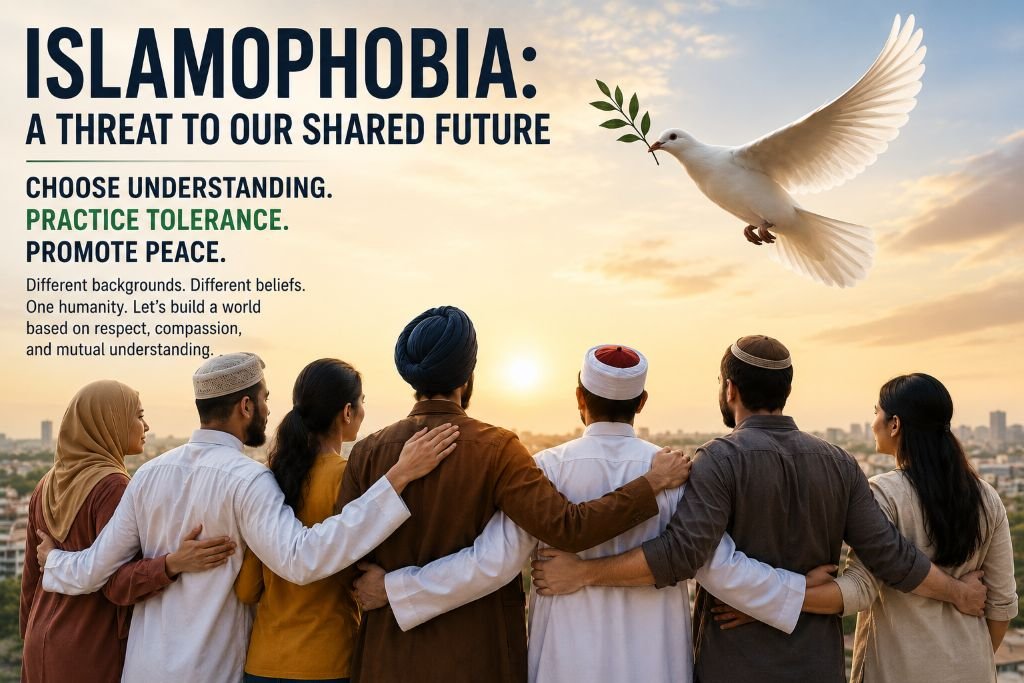
In an increasingly interconnected world, the ideals of peace, coexistence, and mutual respect should be stronger than ever. Yet, despite advancements in communication and globalization, societies across the world continue to witness the rise of prejudice and intolerance. Among the most concerning forms of this intolerance is Islamophobia — a phenomenon that has gradually emerged as a significant social and political challenge in many countries.
Islamophobia is not merely criticism or misunderstanding of a religion; it is the fear, hatred, prejudice, or discriminatory treatment directed toward Islam and Muslims. Over the years, this issue has become more visible in different parts of the world, affecting millions of Muslims in their daily lives. Whether through verbal abuse, social discrimination, restrictions on religious practices, or negative stereotyping, many individuals face challenges simply because of their faith or identity.
One of the major reasons behind the growth of Islamophobia is the portrayal of Muslims in certain media narratives. Isolated incidents involving extremist elements are sometimes generalized and linked to the entire Muslim community. As a result, the actions of a small number of individuals create perceptions that unfairly affect more than a billion Muslims around the world. Such broad assumptions ignore an important reality: no religion can be judged by the actions of a few misguided followers.
Islam, like many major religions, teaches principles of peace, justice, compassion, and respect for humanity. Its teachings emphasize helping the needy, maintaining social justice, and promoting peaceful coexistence among communities. Throughout history, Muslim societies have contributed significantly to science, medicine, education, philosophy, and culture. However, these positive contributions often receive less attention compared to negative headlines.
The consequences of Islamophobia extend far beyond individual suffering. Discrimination and prejudice weaken social cohesion and create divisions within communities. When people feel excluded or targeted because of their identity, trust between different groups can erode. Such divisions can become obstacles to peace and social stability. Furthermore, hatred directed at any religion or community threatens the broader values of tolerance and human rights upon which modern societies are built.
Addressing Islamophobia requires collective efforts from governments, educational institutions, media organizations, and community leaders. Responsible journalism has a crucial role in presenting balanced and accurate narratives. Educational institutions can promote understanding through discussions about cultural and religious diversity. Interfaith dialogue and public awareness initiatives can also help remove misconceptions and encourage mutual respect.
The fight against Islamophobia is not solely a Muslim issue; it is a human issue. History repeatedly shows that intolerance against one community eventually weakens the social fabric of entire societies. Promoting understanding, respect, and justice is therefore not only necessary for Muslims but for all communities striving for a peaceful future.
At a time when the world faces numerous challenges — from conflicts and economic uncertainty to climate crises — humanity needs unity more than division. Building bridges of understanding rather than walls of suspicion may ultimately be one of the most important steps toward ensuring lasting peace and harmony.
The writer is from Turbat-Balochistan.