


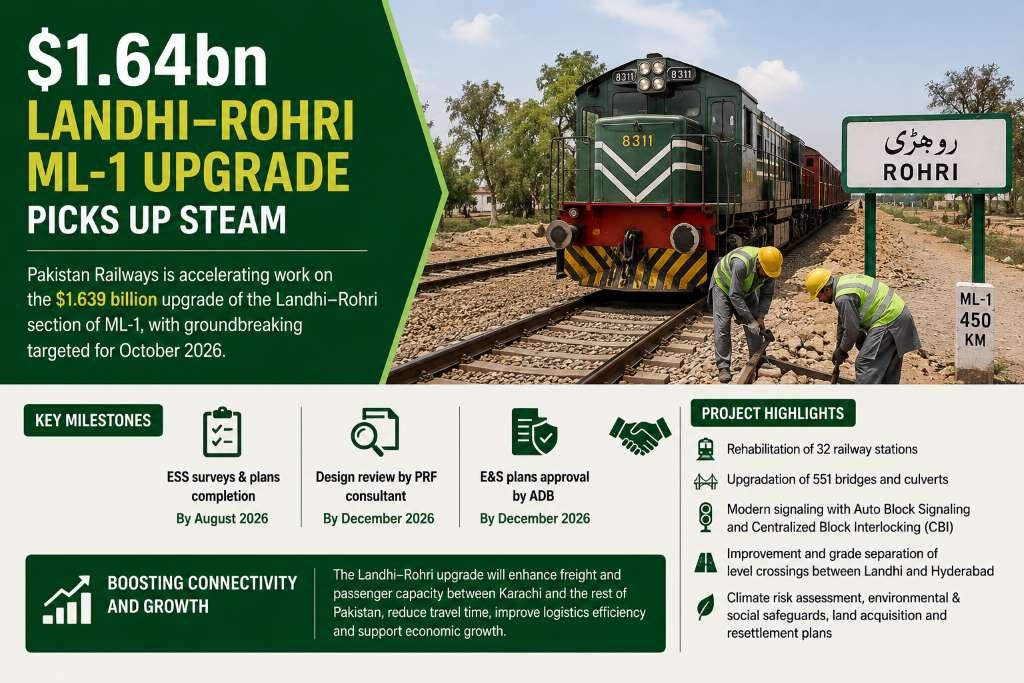
ISLAMABAD, June 7 (ABC): Pakistan Railways (PR) is accelerating work on the $1.639 billion upgrade of the Landhi–Rohri section of Main Line-1 (ML-1), with groundbreaking planned for October 2026.
According to official documents available with Wealth Pakistan, the 450-kilometre corridor will undergo major modernization. The project includes the rehabilitation of 32 railway stations and 551 bridges and culverts. It will also introduce advanced signaling systems, including Auto Block Signaling and Centralized Block Interlocking (CBI), to improve safety and operational efficiency.
Key project milestones
The documents show that Environmental and Social Safeguards (ESS) surveys and planning activities will conclude by August 2026. Pakistan Railways and project consultants will complete design reviews, while the Asian Development Bank (ADB) is expected to approve environmental and social plans by December 2026.
The project team aims to complete several preparatory activities before construction begins. These include contractor procurement, retroactive financing arrangements and final project approvals.
Infrastructure and safety improvements
The upgrade also includes the improvement and grade separation of level crossings between Landhi and Hyderabad. Authorities are conducting climate risk assessments and implementing environmental and social safeguard measures. The project also covers land acquisition and resettlement activities where required.
These interventions will help improve railway safety, reduce operational bottlenecks and strengthen the resilience of the rail network.
Boosting freight and passenger capacity
The Landhi–Rohri upgrade is a key component of Pakistan’s broader railway modernization strategy. Once completed, it will increase freight and passenger carrying capacity between Karachi and the rest of the country.
The project is expected to reduce travel times, improve logistics performance and support stronger regional connectivity. It will also help facilitate trade and contribute to long-term economic growth by enhancing the efficiency of the national transport system.