


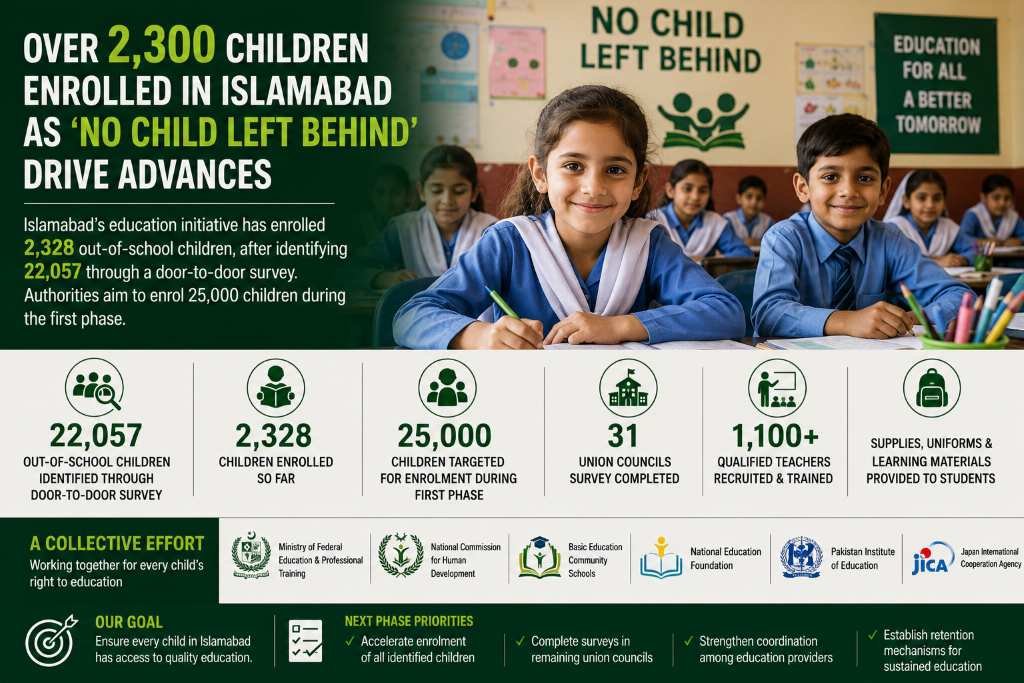
ISLAMABAD, June 08 (ABC): Islamabad has enrolled 2,328 out-of-school children under a nationwide education initiative, marking early progress in efforts to expand access to education across the federal capital.
According to official documents available with Wealth Pakistan, the Ministry of Federal Education and Professional Training launched the programme in March 2026. The initiative aims to identify, enrol and retain out-of-school children in formal and non-formal education institutions across Islamabad Capital Territory (ICT).
Survey identifies over 22,000 out-of-school children
According to the documents, a door-to-door survey has identified 22,057 out-of-school children across ICT. So far, authorities have enrolled 2,328 children. Meanwhile, teams continue efforts to bring the remaining identified children into the education system.
The campaign follows a union council-wise strategy. It combines household surveys, community mobilisation and real-time monitoring. As a result, officials can track enrolment progress more effectively.
Survey work has been completed in 31 union councils. In addition, field teams continue activities in five more councils. The first phase covers 36 rural union councils out of ICT’s 50 union councils during April-June 2026.
Focus on children aged five to 16 years
The programme primarily targets children between five and 16 years of age. Furthermore, authorities aim to enrol 25,000 out-of-school children during the first phase.
To achieve this goal, officials are prioritising admissions in schools operating under the Federal Directorate of Education. At the same time, non-formal education centres and community schools are supporting enrolment efforts in underserved areas.
Moreover, some children are being referred to the Private Educational Institutions Regulatory Authority for admission to private schools.
Learning support and trained teachers
Authorities are providing school supplies, uniforms, teaching materials and learning kits to newly enrolled students. Consequently, children can transition into the education system more smoothly.
The documents also show that more than 1,100 qualified individuals have been engaged as teachers. In addition, these teachers have received comprehensive training to improve learning outcomes.
Data collected through the campaign is being integrated into the Non-Formal Education Management Information System. This online platform helps authorities track identified children and monitor enrolment progress.
Multi-stakeholder effort to expand education access
The initiative brings together several stakeholders. These include the Ministry of Federal Education and Professional Training, the National Commission for Human Development, Basic Education Community Schools, the National Education Foundation, non-governmental organisations, the Pakistan Institute of Education and the Japan International Cooperation Agency.
Going forward, the next phase will focus on accelerating enrolment, completing surveys in the remaining union councils and strengthening coordination among education providers. Additionally, authorities plan to establish stronger retention mechanisms to ensure that enrolled children continue their education.