


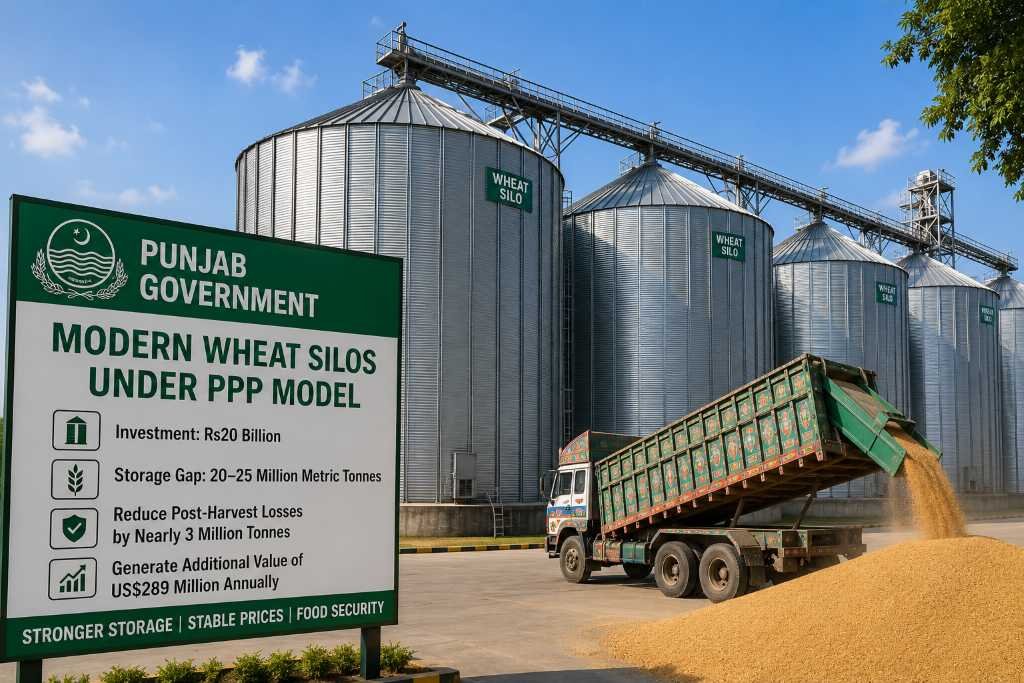
LAHORE, July 20 (ABC): The Punjab government is accelerating efforts to expand the province’s wheat storage capacity through a comprehensive infrastructure programme. The initiative aims to reduce post-harvest losses, improve supply chain efficiency and strengthen food security.
Modern wheat storage
“The work is underway to establish modern wheat silos under a public-private partnership (PPP) model. This will improve long-term storage, reduce post-harvest losses and improve supply chain efficiency,” Director General Food Punjab Amjad Hafeez told Wealth Pakistan.
He said the government is also promoting on-farm silos under the PPP model. The initiative will increase farmers’ storage capacity. It will help them store wheat safely, reduce distress sales and secure better returns on their produce.
According to Hafeez, the initiative involves targeted investments of Rs20 billion to address Pakistan’s estimated wheat storage gap of 20-25 million metric tonnes. The programme will help farmers retain ownership of their produce. It will also prevent nearly three million tonnes of post-harvest losses and generate an estimated $289 million in additional annual value.
In Pakistan, wheat is consumed in various forms, including atta (whole wheat flour), maida (refined flour), suji (semolina), fortified flour, starch, breakfast cereals and crushed wheat.
Wheat stocks remain sufficient
Commenting on wheat stocks, Hafeez said Punjab has sufficient reserves to comfortably meet provincial requirements until the end of the current wheat year in April next year.
He said Punjab produced about 21.91 million metric tonnes (MMT) of wheat this year. The province’s annual domestic consumption is estimated at around 16.5 MMT. This leaves a surplus of approximately 5.41 MMT.
The surplus provides a strong buffer to ensure uninterrupted wheat supplies. It will also help meet inter-provincial requirements, maintain market stability and strengthen food security.
“The releases will be carried out in a calibrated and phased manner to ensure a steady supply of wheat to the milling sector. This approach is intended to maintain adequate flour availability in the market and help keep flour and roti prices stable and affordable for consumers,” Hafeez said.
He added that the Pakistan Agricultural Storage and Services Corporation (PASSCO) will begin dispatching wheat to Punjab this month. The schedule aligns with the province’s supply management plan. It will ensure smooth wheat movement and continued availability of stocks.
Government vows price stability
Hafeez said the government would not allow unjustified increases in wheat, flour and bread prices. He stressed that these essential food items must remain affordable, particularly for low-income households.
He said government wheat releases would continue under a coordinated strategy. Officials are also monitoring market prices closely. He warned that authorities would take strict legal action against anyone involved in hoarding or creating an artificial wheat shortage.
Millers welcome wheat release
Flour millers have welcomed the government’s decision to release wheat from official stocks. They believe the move will help stabilise flour prices across the province.
“The price of the 10kg flour bag has remained in line with the government’s notified rates. The issue has been with the 15kg bag, which is produced from wheat purchased on the open market,” Pakistan Flour Mills Association (PFMA) Patron-in-Chief Asim Ahmad Raza told Wealth Pakistan.
He expressed hope that the release of wheat from government warehouses would lower flour prices. He said it would also reduce the prices of roti and naan.