


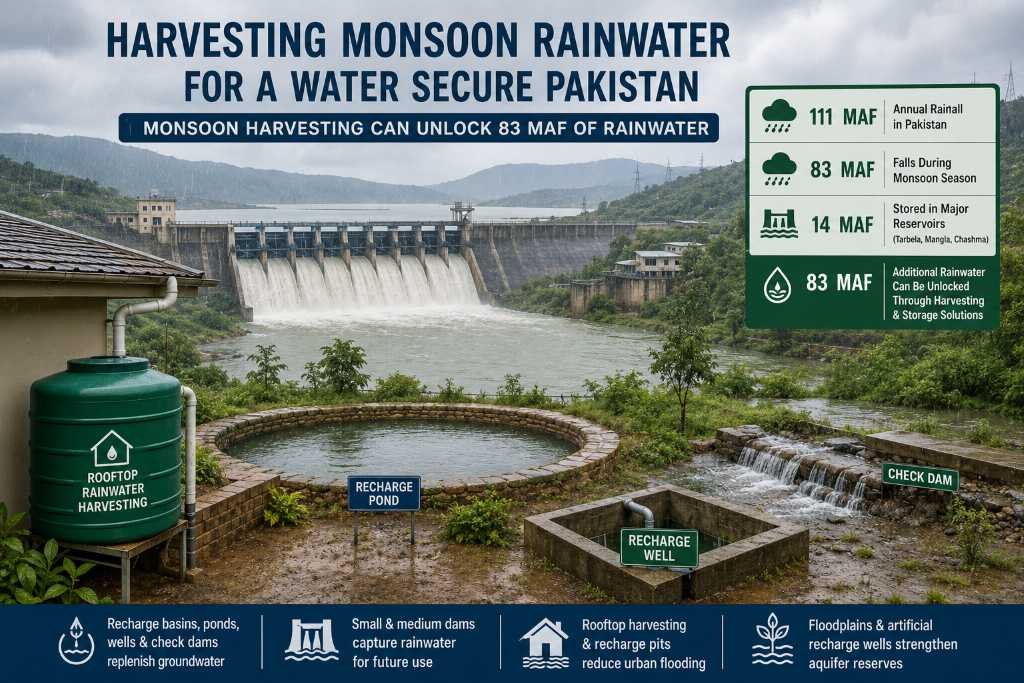
LAHORE, July 21 (ABC): Pakistan can significantly strengthen its water security by effectively harvesting abundant monsoon rainfall. Experts say improved rainwater harvesting and expanded water storage infrastructure can unlock nearly 83 million acre-feet (MAF) of seasonal rainfall for productive use.
Pakistan receives around 111 MAF of rainfall every year. About 83 MAF falls during the monsoon season. At present, the country stores around 14 MAF in major reservoirs, including Tarbela, Mangla and Chashma. This highlights the vast potential for expanding water storage and harvesting systems.
Rainwater harvesting offers major potential
Talking to Wealth Pakistan, Dr Ghulam Zakir Hassan Sial, Director of the Irrigation Research Institute (IRI), Punjab, said Pakistan could substantially improve water availability by adopting both centralized and decentralized water storage solutions.
He said recharge basins, recharge ponds, recharge wells, check dams, flood-spreading basins and injection wells in suitable aquifers are among the most effective methods for conserving monsoon rainwater and replenishing groundwater resources.
Dr Sial said large dams remain important for long-term water storage. However, Pakistan should also prioritise small and medium-sized dams, hill torrent dams and delay-action dams. These structures can capture rainwater that would otherwise flow away.
He said urban centres such as Lahore, Islamabad, Faisalabad and Rawalpindi offer significant opportunities for rooftop rainwater harvesting, underground storage tanks and recharge pits. These measures can improve groundwater replenishment.
According to Dr Sial, rapid urbanisation has increased the area covered by roads and concrete surfaces. As a result, rainwater flows quickly into storm drains instead of naturally recharging aquifers. He said expanding rainwater harvesting infrastructure would improve groundwater reserves and help reduce urban flooding.
Nature-based solutions can boost water storage
Experts also recommend complementing conventional water infrastructure with nature-based solutions to maximise water conservation.
Talking to Wealth Pakistan, Sohail Ali Naqvi, Director of Water Resources at WWF-Pakistan, said Pakistan has tremendous potential to store floodwater in natural floodplains alongside engineered infrastructure such as dams. He said dams provide large-scale water storage, flow regulation and hydropower generation.
Naqvi said Pakistan extracts more than 55 MAF of groundwater every year for agricultural, domestic and commercial use. This creates substantial opportunities to replenish depleted aquifers through managed recharge.
He said floodwater can be diverted to floodplains. This allows water to seep into underground aquifers and strengthen groundwater reserves for future use.
Naqvi said artificial recharge wells are among the most effective Managed Aquifer Recharge (MAR) techniques. The Pakistan Council of Research in Water Resources (PCRWR) introduced this technology, while WWF-Pakistan and other institutions have promoted it in different cities across Punjab.
He said Pakistan should maximise the use of available rainwater, surface water and groundwater. According to Naqvi, the monsoon season offers an ideal opportunity to strengthen water resources for agriculture and other sectors, particularly amid growing uncertainty over transboundary water resources.