


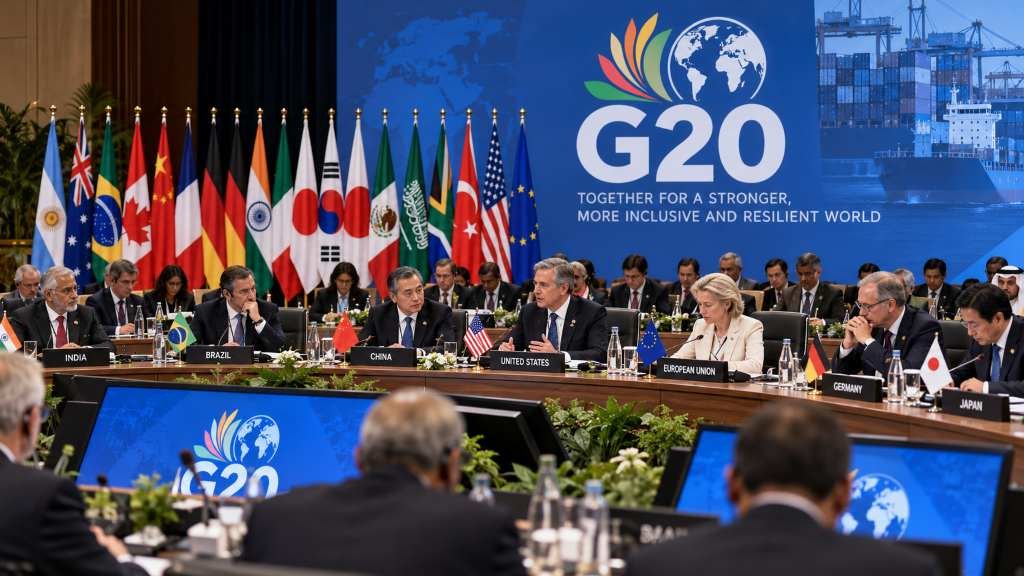
ISLAMABAD, Oct 19 (ABC): Recent G20 trade discussions have renewed attention to the need for stronger international trading rules, greater multilateral cooperation and reforms to the World Trade Organization (WTO), as major economies seek common ground on industrial subsidies, trade imbalances and market access.
The discussions have highlighted the importance of maintaining a predictable, rules-based global trading system that supports international commerce, strengthens business confidence and provides a common framework for resolving disputes among developed and developing economies.
At the G20 trade ministers’ meeting in Milwaukee, participating economies discussed industrial overcapacity and forced labour, identifying areas requiring further dialogue to build broader agreement.
According to media reports, the United States and 14 other market-oriented economies issued a separate joint ministerial statement outlining their shared positions. However, differences over trade practices and industrial policies remained unresolved.
The discussions followed the G20 finance ministers’ meeting in Asheville, where the United States raised concerns over global trade imbalances.
Although consensus remained elusive on some issues at both meetings, the exchanges reinforced the importance of sustained dialogue, institutional reform and mutually agreed rules in addressing international trade challenges.
Aadil Nakhoda, Research Fellow at the Centre for Business and Economic Research, Institute of Business Administration (IBA), Karachi, told Wealth Pakistan that the lack of broad consensus appeared to reflect resistance to protectionist approaches and offered a favourable signal for restoring a rules-based international trading system.
“When superpowers bypass rules and regulations to impose their measures, they end up disrupting trade, creating bottlenecks and challenges for the rest of the global economy,” he said.
Nakhoda said resistance to unilateral trade measures suggested a willingness among G20 members to pursue a more predictable trading environment rather than allow international commerce to become increasingly fragmented.
He emphasised that multilateral cooperation remained essential for maintaining stability in global markets, particularly as differences over industrial policies and trade imbalances became more prominent.
WTO reforms seen as essential for stronger trade cooperation
Nakhoda said the WTO remained the most legitimate international institution for addressing trade disputes and establishing common rules governing global commerce.
However, he stressed that its existing framework required substantial reform to respond effectively to changing industrial policies, government intervention and emerging challenges in international trade.
He said the principles underpinning the multilateral trading system needed to be reassessed to reflect the growing role of industrial subsidies and state-supported economic activities.
Without clearer definitions and greater policy alignment among member countries, the WTO would continue to face difficulties in resolving disagreements over industrial overcapacity and market distortions, he added.
Nakhoda also highlighted the need to restore the effectiveness of the WTO’s dispute-settlement system, particularly its Appellate Body, which has remained unable to hear appeals because of unfilled vacancies.
He said modernising the institution’s ability to address emerging forms of government intervention would strengthen confidence in multilateral trade rules and provide countries with more effective mechanisms for resolving disagreements.
At the same time, Nakhoda cautioned against treating industrial subsidies exclusively as a source of market distortion.
He noted that large-scale investments supported by government policies could also expand production capacity, reduce prices and improve access to affordable goods, particularly for consumers in poorer countries.
“It is imperative to consider how subsidies can be costly as well as benefit certain segments of the global population,” he said.
Nakhoda emphasised the need for detailed research into the broader economic effects of subsidies. Such research, he said, could help international trade rules distinguish between harmful market distortions and policies that generate wider economic benefits.
Haris Bilal Malik, Research Associate at the Institute of Strategic Studies Islamabad, said the Milwaukee meeting demonstrated that major economies continued to hold different positions on industrial overcapacity and global trade imbalances.
However, he said these differences reinforced the importance of developing transparent, evidence-based and mutually agreed mechanisms for addressing trade concerns.
According to Malik, the central question was whether major economies would resolve disagreements through established international rules and negotiated solutions or increasingly rely on unilateral tariffs and trade restrictions.
“Unilateral measures can trigger retaliation, disrupt supply chains and increase costs for businesses and consumers,” Malik said.
He argued that major economies should prioritise dialogue, negotiated solutions and multilateral cooperation to prevent trade disagreements from undermining international economic integration.
Restoring WTO dispute settlement could improve trade stability
Malik said the WTO remained the most important multilateral framework for establishing international trade rules and resolving disputes. However, its effectiveness depended on meaningful institutional reform.
One of the organisation’s principal weaknesses, he noted, was its dispute-settlement mechanism.
The WTO Appellate Body has been unable to hear appeals since December 2019 because vacancies among its members have not been filled.
This situation has weakened the organisation’s ability to deliver final and enforceable rulings in trade disputes, creating uncertainty for countries seeking remedies through established multilateral procedures.
Malik said reform efforts should focus on restoring a fully functioning dispute-settlement mechanism, improving transparency around industrial subsidies and strengthening rules to address genuine market distortions.
Such reforms, he argued, would help create a more predictable international trading environment while allowing countries to address legitimate concerns over unfair competition through agreed procedures.
He also cautioned against interpreting trade imbalances as automatic evidence of unfair trade practices.
Trade surpluses and deficits, he explained, were influenced by several economic factors, including domestic savings, consumption patterns, industrial policies and exchange-rate dynamics.
Sustainable economic rebalancing therefore required policy adjustments in both surplus and deficit economies rather than placing the entire burden of adjustment on individual trading partners, he said.
Developing economies could benefit from predictable trade rules
The renewed focus on multilateral trade rules carries particular significance for developing economies, which depend on stable international markets, predictable trading arrangements and affordable imports to support industrialisation and economic growth.
For countries such as Pakistan, a stronger rules-based trading system could provide greater certainty for exporters, manufacturers and investors. It could also improve the ability of smaller economies to protect their commercial interests through established international mechanisms.
Predictable trade policies could help developing countries participate more effectively in global value chains, attract investment and strengthen their export competitiveness.
Conversely, an escalation of tariff disputes among major economies could increase production costs, disrupt international supply chains and create uncertainty for businesses operating in developing markets.
The G20 discussions have therefore highlighted the importance of balancing legitimate concerns over industrial subsidies and market distortions with the need to preserve open international markets and prevent further economic fragmentation.
Malik said the objective should be to reform and strengthen the multilateral trading system rather than weaken it through competing unilateral measures.
He emphasised that a more effective WTO, supported by transparent subsidy rules and a fully operational dispute-settlement mechanism, would provide major and developing economies with a stronger institutional framework for resolving trade disagreements.