


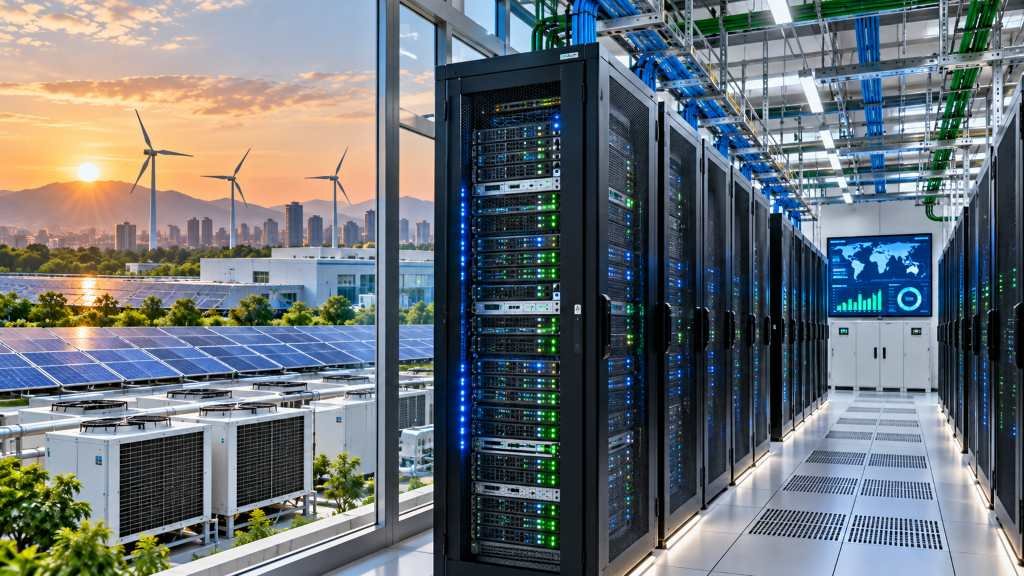
ISLAMABAD, Oct 14 (ABC): The global surge in artificial intelligence (AI) and cloud computing is transforming data-centre development. Governments and technology companies are increasingly focusing on energy efficiency, sustainable infrastructure and economic value alongside the rapid expansion of computing capacity.
As demand for AI infrastructure accelerates, the international data-centre industry is moving beyond simply building more facilities. Instead, greater attention is being paid to operational efficiency, location and the contribution of these facilities to digital innovation and economic growth.
According to UN Trade and Development (UNCTAD), announced investment in data centres exceeded $270 billion in 2025. This accounted for more than one-fifth of global greenfield project values as demand for AI infrastructure, cloud services and digital networks continued to expand.
The investment surge reflects the growing importance of data centres as critical infrastructure for the digital economy. These facilities support AI applications, cloud computing, digital public services and increasingly sophisticated industrial technologies.
Rising electricity demand puts sustainability in focus
However, rapid expansion is placing greater pressure on electricity systems and other resources. The International Energy Agency (IEA) projects that global data-centre electricity consumption will more than double to approximately 945 terawatt-hours by 2030, with AI emerging as the principal driver.
These projections have brought energy availability, renewable electricity integration, efficient cooling systems and water consumption into sharper focus. Countries are also paying greater attention to computing-resource utilisation as they plan their next generation of digital infrastructure.
China is among the countries placing greater emphasis on sustainable and efficient computing facilities. Last month, five Chinese government bodies launched the 2026 selection programme for National Green Computing Facilities.
The programme assesses data centres on energy and carbon efficiency, water consumption, renewable electricity use and utilisation of computing resources.
Industry experts say countries seeking to benefit from the global AI investment boom must look beyond attracting capital and constructing facilities. They also need reliable electricity, high-speed connectivity, technical capabilities and sustainable economic benefits.
Pakistan needs coordinated data-centre development
Hassan Abbas, CEO of Sky47, a Pakistani data-centre and sovereign-cloud operator, told Wealth Pakistan that Pakistan was entering an important phase of digital infrastructure development. However, rapid expansion also carried the risk of uncoordinated development and data-centre sprawl.
He said data centres should be treated as critical national infrastructure rather than isolated technology or real-estate projects. Planning should consider power availability, connectivity, land, water, renewable energy, cybersecurity, disaster recovery, data sovereignty and future AI workloads together.
Abbas said coordination should not restrict private investment. Instead, it should ensure that facilities are developed where strategically required and meet appropriate technical and sustainability standards.
He warned that duplicated or poorly planned facilities could lead to inefficient utilisation of scarce electricity, land and connectivity resources. Such development could also increase the overall cost of digital infrastructure.
Abbas proposed establishing a Pakistan Data Centre Association to bring together operators, cloud service providers and other stakeholders. The association could provide a structured platform for capacity planning, industry standards, sustainability benchmarks, knowledge-sharing and engagement with regulators.
He said such coordination would help Pakistan develop a more integrated digital infrastructure ecosystem while allowing individual operators to compete and innovate.
Data-centre investment should support wider economic growth
Abbas also stressed that authorities should evaluate data-centre investment by the economic activity it enabled rather than simply counting facilities or measuring capital investment.
The wider benefits, he said, included local employment, technical skills, domestic cloud adoption, cybersecurity capabilities and AI infrastructure. Investment could also support software development and help Pakistani businesses develop and scale digital products.
Pakistan already has a Cloud First Policy aimed at increasing public-sector adoption of cloud services. Abbas said the priority should now be consistent implementation and migration of government workloads to avoid further fragmentation of public-sector digital infrastructure.
For the longer term, he emphasised developing a national digital infrastructure ecosystem rather than a collection of independent facilities.
“The principle should be simple: competition between operators, but coordination at the ecosystem level,” Abbas said.
Reliable energy, skills and connectivity remain essential
Muhammad Arif Rabbany, CEO of K2 Peak Technologies and Chairman of the Gilgit-Baltistan IT Association, told Wealth Pakistan that countries competing for data-centre investment faced increasingly demanding requirements.
Investors, he said, were assessing reliable and competitively priced electricity, high-speed connectivity, international bandwidth, cybersecurity standards and regulatory certainty.
Rabbany said Pakistan needed to develop local technical capabilities alongside physical infrastructure. This would help investment generate opportunities for domestic engineers, technicians and businesses working in cooling, networking, power management, cybersecurity and cloud services.
He said partnerships with international technology companies, including Chinese firms already active in Pakistan’s telecommunications and digital sectors, should increasingly incorporate skills development, local engineering and technology transfer. Such cooperation should extend beyond the supply of imported equipment.
Rabbany added that emerging economies should assess whether data-centre investment supported local cloud services, AI companies and technology suppliers. At the same time, development needed to remain compatible with available electricity and infrastructure resources.
Both experts emphasised that sustainability and resource planning were becoming increasingly important as data-centre capacity expanded.
The global shift towards energy-efficient and coordinated computing infrastructure offers an important reference point for Pakistan. It comes as the country develops its digital economy and seeks to benefit from growing investment in AI and cloud services.
For Pakistan, the challenge is to translate these international developments into coordinated planning for electricity, connectivity, technical standards and workforce development. Such an approach could ensure that future data-centre investment supports broader digital-sector growth rather than creating isolated infrastructure.
Abbas said the long-term objective should be an integrated digital infrastructure ecosystem. It should encourage private-sector competition while ensuring coordination on the resources, standards and capabilities needed to sustain growth.