


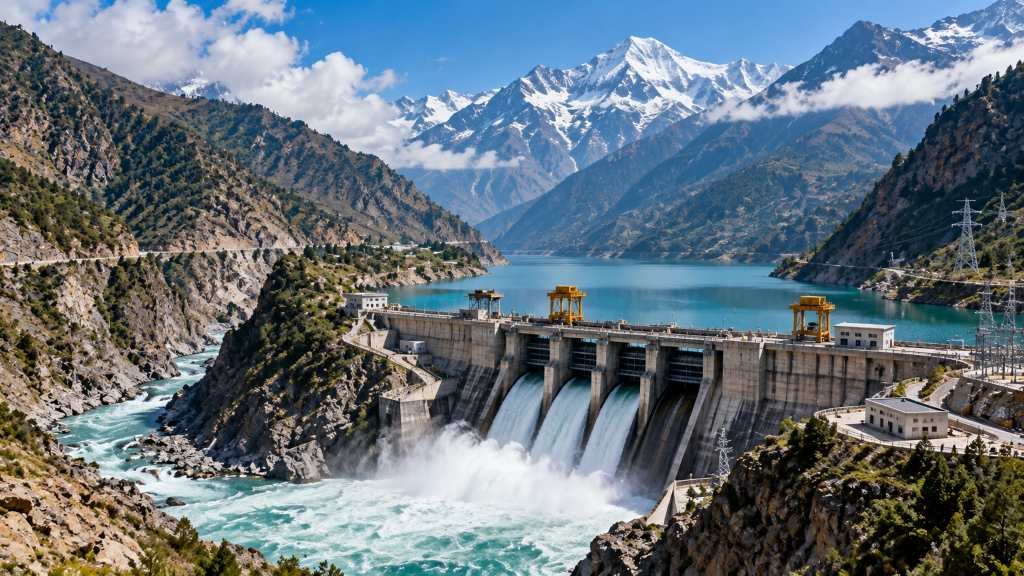
ISLAMABAD, Oct 10 (ABC): Severe flood damage to energy and transport infrastructure in Nepal has highlighted the growing need for climate-resilient hydropower development across South Asia. Himalayan countries face increasing exposure to floods, landslides, glacial hazards and more erratic river flows, raising concerns about the resilience of major infrastructure projects.
The issue has gained renewed attention following catastrophic flooding in Nepal. The World Bank said it had made up to $170 million in emergency financing available to support Nepal’s immediate response. The funding would also help restore critical infrastructure and services following the Rasuwa Bhote Koshi flood.
The economic consequences are extending beyond the immediate disaster. In its latest Nepal Development Update, the World Bank projected the country’s economic growth to slow to 3.7% in FY27. It identified extensive damage to hydropower, solar, electricity transmission and transport infrastructure as a major drag on industrial activity.
However, reconstruction is expected to help Nepal’s economic growth recover to 5.2% in FY28.
The flood also directly affected the Upper Trishuli-1 hydropower project, with the extent of damage still being assessed. Meanwhile, the World Bank is working with Nepal on reconstruction and investment programmes aimed at building more resilient infrastructure.
Nepal’s experience offers lessons for Pakistan
Nepal’s experience carries particular relevance for Pakistan, where much of the country’s existing and planned hydropower capacity is concentrated in mountainous areas. These regions face risks from flash floods, landslides, glacial lake outburst floods and increasingly erratic river flows.
Fatima Rehan, Environmental Economist at the Pakistan Institute of Development Economics, told Wealth Pakistan that the stronger economic case for dams lay in water management, agriculture and protection against repeated flood losses.
“Pakistan’s central problem is not only the volume of water available, but the country’s limited ability to manage that water across seasons. During major flood events, very large flows move through the river system in a short period, while the economy later faces water shortages for irrigation and other uses,” she said.
Rehan said greater storage capacity could improve the country’s ability to manage that imbalance.
“Reservoirs preserve part of the high-flow water for later agricultural and domestic use and support more stable irrigation supplies during dry periods. That directly affects farm productivity, rural incomes and food security,” she said.
She added that dams could also help manage extreme water events when sufficient storage capacity was available and reservoirs were operated effectively.
“When storage space is available and reservoirs are operated effectively, dams reduce pressure on downstream areas and provide authorities with greater control over flood flows. This does not eliminate flood risk, but it strengthens the country’s ability to manage extreme water events and reduce damage to crops, roads, settlements and productive infrastructure,” she said.
Rehan added that Pakistan should evaluate new dam projects on their combined economic benefits rather than on power generation alone.
Climate risks require stronger infrastructure standards
An official of the Environmental Protection Agency (EPA) said Himalayan hydrology required updated infrastructure standards to account for altered river flows, glacial melt and increasingly erratic monsoon patterns.
He said authorities needed to design long-life assets such as dams, hydropower plants, access roads and transmission networks for future climate conditions rather than historical averages.
“Pakistan needs to assess future projects against changing river flows, more intense rainfall, glacial melt and the growing risk of landslides and flash floods. Climate resilience has to become part of the engineering design from the beginning rather than being added after construction,” he said.
Climate-resilient dam infrastructure could also strengthen Pakistan’s ability to manage increasingly volatile water flows. At the same time, it could support electricity generation, agriculture and long-term water security.
Basin-level planning needed for hydropower resilience
The EPA official said protecting individual projects would not be sufficient as climate-related risks increasingly affected entire river systems and associated infrastructure.
“Pakistan also needs to move from project-by-project protection towards basin-level climate-risk planning. Hydropower development, flood management, watershed rehabilitation, sediment control, early-warning systems and downstream community protection should increasingly be planned together because climate risks do not stop at the boundary of an individual project,” he said.