


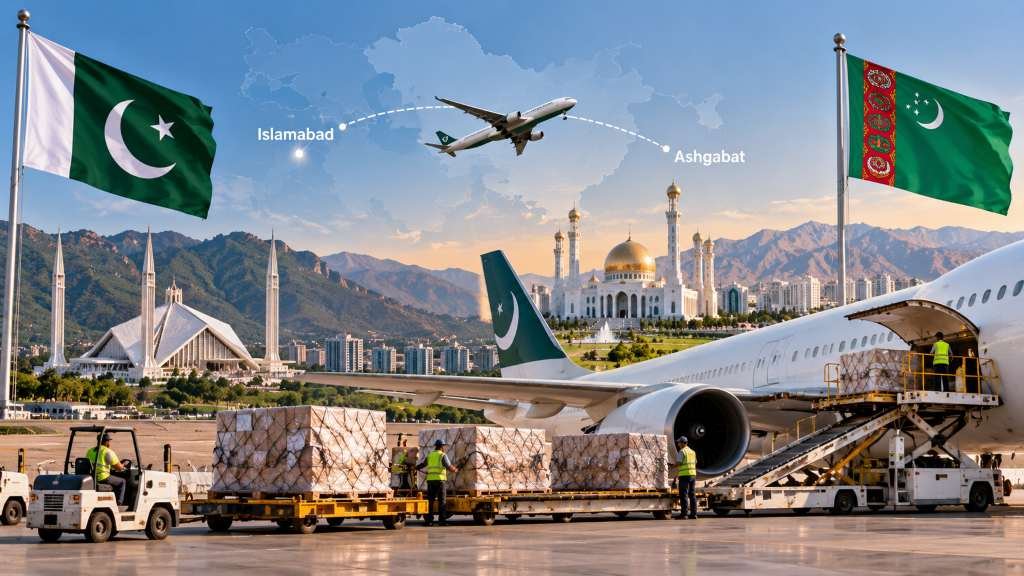
ISLAMABAD, Oct 6 (ABC): The proposed resumption of direct flights between Pakistan and Turkmenistan is set to add a new channel for trade and business connectivity with Central Asia. The air link could complement road and rail corridors whose reliability has increasingly become a concern for regional traders.
Pakistan and Turkmenistan are considering the resumption of cargo and commercial flights between Islamabad and Ashgabat. The proposed connection comes against a backdrop of limited bilateral trade despite the geographical proximity of the two countries.
According to official trade data, Pakistan exported about $1.18 million worth of goods to Turkmenistan and imported $5.87 million in FY2025-26. This took bilateral trade to around $7.05 million.
Air connectivity could open new trade opportunities
Sabz Ali Khan, Director at the Directorate General of Trade Organization (DGTO), told Wealth Pakistan that improved air connectivity could provide another route for moving people, goods and business services. It could also create stronger commercial links with the wider Central Asian region.
He said the small existing trade base showed substantial room for Pakistani exporters to identify products with demand in Turkmenistan. This could help diversify beyond the limited range of goods currently traded.
“Improved trade facilitation, better transport connectivity, market intelligence, business-to-business linkages and participation in trade exhibitions could help Pakistani exporters explore this relatively untapped Central Asian market,” he said.
The significance, however, extends beyond Turkmenistan. The case for alternative connectivity has gained importance as disruptions on Pakistan’s traditional overland route through Afghanistan have exposed the vulnerability of trade access to Central Asian markets.
According to the Asian Development Bank’s Central Asia Regional Economic Cooperation (CAREC) corridor monitoring data, average road border-crossing times across the CAREC network more than doubled from 6.3 hours in 2010 to 14.1 hours in 2024.
The Asian Development Bank (ADB) recently approved a $400 million regional facility aimed at modernising border crossings and reducing transport and logistics costs across participating CAREC economies.
Multimodal connectivity gains importance
Khan said these constraints made multimodal connectivity increasingly important for Pakistan.
He pointed to Pakistan’s existing trade arrangements with Uzbekistan and said bilateral links with individual Central Asian states should be viewed within a broader network of regional transit. Such relationships, he added, should not be treated as isolated trading arrangements.
Pakistan and Uzbekistan already have a Preferential Trade Agreement and an Agreement on Transit Trade, providing an institutional framework for expanding commercial and transport links.
Khan said Uzbekistan’s central geographical position could help connect Pakistani businesses with other Central Asian markets. However, sustainable trade would require predictable transit rules, efficient customs clearance and alternative routes when individual corridors were disrupted.
The same argument was highlighted at the September CAREC meetings in Mongolia. There, Pakistan called for CAREC Corridors 5 and 6 to evolve from basic transport routes into integrated economic corridors. The proposed approach would link Central Asia with the Arabian Sea through logistics, rail, road and port infrastructure.
Air links could complement road, rail routes
Rana Asif Khan, Founder President of the International Road Transport Chamber of Pakistan (IRTCoP), told Wealth Pakistan that greater use of multimodal cargo systems could reinforce regional connectivity. Such systems could combine air, road and maritime transport.
He said a recently introduced multimodal cargo model had created an additional option for cross-border trade. In particular, it could facilitate shipments moving between different modes of transport under a more integrated documentation framework.
According to him, the model is currently centred on Karachi. Extending such arrangements to Islamabad, Lahore, Quetta and Gwadar could broaden Pakistan’s regional logistics network.
He said direct air and multimodal connections could be particularly useful for time-sensitive and higher-value cargo. Meanwhile, road, rail and maritime links would remain essential for larger trade volumes.
For Pakistan, direct Islamabad-Ashgabat flights would therefore be more significant as part of a wider regional connectivity network than as a standalone solution. Air links could improve business mobility and provide an alternative channel for selected cargo, while road, rail and transit arrangements would continue to carry the bulk of regional commerce.