


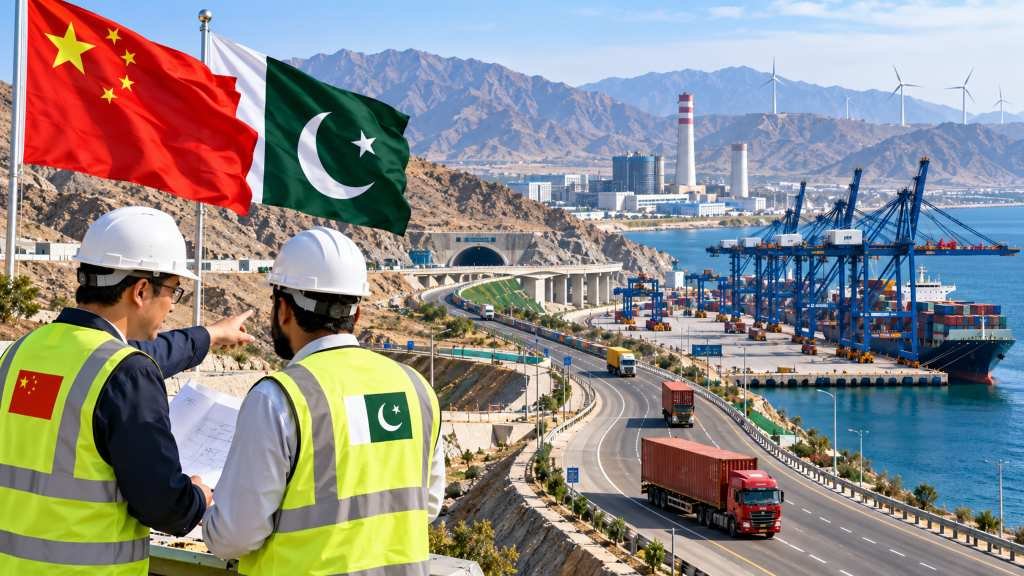
ISLAMABAD, Oct 1 (ABC): China’s overseas economic engagement is maintaining strong momentum across Belt and Road economies. Meanwhile, its growing emphasis on investment, industrial cooperation, energy, minerals and commercially viable projects is giving fresh impetus to the next phase of the China-Pakistan Economic Corridor (CPEC 2.0).
Figures released by China’s Ministry of Commerce show that Chinese companies generated $99.39 billion in turnover from contracted projects in Belt and Road partner countries during January-August 2026. This represented a 12.5% year-on-year increase. Newly signed contracts were valued at $152.92 billion, up 2.4% in dollar terms.
The continued expansion comes as China’s overseas engagement increasingly moves beyond traditional infrastructure construction. Greater emphasis on investment-led and commercially oriented cooperation is creating more scope for industrial partnerships, technology transfer, energy and mineral development across Belt and Road economies.
For Pakistan, the changing model provides an opportunity to align CPEC 2.0 more closely with industrial production, investment and exports. At the same time, securing a larger share of Chinese overseas investment will require stronger project preparation, regulatory consistency and business-to-business facilitation.
China’s development model evolves
Dr Hassan Daud Butt, former CPEC Project Director and Senior Advisor to Energy China, told Wealth Pakistan that China’s development trajectory was undergoing a significant structural transformation.
He said the economy was increasingly moving beyond growth based primarily on scale, capital accumulation and low-cost production. Instead, advanced engineering, technological innovation, green development and higher-value manufacturing were becoming more important.
According to Butt, China’s expanding global commercial footprint could help developing economies integrate more closely with international production networks. However, the availability of Chinese capital alone would not automatically translate into successful investment projects.
“The more important question for Pakistan is no longer whether Chinese companies are investing overseas. The real question is which countries are able to convert Chinese commercial interest into executable projects and create an environment where investments can move quickly from an initial proposal to implementation,” Butt said.
He said Pakistan needed to strengthen its project-preparation capacity. This would allow potential investors to be presented with commercially viable opportunities rather than broad sectoral proposals.
Butt added that Pakistan could derive greater benefits from CPEC and broader China-linked connectivity if infrastructure development was connected more closely with industrial production and exports.
Investment needs to raise productivity
Talking to Wealth Pakistan, Dr Mujeeb Ullah, Assistant Director at the Pakistan Study Centre, University of Peshawar, said the key opportunity for Pakistan was to use foreign investment to raise productivity.
“Investment becomes more valuable when it brings technology, management practices, skills, supplier linkages and access to international markets. Pakistan therefore needs policies that encourage these spillovers into domestic firms and workers,” he said.
He said Pakistan’s industrial sector would need to improve productivity, skills and technological capabilities to benefit from the changing structure of Chinese manufacturing and overseas investment.
“Pakistan cannot compete sustainably only on the basis of low labour costs. The country needs to improve skills, production efficiency, quality standards, energy reliability and technological capabilities so that Pakistani firms can participate in higher-value activities,” he said.
Mujeeb said long-term investors also required predictability. Consistent taxation, access to foreign exchange, reliable energy supplies, efficient customs procedures and stable regulatory policies could significantly influence investment decisions.
Improving these fundamentals, he said, would better position Pakistan to capitalise on China’s evolving industrial and technological strengths.
CPEC 2.0 focus shifts to commercial outcomes
Mujeeb said the next phase of CPEC should increasingly be assessed by tangible commercial and industrial outcomes rather than the number of proposals alone.
“Pakistan should measure success by how many proposals reach financial close, how many joint ventures begin production and how much additional export capacity is created,” he said.
This approach, he added, would better align CPEC 2.0 with the current trajectory of China’s wider overseas economic engagement.