


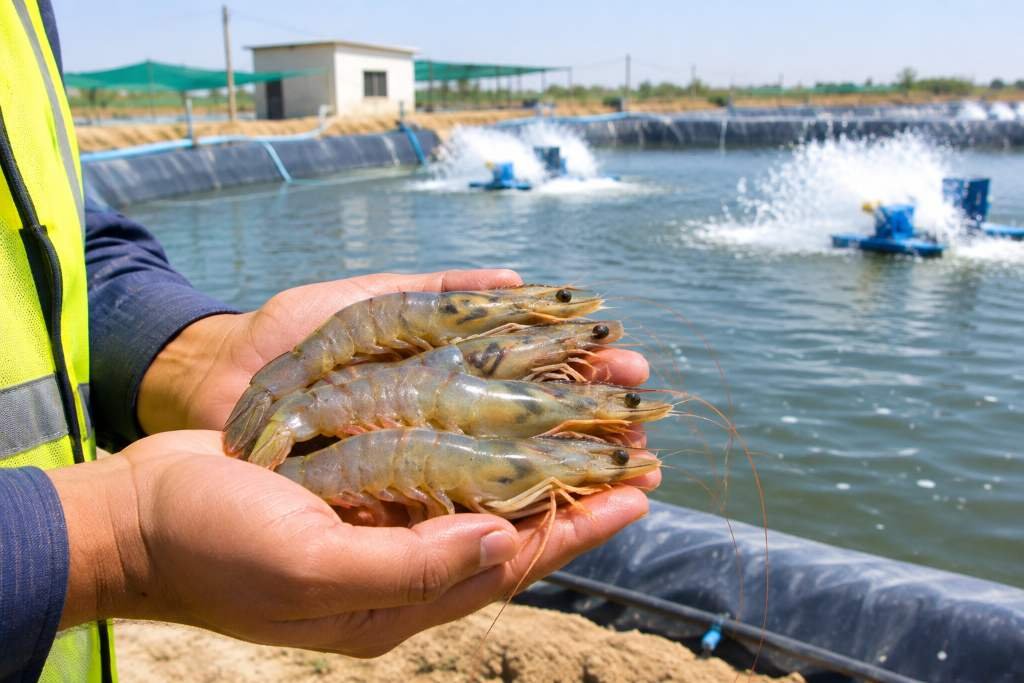
ISLAMABAD, Nov 12 (ABC): Pakistan’s emerging inland shrimp farming industry offers the potential to generate annual net profits of up to Rs11 million per hectare. In comparison, conventional carp farming generates profits of Rs500,000 to Rs800,000 per hectare.
A report by the Pakistan Business Council (PBC) highlights the industry’s potential to increase farmers’ incomes and expand seafood exports. The opportunity comes as Pakistan seeks to enter a global shrimp market worth more than $32 billion annually.
The report, titled Pakistan’s Aquaculture Sector: Opportunities, Challenges & Policy Recommendations for Improving Export Competitiveness, compares the commercial returns from shrimp and carp farming.
According to the report, inland shrimp farming can generate gross annual revenues of Rs9 million to Rs28 million per hectare. Traditional carp farming, meanwhile, generates Rs900,000 to Rs1.6 million per hectare.
Export-grade shrimp fetches Rs900 to Rs1,400 per kilogram at the farm level, compared with Rs250 to Rs350 for carp. However, shrimp farming requires substantially higher initial investment.
The report estimates that establishing a shrimp farm costs Rs2.8 million to Rs7 million per hectare. In contrast, setting up a conventional carp farm requires Rs500,000 to Rs1.1 million per hectare.
The PBC, established in 2005, is a research-based business advocacy platform supported by more than 100 local and multinational private-sector businesses.
Pacific white shrimp offers strong export potential
The report, available with Wealth Pakistan, identifies Pacific white shrimp (Litopenaeus vannamei) as a promising species for commercial farming. Its high market value, export demand and short production cycle make it attractive to investors.
Pacific white shrimp typically completes a production cycle within 90 to 120 days. Moreover, advanced biofloc farming systems can support two to three production cycles annually.
According to the report, shrimp farms can produce eight to 20 metric tonnes per hectare over two production cycles. Conventional carp farming, by comparison, produces three to five tonnes per hectare.
The report also highlights growing demand in international seafood markets. Farmed shrimp accounts for approximately 55% of global shrimp production, while vannamei represents around 70% of farmed shrimp output.
Major markets include the United States, China, the European Union, Japan and Gulf countries. Pakistan could use its existing seafood processing facilities, cold chains and trade links to expand shrimp exports.
Saline land in Punjab and Sindh offers farming opportunities
The PBC report identifies saline groundwater and salt-affected land as potential resources for inland shrimp farming. Such areas exist across southern Punjab, Sindh and Balochistan.
In Punjab, promising locations include Bahawalpur, Rahim Yar Khan, Muzaffargarh and Dera Ghazi Khan. Meanwhile, Thatta, Sujawal and Badin offer potential for commercial shrimp farming in Sindh.
The report also identifies Hyderabad and Jamshoro as possible locations. However, their suitability depends on water quality and detailed feasibility assessments.
Commercial shrimp farms in Thatta and southern Punjab have already demonstrated the viability of modern farming methods. These operations use improved aeration, water management, specialised feed and disease prevention measures.
Furthermore, the development of intensive ponds and biofloc systems could increase production and attract additional investment. These technologies can help farmers improve productivity and manage farming conditions more effectively.
Investment interest grows in Pakistan’s shrimp industry
According to the report, local entrepreneurs, corporate businesses and overseas investors are showing growing interest in shrimp farming. International shrimp companies are also exploring partnerships with Pakistani firms.
Such partnerships could support investment, technology transfer and the development of modern aquaculture facilities. They could also help strengthen the industry’s commercial capacity.
Provincial fisheries departments, particularly in Punjab, are supporting shrimp farming through training and technical assistance. Meanwhile, universities and private operators are working to adapt modern farming technologies to local conditions.
However, the industry remains at an early stage of development and faces several challenges. These include limited domestic hatchery capacity and dependence on imported shrimp seed.
Disease risks, inadequate cold-chain infrastructure and limited processing facilities also constrain the sector’s expansion. In addition, the report identifies insufficient export certification facilities and a shortage of skilled workers as major challenges.
Therefore, the PBC calls for investment in hatcheries, feed production, disease prevention and supporting infrastructure. Such investment could improve the industry’s competitiveness and long-term commercial viability.
Shrimp farming could boost Pakistan’s seafood exports
Looking ahead, the PBC describes inland shrimp farming as Pakistan’s most commercially attractive emerging aquaculture segment.
Currently, shrimp farming accounts for less than 2% of Pakistan’s total aquaculture production. Nevertheless, the report suggests that even modest expansion could generate substantial export earnings because of the product’s high value.
The report indicates that Pakistan has opportunities to develop commercial shrimp farming by using suitable land, modern production systems and existing seafood trade networks.
However, realising this potential will require investment in infrastructure, technical expertise and disease management. Strengthening these areas could help Pakistan increase shrimp production and improve its position in international seafood markets.