


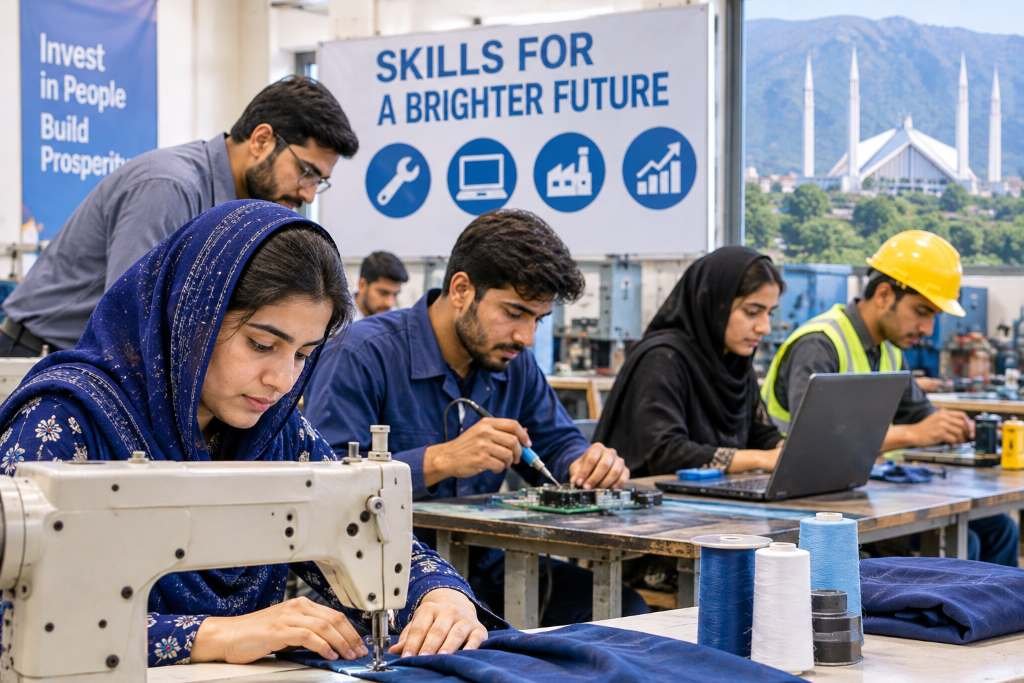
ISLAMABAD, Nov 13 (ABC): South Asia needs greater investment in skills development, productive employment, access to finance and market opportunities to reduce poverty. Experts say these measures could help the region turn its large working-age population into a driver of sustainable economic growth.
The urgency is highlighted in a World Bank report released on November 3, which estimates South Asia’s working-age population at approximately 1.17 billion. However, the region’s demographic window is gradually narrowing, increasing pressure on governments to create productive jobs.
According to the report, only 60% of South Asia’s working-age population is employed. Moreover, 88% of employed people work in the informal sector, where earnings and job security are often limited.
The report, Demographic Change in South Asia: From Tailwinds to Headwinds for Development, calls for stronger education systems and better employment opportunities. It also recommends expanding access to finance for micro, small and medium enterprises (MSMEs) and removing barriers to women’s employment.
Pakistan’s poverty rate rises to 29%
The regional challenges are particularly relevant for Pakistan, where poverty has increased in recent years.
According to the World Bank’s October 2026 Poverty and Equity Brief, Pakistan’s national poverty rate rose from 22% in 2018–19 to 29% in 2024–25.
The increase highlights the importance of creating sustainable employment opportunities alongside existing poverty reduction initiatives.
Minister of State for Planning, Development and Special Initiatives Chaudhry Armaghan Subhani told Wealth Pakistan that development should improve ordinary people’s lives.
He said economic policies must create jobs, reduce poverty and provide families with opportunities to build better futures.
Subhani stressed that financial assistance alone could not provide a lasting solution to poverty.
“We must also give people skills, jobs, and opportunities to earn a living,” he said, emphasising their importance for sustainable poverty reduction.
According to Subhani, Pakistan’s development priorities include exports, digital services, clean energy and broader economic opportunities.
He also highlighted the importance of ensuring that economic development reaches vulnerable communities and less-developed areas.
Pakistan seeks stronger China cooperation in skills and employment
Subhani said future cooperation with China should increasingly focus on job training, small businesses and economic opportunities for disadvantaged communities.
In particular, he emphasised expanding opportunities for women, young people and residents of less-developed areas.
He also called for greater cooperation among South Asian countries to exchange successful development practices.
Such cooperation could help improve agricultural productivity, strengthen small businesses and expand vocational training and employment opportunities.
Meanwhile, Dr Zafar Uddin Mahmood, Special Representative of the Prime Minister of Pakistan on China Affairs and President of the Understanding China Forum, highlighted China’s poverty alleviation experience.
Talking to Wealth Pakistan, Mahmood said China’s development experience offered valuable lessons for Pakistan and other South Asian economies.
He identified sustained economic growth, investment in human capital, infrastructure development and effective governance as important factors in China’s development.
“For Pakistan and South Asia, the priority is to translate our region’s immense human and economic potential into inclusive and sustainable development,” Mahmood said.
He added that closer cooperation with China in trade, investment, agriculture, technology and connectivity could support economic development.
Furthermore, collaboration in skills development could create employment opportunities, improve livelihoods and contribute to poverty reduction.
Poverty reduction requires integrated economic policies
Mahmood stressed that governments should not treat poverty alleviation as a stand-alone initiative.
Instead, he called for an integrated development approach combining economic growth, education, healthcare and employment generation.
He also emphasised the importance of social protection and rural development in improving living standards.
According to Mahmood, strong institutions, effective implementation and accountability are essential for achieving sustainable results.
These measures could help governments address the multiple economic and social challenges that contribute to poverty.
Moreover, linking infrastructure investment and economic development with employment opportunities could improve the long-term impact of poverty reduction programmes.
Skills, microfinance and market access form ‘golden triangle’
Dr Abid Qaiyum Suleri, Executive Director of the Sustainable Development Policy Institute, highlighted the importance of connecting skills development with sustainable incomes.
Talking to Wealth Pakistan, he said South Asian countries should focus more strongly on turning vocational skills into employment and entrepreneurship opportunities.
Suleri proposed a “golden triangle” of skills, microfinance and market integration as a practical model for reducing poverty.
Under this approach, skills development would help people acquire marketable abilities. Meanwhile, access to microfinance could support small businesses and self-employment.
Stronger market connections would then help entrepreneurs sell their products and services, creating opportunities for sustainable income generation.
Suleri also suggested that Pakistan could benefit from China’s poverty reduction experience by establishing demonstration sites in selected districts.
These sites could test successful development approaches and adapt them to local economic and social conditions.
Furthermore, he called for renewed attention to vocational training programmes.
According to Suleri, training should respond to actual market demand and provide clearer pathways to employment and entrepreneurship.
Productive employment key to South Asia’s demographic dividend
The experts’ recommendations broadly align with the World Bank’s assessment of South Asia’s demographic challenges.
The report indicates that the region’s remaining demographic dividend will depend on its ability to create better-paying jobs and strengthen human capital.
It also highlights the importance of improving access to finance for small businesses and expanding women’s participation in economic activity.
For Pakistan, the challenge extends beyond providing social protection to creating sustainable pathways out of poverty.
Productive employment, marketable skills, entrepreneurship and stronger market connections could help households achieve greater financial stability.
At the same time, investment in education, healthcare and institutional capacity would support long-term economic development.
Greater regional cooperation, including partnerships with China, could further strengthen opportunities in trade, technology, agriculture and skills development.
Overall, combining employment generation with human development and market access could help South Asia use its demographic potential more effectively.
Such an approach could improve livelihoods, support inclusive economic growth and contribute to sustainable poverty reduction across the region.