


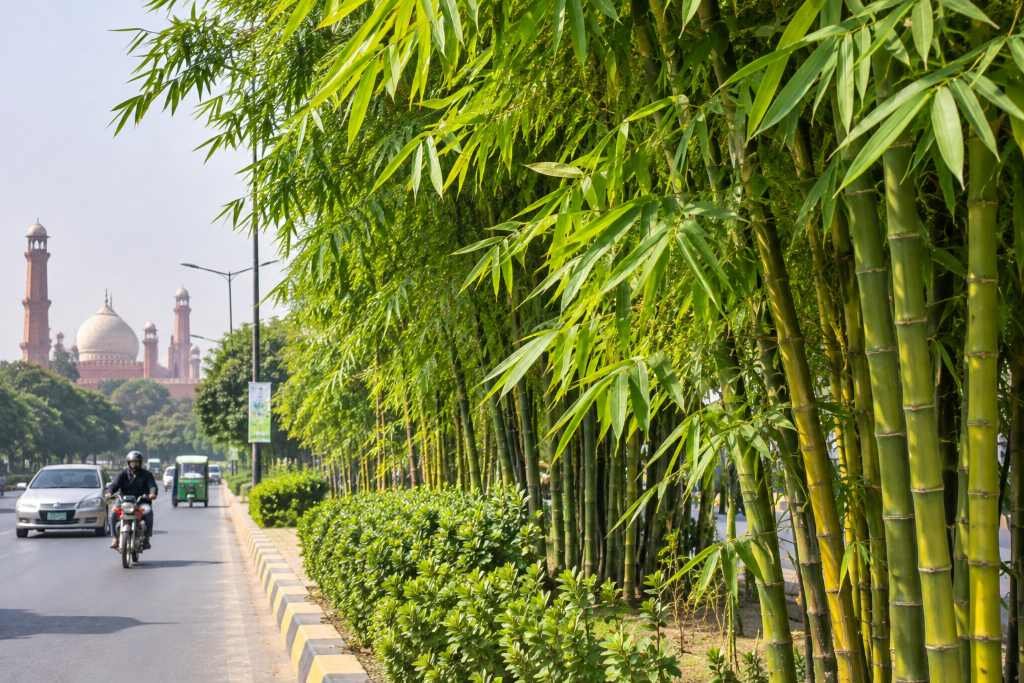
LAHORE, Nov 14 (ABC): Inspired by China’s experience in using bamboo plantations to improve urban environments, the Punjab Forest Department is expanding bamboo cultivation in Lahore. The initiative aims to increase green cover, improve air quality and help address the city’s recurring winter smog problem.
The department has already planted more than 20,000 bamboo plants across different parts of Lahore. These plantations form part of a broader urban forestry and green infrastructure strategy.
According to Punjab Forest Department officials, bamboo cultivation offers a nature-based approach to improving urban environmental conditions. Its rapid growth, dense foliage and carbon absorption potential make it a useful addition to urban green spaces.
However, environmental experts stress that bamboo plantations should complement other pollution-control measures rather than serve as the only solution to smog.
Over 20,000 bamboo plants grown across Lahore
A Punjab Forest Department spokesman told Wealth Pakistan that more than 20,000 bamboo plants have been grown in different areas of Lahore.
The plantation sites include Ali Town, Maulana Shaukat Ali Road and Raiwind Road. These locations form part of the department’s efforts to expand green infrastructure across the city.
“More than 20,000 bamboo plants have been grown in Lahore areas like Ali Town, Maulana Shaukat Ali Road, and Raiwind Road under the urban greening strategy,” the spokesman said.
He explained that bamboo is a fast-growing plant that supports carbon sequestration, biomass production and soil conservation. Moreover, its cultivation can contribute to the development of green spaces in urban and peri-urban areas.
The department is promoting bamboo alongside native tree species to improve biodiversity and strengthen long-term ecological resilience.
Bamboo cultivation expands to over 20,000 acres in Punjab
Beyond Lahore, bamboo cultivation has also expanded to agricultural and irrigated lands across several Punjab districts.
According to the spokesman, commercial bamboo plantations now cover more than 20,000 acres of private land in the province.
The districts include Sargodha, Jhang, Khushab, Mandi Bahauddin, Kasur, Narowal, Sheikhupura and Gujranwala.
The department considers bamboo an important species because of its rapid growth and multiple environmental benefits. In addition to absorbing carbon dioxide, bamboo can help conserve soil and support biomass production.
Furthermore, the expansion of bamboo cultivation could strengthen green cover across suitable agricultural and irrigated areas.
The spokesman said the Forest Department was also promoting native trees as part of its wider environmental strategy. This combined approach aims to improve biodiversity while supporting sustainable plantation development.
Punjab identifies roads and open spaces for bamboo plantations
Under its urban forestry strategy, the Punjab Forest Department is identifying suitable locations for bamboo cultivation in cities and surrounding areas.
Potential plantation sites include road corridors, institutional lands, open spaces and locations requiring green buffers.
However, officials assess several factors before selecting a site. These include land availability, soil conditions, water requirements and the suitability of different bamboo species.
The department is also coordinating with other government institutions to expand urban green cover.
“We are collaborating with the Parks and Horticulture Authority (PHA), local governments, educational institutions, and other relevant agencies to expand urban green cover,” the spokesman said.
According to him, these partnerships help identify suitable plantation sites and ensure the protection and maintenance of planted areas.
He emphasised that coordinated efforts among government departments were essential to addressing Lahore’s smog problem and improving urban environmental conditions.
Environmental experts highlight bamboo’s air purification potential
Environmental experts have welcomed the government’s efforts to promote bamboo cultivation in Lahore. However, they believe the city needs a broader strategy to control air pollution.
Naseem-ur-Rehman Shah, an environmental consultant and former Director of the Environment Protection Department, said native trees also play an important role in improving air quality.
“All native trees, like Neem, have always been helpful in reducing environmental pollution and combating climate change through high carbon absorption,” he told Wealth Pakistan.
Nevertheless, Shah acknowledged that bamboo could contribute significantly to several ecological functions.
He said bamboo absorbs carbon dioxide and releases oxygen through photosynthesis. According to him, some bamboo species can release around 35% more oxygen than many traditional tree species.
He added that bamboo plantations can capture several tonnes of carbon dioxide per hectare annually, depending on the species and growing conditions.
Shah also highlighted bamboo’s potential to capture airborne pollutants through its dense foliage and leaf surfaces.
“Its dense foliage and waxy surfaces help trap airborne particulate matter, especially PM2.5, sulfur dioxide, nitrogen oxide, and other gases in urban and industrial zones,” he said.
While leaves can capture particulate matter, the extent of pollutant removal depends on local environmental conditions and plant characteristics.
Bamboo root systems can support soil and water conservation
Besides its potential contribution to air quality, bamboo can also support soil and water management.
Shah explained that bamboo’s extensive root systems help stabilise soil and reduce runoff. These characteristics can make the plant useful in suitable areas requiring ecological restoration.
He also highlighted bamboo’s potential role in phytoremediation, a process through which plants help remove or reduce certain contaminants from the environment.
According to Shah, bamboo root systems can help absorb excess nutrients and some heavy metals from contaminated water and soil. Such processes may contribute to reducing water pollution under suitable conditions.
However, the effectiveness of phytoremediation depends on the bamboo species, pollutant concentrations and environmental conditions.
Overall, the Punjab Forest Department’s bamboo cultivation initiative reflects growing interest in nature-based approaches to urban environmental management.
By combining bamboo plantations with native trees and coordinated urban greening, the department aims to improve Lahore’s green cover and environmental resilience.
Nevertheless, experts maintain that controlling smog requires broader measures to reduce pollution at its sources. Bamboo cultivation can support these efforts, but it cannot independently resolve the city’s air quality challenges.