


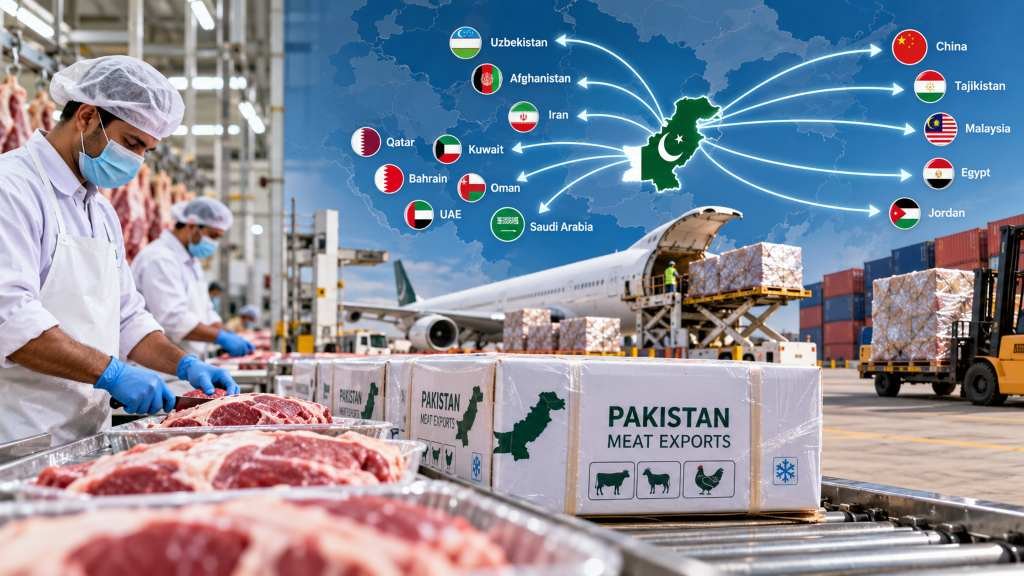
ISLAMABAD, Oct 06 (ABC): Pakistan has established a meat export base in 14 countries as the government continues efforts to expand market access. It is also seeking to diversify livestock and meat exports across Gulf, Asian and other international markets.
According to official documents available with Wealth Pakistan, Pakistan’s existing meat export markets include Qatar, Afghanistan, Kuwait, Bahrain, Oman and the United Arab Emirates. Other markets include Saudi Arabia, Iran, Uzbekistan, Egypt, Malaysia, Tajikistan, Jordan and China.
The Ministry of Commerce is pursuing further market access and addressing foreign-country restrictions through Trade and Investment Officers (TIOs) and the Trade Development Authority of Pakistan (TDAP). It is also coordinating with the Ministry of National Food Security and Research (MNFSR), Animal Quarantine Department (AQD) and relevant authorities in importing countries.
Under the Prime Minister’s Export-led Growth Initiative, the Ministry of Commerce has undertaken product-market prioritisation, market intelligence and market-access facilitation. In addition to established GCC markets, Uzbekistan, China, Tajikistan, Kazakhstan, Azerbaijan, Jordan, Egypt and Lebanon have been identified as diversification opportunities.
Uzbekistan, Saudi Arabia emerge as key markets
Uzbekistan has shown growing potential, with Pakistan’s meat exports to the country increasing from around $15.1 million, or 4,439 metric tonnes, in FY2025 to $18 million, or 6,094 metric tonnes, in FY2026.
Saudi Arabia remains another major market, with Pakistan’s meat and poultry exports reaching $191.5 million in FY2025-26.
Meanwhile, further market-access and establishment work is being pursued with China, Uzbekistan, Malaysia and Lebanon in coordination with MNFSR and AQD.
For poultry, Pakistan has sought market access in Saudi Arabia and the UAE. Access also remains under process for Malaysia, China, Hong Kong and Vietnam. Applications concerning table and hatching eggs in Saudi Arabia are under consideration by the relevant authorities.
China-related applications cover boiled chicken feet, ready-to-eat chicken products and pasteurised egg products. In addition, Vietnam’s country-registration dossier has been submitted for further processing.
TDAP rolls out 24-month export marketing plan
The export drive is being supported by TDAP’s 24-month Agri-Exports Marketing Plan covering September 2026 to August 2028. It includes international exhibitions, trade delegations, business-to-business matchmaking, webinars, field seminars and targeted buyer and regulatory delegations.
Planned participation covers major international events, including the Saudi Food Show, SIAL Paris, Gulfood, SIAL Shanghai and FoodExpo Kazakhstan. Other events include Oman AgroFood, FOODEX Japan, SIAL Canada, Food Africa and Africa’s Big 7.
FoodAg 2026 in Karachi is also included as a national buyer-matching platform involving buyers from 80 countries.
The plan provides for 98 webinars and online B2B sessions covering meat, dairy, fruits and vegetables, rice, seafood and other priority products. It also includes 32 field seminars focusing on export compliance and production-related requirements.
Modern-trade initiatives are planned in Saudi Arabia and the UAE. Meanwhile, product-development measures include heat-treated beef cuts for China and other value-added products.
From September 2027, exhibitions, delegations and campaigns are planned to continue on an outcome-based basis. Their continuation will depend on confirmed orders, modern-trade listings and successful market-access outcomes.
New trade missions planned
Sector-specific promotion includes proposed outgoing trade missions to Thailand for meat, dairy and livestock and to China for dairy. Missions are also planned for CIS markets, including Azerbaijan, Uzbekistan, Tajikistan and Kazakhstan, for meat and dairy, as well as Brazil for meat and livestock.
Incoming delegations from China, Lebanon, Malaysia and Uzbekistan are also envisaged to facilitate inspections, protocols and commercial engagement.
The documents identify disease control, traceability, animal productivity, meat and milk yields, breed improvement and exportable surplus as areas requiring attention. Logistics, value addition and sanitary and phytosanitary compliance are also considered important for further export growth.
These supply-side areas require coordinated action by MNFSR, provincial livestock departments, AQD and other competent authorities. At the same time, the Ministry of Commerce and TDAP will continue to pursue market access, buyer engagement and promotion of value-added products.