


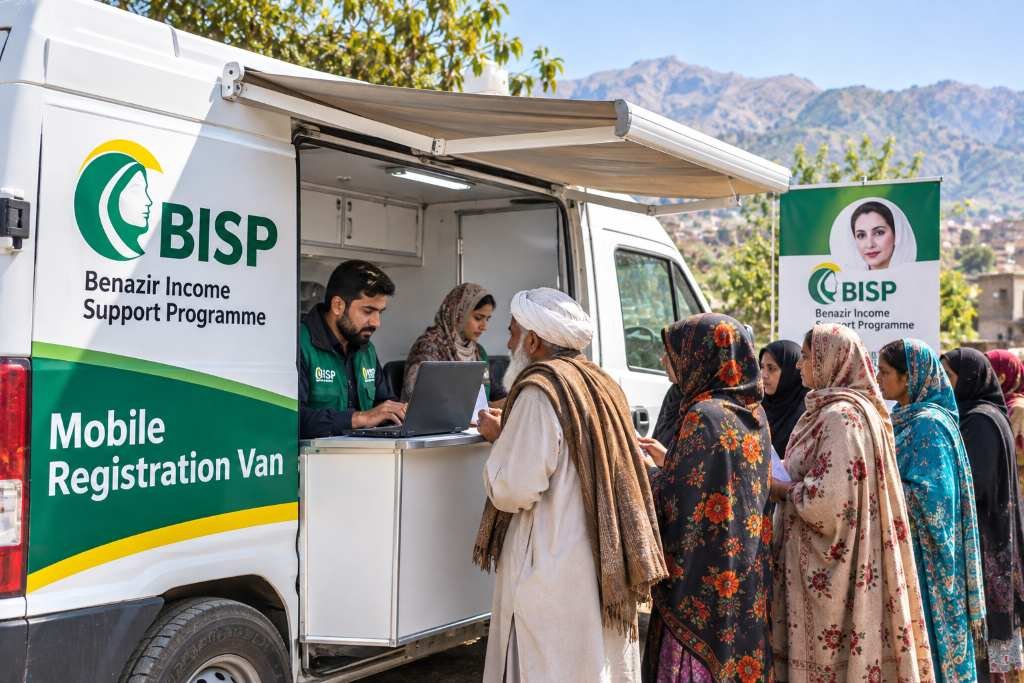
ISLAMABAD, Nov 16 (ABC): The Benazir Income Support Programme (BISP) plans to add seven mobile registration vans to its existing fleet of 25, increasing the total to 32. The expansion aims to improve access to registration and survey services for vulnerable households in remote and underserved areas of Pakistan.
According to official documents available with Wealth Pakistan, the additional mobile registration vans (MRVs) will strengthen outreach services in hard-to-reach locations. These include the newly merged districts of Khyber Pakhtunkhwa, where residents often face difficulties accessing registration facilities.
The existing fleet comprises 16 vans in Balochistan, five in Sindh, three in Khyber Pakhtunkhwa and one in Islamabad. With seven more vehicles planned, BISP expects to expand its capacity to register households under the National Socio-Economic Registry (NSER).
BISP operates 647 Dynamic Registry Centres nationwide
Alongside its mobile registration services, BISP has established 647 Dynamic Registry Centres (DRCs) at the tehsil level across Pakistan. These centres provide free household registration facilities and allow citizens to update their socioeconomic information.
The centres operate under the dynamic NSER framework, which enables households to register without waiting for another nationwide survey. As a result, eligible families can provide updated information when their financial or household circumstances change.
The NSER was initially developed through a nationwide door-to-door survey during FY2010-11. However, BISP transformed it into a dynamic registry in February 2023 through the Multiple Entry Localised Access (MELA) approach.
According to the official document, the registry now contains socioeconomic information on more than 38.7 million households. Of these, approximately 10.2 million households receive financial assistance under various BISP programmes.
The expansion of mobile registration facilities will complement the existing network of registry centres. Moreover, it will help BISP reach households that face geographical or logistical barriers to accessing registration services.
BISP uses 43 indicators to assess household eligibility
BISP uses the Proxy Means Test (PMT) to assess household socioeconomic conditions and determine eligibility for financial assistance. The assessment considers 43 indicators covering different aspects of household circumstances.
These indicators include household size, education, employment status, disability, assets, agriculture and health. Together, they help the programme evaluate the socioeconomic position of households seeking assistance.
Under the relevant unconditional cash transfer programme, households with a PMT score of 32 or below meet the poverty-score criterion for assistance. However, BISP applies a higher eligibility threshold of 37 for households that include persons with disabilities.
The programme also provides specific eligibility arrangements for transgender individuals. Those registered with the National Database and Registration Authority (NADRA) under the recognised gender category can qualify without PMT score restrictions.
However, they must complete the NSER survey and meet other applicable programme requirements. These provisions form part of BISP’s framework for identifying and supporting vulnerable population groups.
Government database checks support beneficiary verification
To improve the accuracy of beneficiary selection, BISP cross-checks household information against several government databases. These include employment, pension, excise and taxation records.
The verification process helps the programme assess eligibility and identify discrepancies in household information. Furthermore, it supports efforts to ensure that financial assistance reaches eligible and vulnerable families.
The dynamic registration system also allows BISP to maintain updated socioeconomic records instead of relying entirely on information collected during periodic nationwide surveys. This approach supports more responsive beneficiary assessment as household circumstances change.
Meanwhile, the planned addition of seven mobile registration vans will strengthen the programme’s outreach capacity in underserved areas. Combined with the 647 Dynamic Registry Centres, the expanded fleet is expected to make registration services more accessible across Pakistan.
The initiative forms part of BISP’s continuing efforts to improve household registration, strengthen beneficiary targeting and expand access to social protection programmes.