


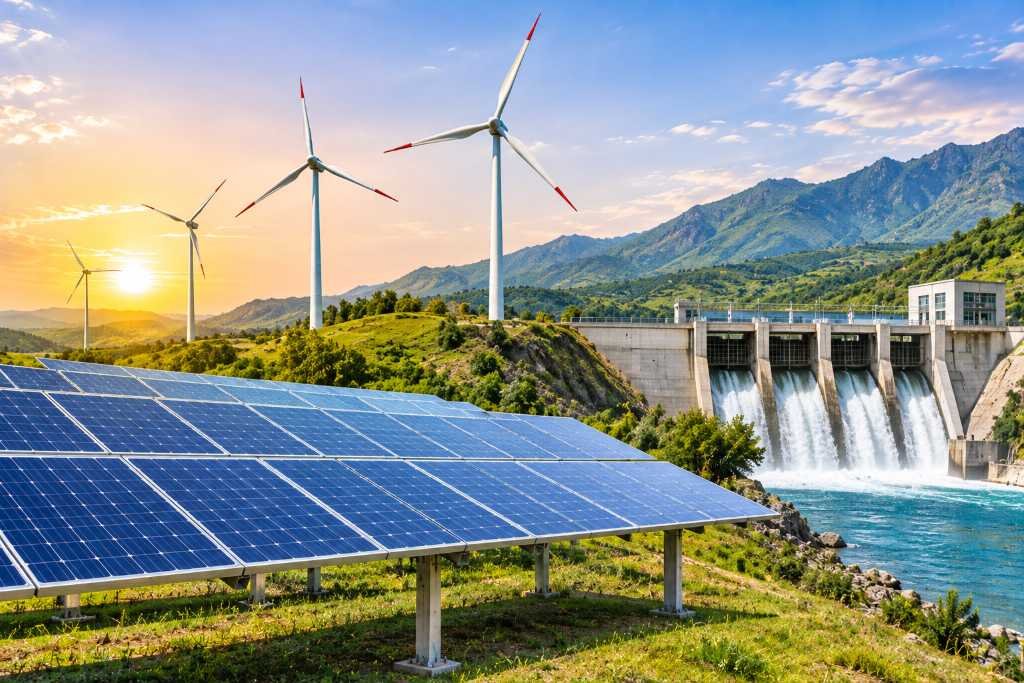
ISLAMABAD, Nov 18 (ABC): The government plans to add 15,206 megawatts (MW) of renewable energy capacity, including hydropower, to Pakistan’s electricity generation system by 2035. These projects will account for approximately 93% of the total planned capacity additions during 2025–35.
According to official documents available with Wealth Pakistan, the National Electric Power Regulatory Authority (NEPRA) has approved the Integrated System Plan (ISP) 2025–35. The plan envisages adding 16,406 MW of electricity generation capacity over the 10-year period.
Of the planned additions, renewable energy projects, including hydropower, will contribute 15,206 MW, while nuclear power will account for the remaining 1,200 MW. The expansion forms part of Pakistan’s efforts to increase the share of renewable energy in its electricity generation system.
Solar, hydropower and wind to drive renewable energy expansion
The approved plan identifies solar, hydropower and wind as the main sources of new renewable energy capacity. Solar photovoltaic projects under net-metering arrangements will contribute the largest share, with planned additions of 8,120 MW.
Meanwhile, hydropower projects will add 4,505 MW, while wind power projects will contribute another 2,581 MW. Together, these three sources account for the entire 15,206 MW of planned renewable energy additions.
The document further provides a breakdown of the proposed wind power capacity. Of the 2,581 MW, approximately 1,190 MW will connect through the National Grid Company/National Transmission and Despatch Company (NGC/NTDC) network.
The remaining 1,391 MW of wind power capacity will be integrated through K-Electric. These additions will support the expansion of renewable electricity generation across the national and Karachi power systems.
According to the document, Pakistan’s total installed electricity generation capacity is projected to reach approximately 62,383 MW by 2035. Renewable energy, including hydropower, will account for more than 60% of the country’s installed generation capacity.
Pakistan targets 60% renewable energy capacity share
The government’s renewable energy expansion is supported by the National Electricity Policy 2021 and the National Electricity Plan 2023–27. Both policy documents provide a framework for progressively increasing renewable energy’s share in Pakistan’s installed generation capacity.
Under this framework, the government envisages achieving a 60% renewable energy capacity share by 2030. Subsequent capacity additions will depend on electricity system requirements, economic considerations and least-cost planning principles.
Currently, utility-scale renewable energy, including hydropower, represents approximately 35% of Pakistan’s installed generation capacity. However, the share exceeds 45% when distributed solar capacity connected through net-metering arrangements is included.
The approved ISP also provides a framework for future electricity generation investments. According to the document, the Indicative Generation Capacity Expansion Plan (IGCEP) will guide capacity additions through least-cost system planning.
Furthermore, the government will implement new projects under the applicable electricity policy and procurement framework. This approach aims to align future generation investments with system requirements and economic considerations.
Battery storage requirement estimated at 600 MW
Alongside renewable energy expansion, the IGCEP 2025–35 assessed the need for battery energy storage systems (BESS). Such systems can support grid reliability, frequency response and the integration of increasing renewable energy capacity.
The plan identified an indicative requirement of approximately 600 MW of battery storage inverter capacity. This would be supported by around 1,500 megawatt-hours (MWh) of energy storage.
According to the document, the proposed battery storage infrastructure would require an estimated investment of $900 million to $910 million. However, NEPRA has not approved this investment at the current planning stage.
Instead, the regulator excluded BESS from the approved Revised Base/Recommended Case. NEPRA also directed the Independent System and Market Operator (ISMO) to conduct a comprehensive technical and economic assessment before considering battery storage in future plans.
The assessment will determine the actual storage requirement and identify suitable capacity, duration, technology and geographical locations. It will also examine operational applications, reliability requirements, costs, benefits and overall cost-effectiveness.
Moreover, the study will consider the potential deployment of consumer-level battery storage systems. Its findings will inform subsequent IGCEP and ISP planning exercises for NEPRA’s consideration.
Jhimpir battery storage pilot finalised at $15.7m
Meanwhile, the National Grid Company has finalised a pilot battery storage project at the Jhimpir-I grid station. The project will have a capacity of 20 MW and an energy storage capability of 20 MWh.
According to the official document, the pilot project falls under Contract No. ADB-302-2021. Its revised cost stands at approximately $15.7 million.
The project represents a step towards assessing battery storage applications within Pakistan’s electricity transmission system. Such facilities can help evaluate the technical and operational requirements of integrating storage with the power network.
In addition, an Asian Development Bank (ADB)-hired consultant is associated with proposed large-scale battery storage projects in southern and northern Pakistan.
The proposed development comprises two phases, each involving 500 MW of battery storage inverter capacity and 1,000 MWh of energy storage.
Under Phase-I, the government is considering a 500 MW/1,000 MWh battery storage project in the South. Phase-II envisages another 500 MW/1,000 MWh facility in the North.
The first phase carries an estimated cost of $400 million and is expected to achieve commercial operation in FY2029–30, according to the document.
However, these proposed projects remain subject to the applicable planning, assessment and approval requirements.
Renewable energy growth to reshape Pakistan’s power mix
The approved ISP 2025–35 outlines a substantial expansion of Pakistan’s renewable energy capacity over the coming decade. Solar net-metering projects will account for the largest share of new additions, followed by hydropower and wind.
Meanwhile, the planned 1,200 MW of nuclear power will complement renewable energy additions within the overall capacity expansion programme.
The projected increase in renewable energy capacity will also require careful planning of transmission networks and system operations. Consequently, NEPRA’s assessment of battery storage requirements will remain important for future electricity planning.
With total installed generation capacity projected to reach 62,383 MW by 2035, renewable energy is expected to account for more than 60% of Pakistan’s power generation capacity.
The government’s ability to implement these additions through least-cost planning, appropriate procurement and reliable grid integration will be central to achieving the proposed expansion.