


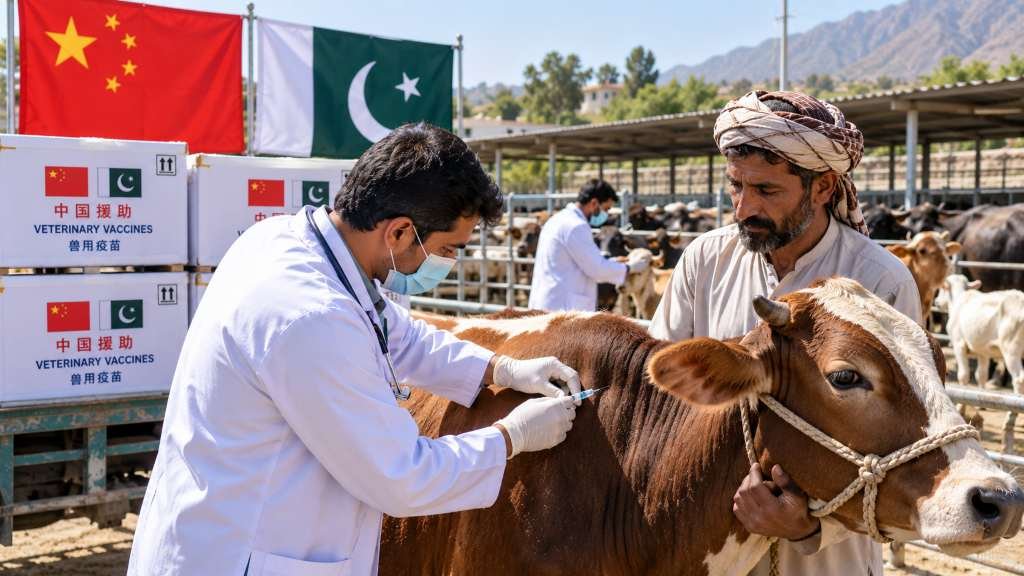
ISLAMABAD, Oct 5 (ABC): China’s provision of 300,000 veterinary vaccine doses to Pakistan has strengthened efforts to protect livestock from disease. It also highlights the need for a sustained system of surveillance, vaccination and veterinary coverage to safeguard rural incomes and animal productivity.
The vaccines are intended to support the control of lumpy skin disease (LSD) and Brucella melitensis. Pakistan’s Ministry of National Food Security and Research said they would be used under applicable technical requirements. These include proper cold-chain management, monitoring and coordination with provincial livestock authorities.
The intervention is economically significant because livestock is Pakistan’s largest agricultural subsector. According to the Pakistan Economic Survey 2025-26, livestock contributed 62.45% of agricultural value addition and 14.64% of GDP. The subsector grew 3.75% during the year.
Pakistan’s Agricultural Census 2024 counted 55.86 million cattle, 47.74 million buffaloes, 44.59 million sheep and 95.83 million goats. These numbers illustrate the scale of household and rural assets exposed to livestock disease.
Disease prevention protects rural incomes
Globally, animal-health authorities increasingly view disease prevention as an economic, food-security and public-health issue. The World Organisation for Animal Health (WOAH) says vaccination, early detection, biosecurity and movement controls are central to managing lumpy skin disease. Meanwhile, brucellosis is a zoonotic disease with significant economic consequences for livestock producers.
Speaking to Wealth Pakistan, Sher Ahmed, former Chief of the Mountain Agricultural Research Centre at the Pakistan Agricultural Research Council, said the economic value of vaccination extended beyond preventing animal deaths.
“Livestock diseases translate directly into losses in farm income, productivity and food security,” he said. “Lumpy skin disease reduces milk production, affects fertility and damages hides, while brucellosis causes reproductive losses and can also infect humans.”
Ahmed said the Chinese assistance should be treated as the beginning of a structured disease-control programme rather than a one-off vaccine distribution exercise.
He said vaccination should be guided by disease prevalence and supported by diagnostic testing and surveillance. Cold-chain management, animal identification and systematic records showing which herds had been vaccinated were also important.
Pakistan strengthens disease surveillance
The need for such a system has also gained wider policy attention. On September 25, Pakistan called at an FAO meeting in Rome for greater investment in animal health and disease surveillance.
The government said an upgraded electronic Animal Disease Reporting and Surveillance System was being developed with the endorsement of provinces and regions. The initiative forms part of broader One Health efforts.
At the farm level, however, access to preventive veterinary care remains uneven.
Muhammad Shaukat, who runs a dairy farm in Islamabad, told Wealth Pakistan that disease outbreaks could impose substantial losses on farmers. At the same time, awareness and institutional support remained limited.
“We mostly depend on our own networks. If a disease appears in another area, we become alert and get our animals vaccinated,” he said.
Shaukat said he normally consulted a local veterinarian and purchased vaccines privately. He estimated that vaccination for around 24-25 animals could cost approximately Rs10,000.
Dr Umar Nawaz, Manager Dairy and Livestock at HBL Zarai Services, said the Chinese vaccine donation highlighted the need to improve access at the village level. Farmers in some areas could face vaccine shortages and limited veterinary coverage.
He said disease-control programmes should identify hotspots and develop disease-controlled areas that could gradually be expanded. Greater farmer awareness should also form part of such efforts.
Disease control could support meat exports
Ahmed said stronger disease control could also support Pakistan’s livestock-export ambitions. However, vaccination would need to be integrated with traceability, testing, accredited laboratories and veterinary certification.
Pakistan exported 114,046 tonnes of meat and meat preparations worth $530.25 million in FY2025-26, according to Pakistan Bureau of Statistics data.
China is also becoming a growing market for selected Pakistani meat products. Data from China’s General Administration of Customs showed that Pakistan exported 2.38 million kilograms of boiled beef worth $14.52 million to China in 2025. The export value increased 177% year-on-year.
Ahmed cautioned that vaccination alone would not deliver export competitiveness.
“Disease surveillance, vaccination, traceability, accredited laboratories and export certification have to be developed as one integrated system,” he said. Pakistan also needed stronger control of other trade-relevant diseases, particularly foot-and-mouth disease, he added.
Cooperation could move towards technology transfer
The vaccine assistance also fits into broader Pakistan-China agricultural cooperation. The two countries exchanged a Letter of Exchange on animal vaccines in May 2026. Agriculture and livestock development, technology transfer and disease-control capacity also form part of cooperation under CPEC Phase II.
Ahmed said the next stage should move from vaccine donations towards technology transfer, modern diagnostics and laboratory development. Cooperation could also cover disease modelling and, eventually, local vaccine-production capacity.
“Pakistan should use this cooperation to build long-term disease-control capacity rather than depend on periodic assistance,” he said.
Stronger surveillance, reliable vaccination coverage and improved veterinary services, he added, would help protect farmers from preventable losses. These measures could also strengthen livestock productivity and Pakistan’s ability to meet animal-health requirements in export markets.