


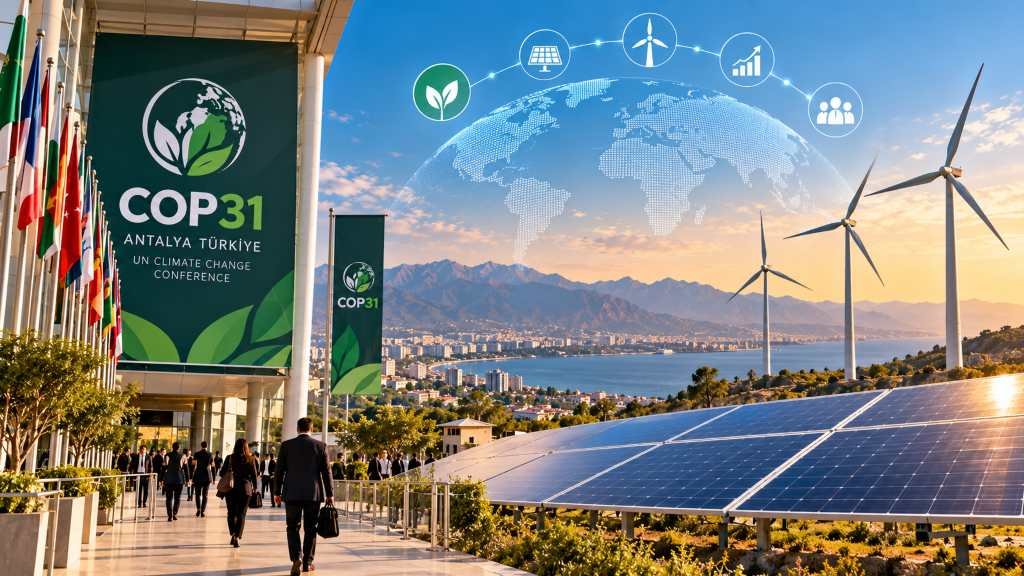
ISLAMABAD, Oct 7 (ABC): COP31 offers developing countries an opportunity to turn national energy-transition ambitions into investable projects. Experts say clearer fossil-fuel transition plans, backed by international finance, technology transfer and stronger implementation frameworks, could help translate climate commitments into action.
During the UN General Assembly high-level week in September, UN Secretary-General António Guterres called on governments to develop credible national roadmaps for transitioning away from coal, oil and gas. These roadmaps should include clear timelines and protections for affected workers and communities.
The call comes as global energy investment reaches record levels, creating opportunities for countries with well-prepared transition projects. However, access to financing remains unevenly distributed.
According to the International Energy Agency’s World Energy Investment 2026, total energy investment is expected to reach $3.4 trillion this year.
The International Renewable Energy Agency (IRENA) and Climate Policy Initiative (CPI), however, found that 90% of energy-transition investment remained concentrated in advanced economies and China. Grants accounted for less than 1% of financing.
The financing question is gaining immediate attention as COP31 will take place in Antalya, Türkiye, from November 9-20, with Türkiye holding the presidency and Australia leading the negotiations.
Developing countries need finance, technology support
Muhammad Arif Goheer, Executive Director of the Global Climate-Change Impact Studies Centre (GCISC), told Wealth Pakistan that stronger transition commitments from developing countries needed adequate international finance, technology transfer and capacity-building.
He said developing countries should also arrive at COP31 with clearly identified projects and implementing institutions. They should demonstrate domestic resources already committed and specify financing gaps rather than presenting financing requirements alone.
Pakistan’s Nationally Determined Contribution (NDC) 3.0 illustrates both the scale of the investment requirement and the potential pipeline for climate-related projects. It estimates total investment requirements of $565.7 billion by 2035, including $163.7 billion for the low-carbon power transition.
Pakistan aims to reduce its projected 2035 greenhouse-gas emissions by up to 50%. Of this, 17 percentage points are to be achieved through domestic resources. Another 33 percentage points are conditional on adequate international climate finance, technology transfer and capacity-building.
Goheer said the climate process needed to move from commitments to finance and from finance to implementable outcomes.
Climate disasters squeeze fiscal space
Anfal Nadir, Research Associate at the Policy Research Institute for Equitable Development (PRIED), said calls for national transition roadmaps should also acknowledge the financial pressures confronting climate-vulnerable developing economies.
She said countries were being asked to finance long-term transitions away from fossil fuels while simultaneously meeting growing recovery costs from floods and other climate disasters. This reduces the fiscal space available for investments in grids, renewable generation, storage and other transition infrastructure.
Nadir said the challenge was not simply the overall volume of climate finance. The speed with which countries could access funding and whether support arrived through grants or additional debt were also important.
She said the timeline between climate disasters and the eventual availability of international assistance illustrated another challenge. A significant gap could emerge between an immediate climate emergency and the institutional processes required to approve financing.
Nepal’s August floods highlighted such pressures. The government formally sought emergency support from the Loss and Damage Fund following the August 26 disaster. Its Rapid Damage and Needs Assessment subsequently estimated reconstruction requirements at approximately $4.78 billion.
Nadir said repeated climate shocks could further shrink the fiscal space available for longer-term energy transition. This was particularly relevant where countries already faced high borrowing costs and recovery itself required additional debt.
She called for faster financing mechanisms and a greater share of grants for highly indebted and vulnerable economies. Simpler access procedures were also needed for countries and institutions with limited technical capacity.
Pakistan needs investment in grids, storage
Muhammad Basit Ghauri, Manager, Special Initiatives and China Program at Renewables First, told Wealth Pakistan that Pakistan’s expansion of distributed solar showed that parts of the energy transition were already taking place. However, the next phase would require much larger investment in storage, grids and clean electrification.
He said efforts to prepare bankable projects were useful, but project readiness alone could not overcome a wider shortage of affordable climate finance.
At COP29, countries agreed that developed countries would take the lead in mobilising at least $300 billion annually for developing countries by 2035. Meanwhile, all actors would work towards scaling climate finance from public and private sources to at least $1.3 trillion annually by the same year.
Ghauri said the $300 billion commitment remained inadequate relative to developing-country requirements. He added that COP31 needed to address not only the volume of climate finance but also its affordability and accessibility.
Greater access to affordable finance, he said, would be critical if countries such as Pakistan were to expand renewable energy, storage and stronger electricity systems without adding to existing debt pressures.