


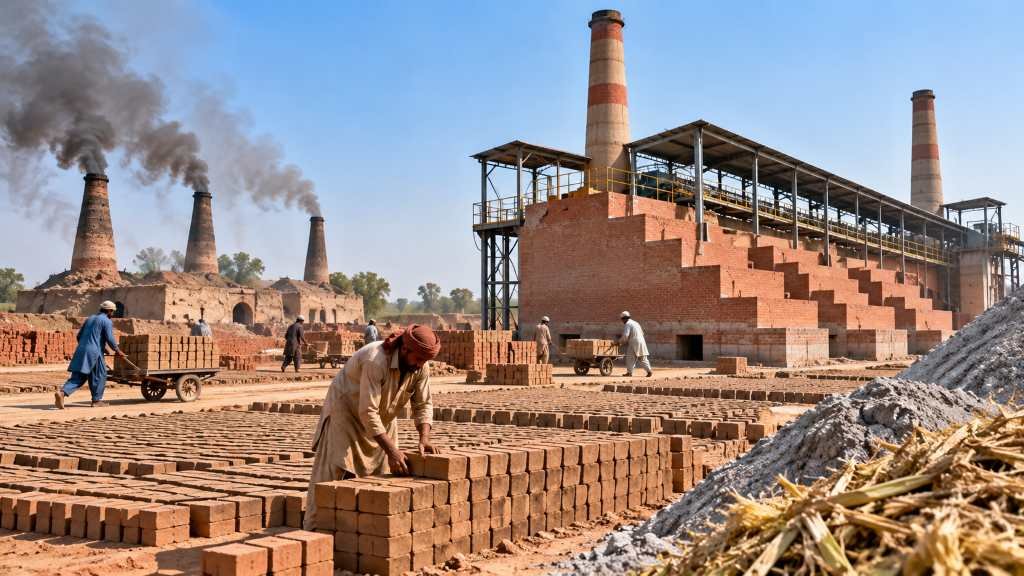
ISLAMABAD, Oct 08 (ABC): The Sindh government has proposed a $3.5 million project to convert more than 120 traditional brick kilns to zig-zag technology by 2029. The initiative aims to reduce harmful particulate emissions and promote the use of industrial and agricultural waste in cleaner production processes.
According to an official document available with Wealth Pakistan, the project is titled Decarbonizing Brick Kilns in Sindh through Modernization and Circular Economy Integration. It envisages modernising conventional brick kilns, training owners and workers, and improving environmental monitoring and occupational safety.
The project targets an approximately 40% reduction in PM2.5 emissions. It also seeks to benefit 3,000 people directly and another 20,000 indirectly.
In addition, the initiative aims to divert 20,000 tonnes of waste annually through circular-economy interventions. It also proposes establishing a carbon monitoring, reporting and verification (MRV) and crediting platform.
Cleaner brick production and waste utilisation
The proposed activities include kiln retrofitting or replacement, cleaner-production training and occupational-safety training. They also cover digital MRV, carbon-credit aggregation and the use of fly ash and agricultural waste in compressed stabilised earth blocks (CSEBs).
According to the document, the proposed carbon MRV and crediting platform would help measure and document the environmental outcomes associated with the project.
The ECC&CDD Sindh has been designated as the lead agency, with GIZ and UNDP identified as technical partners. Meanwhile, implementation support is envisaged from the Pakistan Brick Kiln Association and cement and fly-ash suppliers.
The Sindh Environmental Protection Agency, Labour Department, universities and research institutes are also identified as collaborators.
Kiln modernisation targeted for 2029
The document sets 2029 as the target for completing the conversion of more than 120 traditional brick kilns to zig-zag technology.
Monitoring and evaluation activities would include baseline, mid-term and end-line reviews, along with third-party audits. Continuous digital monitoring, reporting and verification would also form part of the proposed system.
The project carries an estimated budget of $3.5 million. It is among the proposals being processed under the World Bank Country Partnership Framework for Pakistan, covering FY2026 to FY2035.