


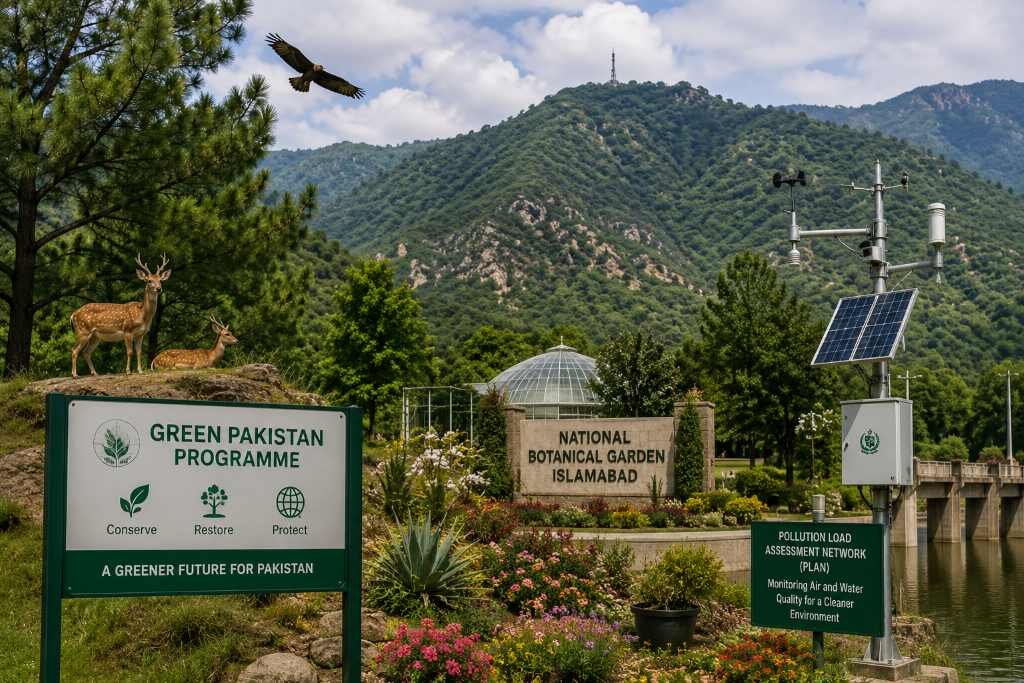
ISLAMABAD, July 15 (ABC): The federal government plans to launch three new environmental projects under the revised Upscaling of Green Pakistan Programme (UGPP) during FY2026-27.
According to documents available with Wealth Pakistan, the programme carries a total cost of Rs122.146 billion, including a federal PSDP share of Rs76.322 billion. The government has allocated Rs2.335 billion for FY2026-27.
The Ministry of Climate Change and Environmental Coordination describes UGPP as its flagship initiative for ecological restoration, biodiversity conservation and climate resilience.
Programme to strengthen natural resources
The revised programme supports large-scale afforestation, biodiversity conservation and carbon sequestration.
It also promotes climate adaptation, climate change mitigation, carbon credit generation and compliance with Pakistan’s international environmental commitments.
The project follows a cost-sharing model. The federal government will contribute about Rs76.3 billion, while provincial governments will provide around Rs45.8 billion.
The programme also includes forest restoration, promotion of non-timber forest products, carbon financing, GIS and remote sensing, institutional strengthening and environmental monitoring.
Margalla Hills conservation project
The first new initiative focuses on biodiversity conservation and landscape management in Margalla Hills National Park and its buffer zones.
The project has an estimated cost of Rs1.689 billion.
Under the plan, the government will establish a Wildlife Rescue Centre and an Urban Forestry Unit inside the national park.
These facilities will support wildlife rescue and rehabilitation, biodiversity conservation and the expansion of urban green spaces.
The Islamabad Wildlife Management Board will implement the project.
National Botanical Garden planned
The second initiative proposes the establishment of a National Botanical Garden at Bani Gala in Islamabad.
The Phase-I project carries an estimated cost of Rs800 million.
The botanical garden will conserve plant species, protect Pakistan’s natural heritage and support national and international conservation commitments.
The project includes nurseries, seed banks, herbarium facilities, research centres, thematic gardens, ecological restoration sites and visitor facilities.
The Zoological Survey of Pakistan will oversee the project.
According to the documents, the National Botanical Garden will become a leading institution for plant conservation, scientific research, environmental education and sustainable ecotourism.
Pollution monitoring network for Islamabad
The third proposed initiative is the Pollution Load Assessment Network (PLAN), with an estimated cost of Rs1 billion.
The project will establish modern infrastructure to monitor air and water pollution across the Islamabad Capital Territory.
It will also strengthen the institutional capacity of environmental authorities to support evidence-based policymaking, environmental regulation and compliance monitoring.
The Pakistan Environmental Protection Agency will implement the initiative.
Supporting climate resilience
According to the documents, the three new projects will strengthen biodiversity conservation, improve pollution monitoring and expand ecological restoration efforts.
Together, they will support Pakistan’s long-term climate resilience goals while protecting natural resources and strengthening environmental management.