


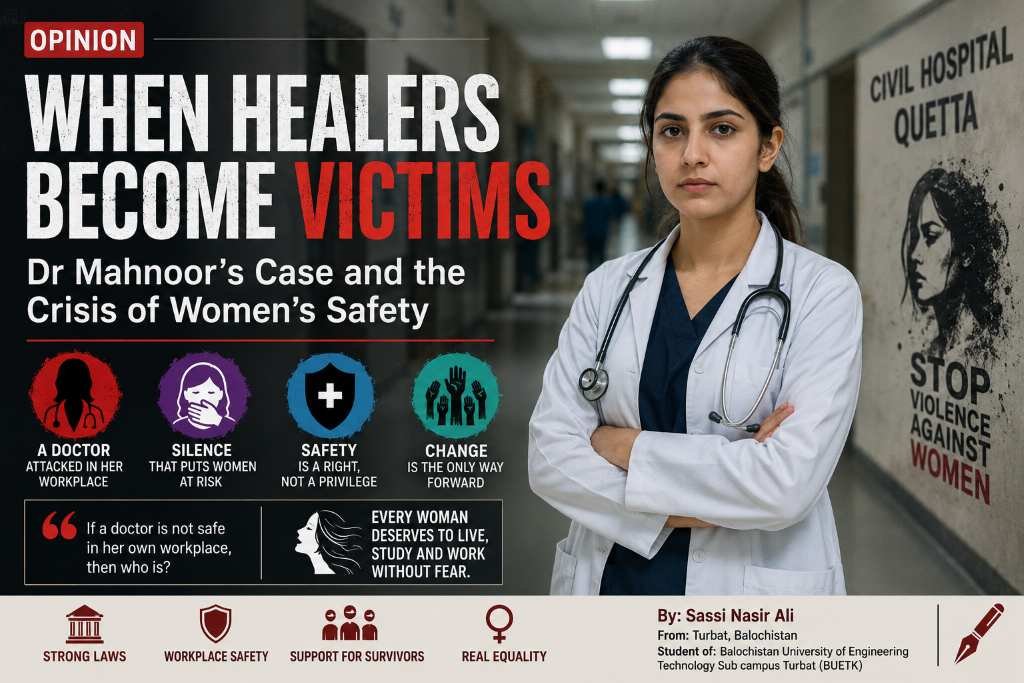
The attack on Dr Mahnoor Nasir has shaken not only Balochistan’s medical community but also countless families who encourage their daughters to pursue education and professional careers. Hospitals are supposed to be places of healing and safety. They are places where doctors dedicate themselves to saving lives, often under immense pressure and with limited resources. Few people would ever imagine that a doctor could become the victim of such a horrific act within the very institution where she worked.
On June 6, 2026, Dr Mahnoor Nasir, a postgraduate trainee in general surgery at Civil Hospital Quetta, opened the door of her room after a knock. According to reports, a man standing outside threw acid on her face and body. The suspect was later identified as Hamayoun Shah, a contractual lift operator employed at the same hospital. He was not a stranger but someone who worked within the same environment that should have provided security and protection.
According to Balochistan Health Minister Bakht Muhammad Kakar, investigators found evidence on the suspect’s phone suggesting months of harassment and attempts to force a relationship that Dr Mahnoor never encouraged. Like many women in Pakistan, she reportedly chose not to report the harassment.
Her silence reflects a larger social reality. Women often hesitate to report harassment because they fear they will face scrutiny rather than support. Questions are frequently raised about their character, conduct and personal choices. Many women decide to remain silent in the hope that the problem will disappear. Unfortunately, silence does not always provide safety.
The consequences for Dr Mahnoor were devastating. Initial reports suggested extensive injuries, prompting her transfer from Civil Hospital Quetta to a private facility and later to Aga Khan University Hospital in Karachi through an air ambulance. Medical examinations later confirmed burns affecting 13 percent of her body. Both eyes were impacted, although doctors reported that her eyesight remained intact and her vital organs were safe. She remains under specialist care.
The attack also injured a young man who attempted to help her during the incident. His actions remind us that even in moments of violence, courage and humanity still exist.
Police launched a district-wide manhunt and tracked the suspect near Quetta’s inter-city bus terminal. According to officials, he opened fire when officers attempted to arrest him. Police returned fire, and he was killed in the exchange.
Many officials described the outcome as the logical conclusion to the case. Yet the death of the suspect does not answer the deeper questions raised by this tragedy.
Investigators continue to examine the circumstances surrounding the attack and whether others had prior knowledge of the harassment. More importantly, society must ask why warning signs failed to trigger intervention before violence occurred.
Meanwhile, the Young Doctors Association has continued protests and strikes across government hospitals in Quetta. Their demands focus on stronger workplace security and practical protection measures rather than assurances alone.
As someone from Balochistan, I found this incident deeply disturbing. Growing up, I believed such horrific acts happened somewhere else. They were stories that appeared in distant headlines rather than in our own communities.
When I learned about Dr Mahnoor’s case, that illusion disappeared.
This was not an attack in another country or another province. It happened in Quetta. It happened in a hospital. It happened to a young doctor who dedicated her life to helping others.
The attack has created fear among women and families across Balochistan. Parents who proudly support their daughters’ education now worry about their safety. If a doctor is not safe in her workplace, many people wonder who is.
Today the victim is Dr Mahnoor. Tomorrow it could be a teacher, an engineer, a student or any other woman pursuing her ambitions.
The attack cannot be viewed in isolation. It exists within a broader environment where women continue to face barriers, discrimination and violence.
According to reports by women’s rights organisations, incidents of violence against women remain a serious concern in Balochistan. Honour killings, domestic abuse and harassment continue to affect many lives, while countless cases never reach official records.
Pakistan also continues to struggle with gender inequality. International reports consistently rank the country among the lowest performers in measures of economic participation and opportunity for women. In Balochistan, female labour force participation remains extremely low, and many working women receive little or no financial compensation for their contributions.
These statistics are not merely numbers. They represent the reality faced by women who choose to study, work and build careers despite numerous obstacles.
Research has repeatedly highlighted weaknesses in workplace harassment reporting systems. In many institutions, women lack confidence in complaint mechanisms or fear retaliation if they speak out.
As a result, many victims choose silence.
Dr Mahnoor reportedly chose silence. It did not protect her.
The lesson is not that women should simply report harassment. The lesson is that institutions must create systems where reporting is safe, confidential and effective. Women must trust that complaints will lead to protection rather than additional hardship.
Balochistan needs stronger workplace protection mechanisms, especially in hospitals, educational institutions and government offices. Every organisation should maintain functional anti-harassment committees and confidential reporting systems.
The province also needs greater female representation in law enforcement and the justice system. Women who experience harassment or threats often feel more comfortable seeking help from female officers and investigators.
Security arrangements for female staff must become a priority rather than an afterthought. Hospitals should be places where doctors focus on saving lives, not places where they fear for their own safety.
Most importantly, society must stop blaming victims and start holding perpetrators accountable. Cultural attitudes that discourage women from speaking out contribute to an environment where harassment escalates unchecked.
Dr Mahnoor will hopefully recover with time, treatment and support. Medical science may help heal many of her physical injuries.
The emotional scars, however, may last much longer.
The fear created by this attack extends beyond one individual. It has affected doctors, students, professionals and families throughout Balochistan. It has raised painful questions about safety, dignity and justice.
The state can pay for treatment and surgery. It can provide financial assistance and public statements. What it must also provide is meaningful reform.
Pakistan cannot afford another case like this. Every woman deserves the right to study, work and pursue her ambitions without fear. Until that right becomes a reality, the story of Dr Mahnoor Nasir will remain a reminder of promises yet to be fulfilled.
Sassi Nasir Ali is a student at the Balochistan University of Engineering and Technology, Sub-Campus Turbat (BUETK). She writes on social issues, youth development, education and women’s rights, with a particular focus on challenges facing communities in Balochistan.