


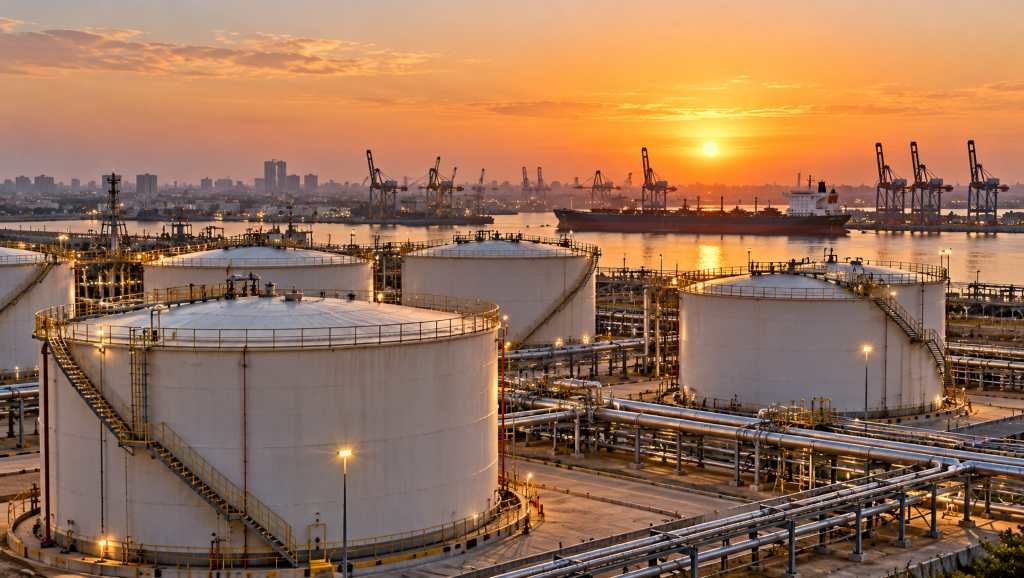
ISLAMABAD, Oct 27 (ABC): Strategic petroleum reserves are becoming increasingly important for global energy security as governments coordinate emergency stock releases to ease fuel supply pressures. Such reserves can help import-dependent economies manage temporary disruptions and sudden price shocks.
The issue has gained international attention amid pressure on diesel markets and reports that the United States urged France and Germany to release emergency diesel stocks.
According to Reuters, Washington also asked the European Union to release approximately 120 million barrels of diesel over six months. It also raised the possibility of restricting US diesel exports.
On October 15, the International Energy Agency (IEA) reported that countries had already released approximately 330 million barrels under the 400-million-barrel emergency action agreed in March.
Member countries also agreed to accelerate the release of around 100 million barrels of remaining stocks. Meanwhile, additional contributions were expected to push the overall volume beyond the original commitment.
The coordinated response includes plans to release more than 20 million barrels of diesel as soon as possible. This highlights the importance of emergency inventories in responding to disruptions in international fuel markets.
Although strategic reserves cannot permanently reduce global petroleum prices, they can help maintain supplies and give governments time to manage short-term pressures.
Muhammad Arif, Managing Partner and Principal Oil and Gas Lawyer at Arif and Associates and former Member Gas of the Oil and Gas Regulatory Authority (OGRA), told Wealth Pakistan that strategic petroleum reserves provided temporary protection during supply emergencies.
He explained that maintaining emergency stocks could help governments stabilise fuel availability and reduce sudden price pressures when international supply chains faced disruptions.
According to Arif, such reserves were particularly important for import-dependent economies. Disruptions in global petroleum markets could quickly affect domestic fuel availability, transportation costs and wider economic activity.
For Pakistan, however, establishing strategic reserves would require substantial investment in storage infrastructure, logistics and financing.
Therefore, careful planning would be essential to develop a financially sustainable system.
Pakistan explores establishment of strategic petroleum reserves
Pakistan currently relies largely on commercial petroleum inventories maintained by oil companies to support normal market operations.
Oil marketing companies are required to maintain minimum stocks broadly equivalent to approximately 20 days of demand or sales.
However, these commercial inventories differ from a dedicated, state-controlled strategic petroleum reserve designed to address major supply emergencies.
Pakistan has already started examining the feasibility of establishing such a reserve.
In August, the Petroleum Division selected Wood Mackenzie through competitive bidding to conduct a feasibility study for Strategic Petroleum Reserves.
The study covers infrastructure, logistics, financing and regulatory requirements. Its findings are expected to help assess the practical arrangements needed to establish and maintain emergency petroleum stocks.
Arif said strategic reserves should form part of a broader national energy-security strategy rather than serve as a complete solution to Pakistan’s dependence on imported petroleum.
He also emphasised the need to increase domestic oil and gas exploration while expanding alternative energy sources.
Such measures could help reduce the country’s long-term exposure to international fuel markets.
Diesel reserves could protect transport and agriculture
Muneeb Shah, Research Associate at the Economic Security Chair of the Islamabad Policy Research Institute (IPRI), told Wealth Pakistan that developments in international diesel markets had direct implications for Pakistan.
He explained that domestic petroleum prices were closely linked to international product benchmarks.
As a result, sudden changes in global fuel markets could affect transportation, production and distribution costs across the economy.
Shah said a strategic reserve would not protect Pakistan against prolonged increases in international petroleum prices. However, it could provide a temporary buffer during short-lived supply disruptions.
Such an arrangement could give policymakers additional time to respond before international supply pressures fully affected domestic economic activity.
Pakistan’s exposure to international petroleum markets remains substantial.
According to the Pakistan Bureau of Statistics, petroleum-group imports reached $16.86 billion during FY2025-26. This highlights the country’s considerable foreign-exchange requirements for imported energy.
Shah said diesel should receive particular attention in any future strategic reserve system because of its importance to freight transportation, agriculture and the movement of goods.
A temporary diesel buffer could provide several weeks of additional supply security during an international disruption.
Consequently, authorities could gain more time to manage immediate pressures on transport services, agricultural operations and other economic activities.
Financing and storage remain major challenges
Despite the potential benefits, establishing government-owned strategic petroleum reserves would involve substantial financial costs.
Pakistan already faces fiscal and foreign-exchange constraints, making the financing structure an important consideration.
To address these challenges, Shah suggested exploring arrangements under which foreign suppliers could maintain petroleum inventories in customs-bonded storage facilities within Pakistan.
Such arrangements could potentially strengthen domestic supply security without requiring the government to finance the entire inventory upfront.
He also cautioned against funding strategic petroleum reserves through a permanent large levy on consumers.
According to Shah, such a mechanism could create continuing inflationary pressures while providing protection mainly against occasional supply disruptions.
The international use of emergency petroleum stocks demonstrates how strategic reserves can help governments respond to temporary market disruptions.
However, their effectiveness depends on available inventory levels, release mechanisms and the duration of supply pressures.
For Pakistan, a dedicated strategic petroleum reserve could provide additional protection alongside existing commercial inventories.
It could also complement efforts to increase domestic energy production and diversify energy sources.
Experts believe that a carefully designed reserve system, supported by sustainable financing and adequate storage infrastructure, could strengthen Pakistan’s ability to manage external fuel supply shocks.
As global energy security concerns grow, strategic petroleum reserves could provide import-dependent economies with valuable time during supply emergencies, even though they cannot offer lasting protection against prolonged increases in international oil prices.