


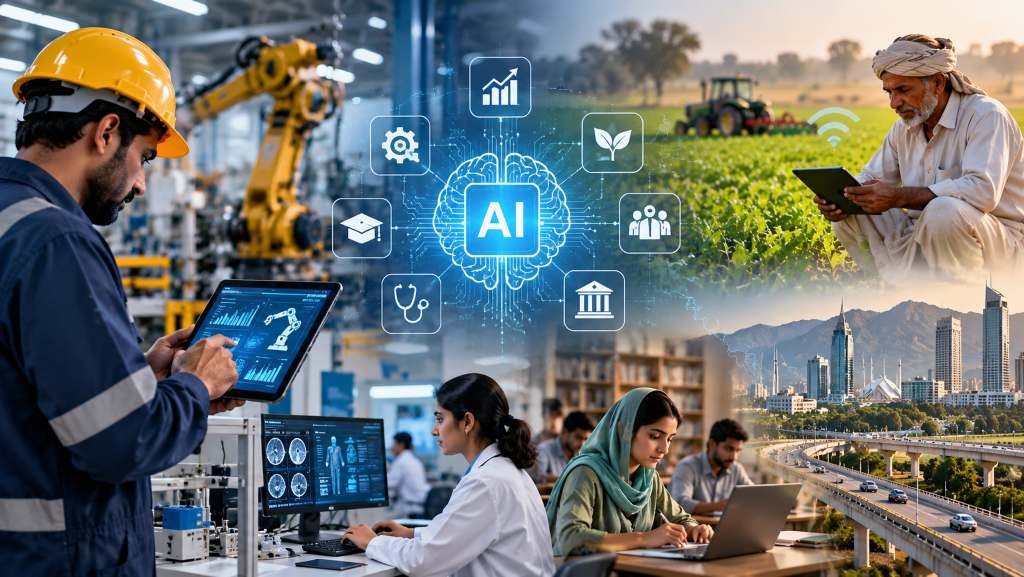
ISLAMABAD, Oct 21 (ABC): Artificial intelligence (AI) is creating new opportunities for economic growth in developing countries. The technology could improve workforce productivity, strengthen public services and help overcome shortages of specialised skills. However, gaps in digital infrastructure and technological readiness could limit these benefits.
According to the World Bank’s World Development Report 2026, around 16.2% of jobs in developing economies could benefit from meaningful AI productivity gains. The corresponding figure for high-income countries stands at 18.7%.
This relatively small difference suggests that developing economies could benefit considerably from AI adoption.
The report also estimates that 4.5% of jobs in low- and middle-income countries face potential automation risks. In comparison, the figure reaches 14.2% in high-income economies.
These findings suggest that AI could help developing countries improve productivity while exposing a smaller share of jobs to automation risks.
Meanwhile, developing economies face a challenging growth outlook. UN Trade and Development expects their combined economic growth to slow from 4.7% in 2025 to approximately 4% in 2026. Global growth is projected at 2.6%.
Separately, International Monetary Fund (IMF) estimates suggest that AI could eventually increase annual global productivity growth by as much as 0.8 percentage points.
Prof Dr Muhammad Usman Ghani Khan, Director of the National Centre of Artificial Intelligence at UET Lahore, told Wealth Pakistan that developing economies should focus on using AI to improve workforce productivity rather than replace workers.
“For countries where capital and specialised expertise are limited, AI can help people perform tasks faster, make better decisions and access knowledge that previously required expensive professional support. That creates the possibility of productivity gains without waiting decades to build the same institutional capacity as advanced economies,” he said.
Khan explained that AI could offer substantial benefits to countries facing shortages of skilled professionals and limited institutional resources. It could also help businesses that lack the financial capacity to invest heavily in modern technologies.
He identified agriculture, healthcare, education, manufacturing, financial services and public administration as sectors with considerable potential for AI adoption.
In agriculture, AI-based advisory systems could provide farmers with useful information and support better decision-making. Similarly, healthcare institutions could use AI to improve administrative processes and service delivery.
Educational institutions could use the technology to support teaching and administrative activities. Manufacturers and financial service providers could also improve efficiency, strengthen analytical capabilities and reduce repetitive workloads.
However, Khan stressed that simply providing access to AI tools would not automatically improve economic productivity.
“Using a chatbot is not the same as achieving an economic productivity gain. The real transformation happens when AI becomes part of a factory process, hospital workflow, farm advisory system, financial operation or government service and measurably reduces time, cost or error,” he said.
AI could help developing economies improve productivity
Developing economies are increasingly exploring AI as a new source of growth. Many countries face pressure on traditional economic drivers, including investment, exports and industrial expansion.
The World Bank’s findings suggest that AI could help workers and institutions perform their existing tasks more efficiently. As a result, businesses could increase output without requiring equally large increases in labour or capital.
However, the productivity benefits of AI vary across sectors, occupations and organisations.
An International Labour Organization (ILO) review found that AI applications produced productivity gains ranging from approximately 10% to 70% in selected tasks and settings.
Nevertheless, the review noted that improvements in individual tasks did not always translate into higher productivity across entire businesses or national economies.
This distinction highlights the importance of organisational readiness and effective implementation.
For developing countries, weak digital infrastructure, limited workforce skills and institutional constraints could prevent businesses from fully benefiting from AI.
Therefore, experts believe countries must combine technology adoption with workforce training, institutional improvements and investment in digital infrastructure.
Pakistan plans $1 billion investment in AI by 2030
Pakistan could benefit from AI adoption in manufacturing, agriculture, public services and other economic activities.
The government has committed to investing $1 billion in artificial intelligence by 2030. The planned investment includes developing sovereign computing infrastructure and strengthening research capabilities.
The government’s objectives also include training one million non-IT professionals in AI-related skills. In addition, it plans to provide 1,000 fully funded doctoral scholarships in artificial intelligence.
Under the National AI Advancement Initiative, seven AI hubs are being established across the country. The initiative also envisages 20,000 training opportunities to support skills development and wider technology adoption.
According to the government, the National Centre of Artificial Intelligence and its network of laboratories have already developed more than 220 AI products and designs across different sectors.
These initiatives aim to strengthen Pakistan’s technological capabilities and encourage the use of AI in economic and public-sector activities.
However, investment commitments and training programmes alone may not produce measurable productivity improvements.
Pakistan will also need stronger cooperation among research institutions, businesses and public-sector organisations to translate technological progress into practical economic benefits.
Khan said developing economies should prioritise practical AI applications rather than immediately competing with advanced economies to develop the largest and most sophisticated AI models.
He explained that countries with limited financial and technological resources could still achieve substantial benefits by adapting existing AI systems to local needs.
“The advantage will come from solving local problems at scale. If developing countries can combine affordable AI with skilled people, reliable data and sector specific applications, productivity gains can spread far beyond the technology industry itself,” he said.
According to Khan, AI could deliver the greatest benefits when businesses and institutions use it to address specific operational problems.
Such applications could improve decision-making, reduce costs and help organisations use their existing resources more efficiently.
For Pakistan, closer cooperation among universities, research centres and businesses could support the development of AI applications suited to domestic industries.
At the same time, the country would need skilled professionals, reliable digital infrastructure and relevant data to support wider adoption.
Digital infrastructure remains a major challenge
Despite its potential, AI could also widen economic differences between advanced and developing countries.
Access to reliable electricity, internet connectivity, computing resources and skilled professionals varies considerably across economies.
Countries with stronger digital infrastructure and established innovation systems may adopt AI more rapidly. In contrast, countries facing infrastructure and skills shortages could struggle to achieve similar results.
Consequently, unequal access to technology could increase existing productivity gaps between advanced and developing economies.
However, the World Bank’s estimates suggest that developing countries still have substantial opportunities to benefit from AI, particularly when it supports existing workers.
For Pakistan and other developing economies, the priority should be to turn growing access to AI into measurable improvements in manufacturing, agriculture, services and public administration.
Experts believe that countries can achieve these gains by developing workforce skills, strengthening digital infrastructure and encouraging practical applications across industries.
Ultimately, the economic impact of AI will depend on how effectively countries integrate the technology into productive activities rather than simply increasing access to digital tools.