


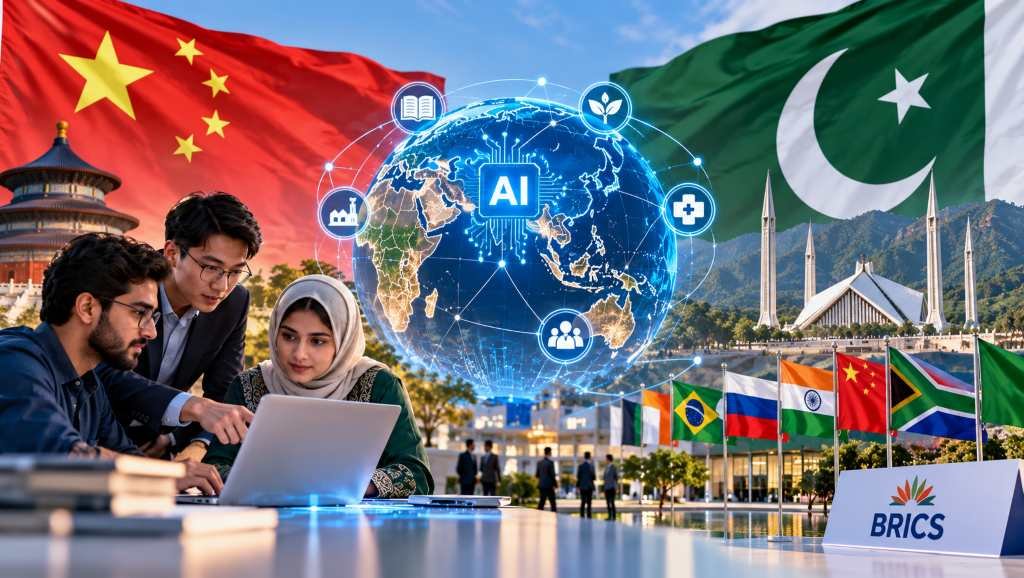
ISLAMABAD, Oct 26 (ABC): China’s growing emphasis on international cooperation in open-source artificial intelligence (AI) could help developing economies strengthen their technological capabilities, develop locally relevant applications and create new opportunities for innovation and economic growth, according to experts.
The prospects for wider cooperation have gained attention following China’s proposal at the BRICS Summit in New Delhi in September to establish an AI open-source community. The initiative aims to promote joint development and application of large language models while supporting specialised training among participating countries.
The issue is expected to receive further attention at the 2026 World Internet Conference Wuzhen Summit, scheduled for November 2-5 in China’s Zhejiang province.
Organisers have identified open-source AI and international cooperation on AI development and governance as major themes. Discussions will also focus on building a global open-source AI ecosystem and improving interoperability among AI systems.
These initiatives could help developing economies reduce their dependence on imported AI technologies. They could also encourage greater participation in developing, adapting and commercialising AI solutions suited to local economic needs.
Dr Uzair Khaleeq uz Zaman, Head of Policy for Science, Technology and Innovation at the Centre of Excellence for CPEC, Ministry of Planning, Development and Special Initiatives, told Wealth Pakistan that open-source AI could reduce technological barriers for developing countries.
“Open-source AI offers developing economies like Pakistan an opportunity to move from technological dependence towards indigenous innovation,” he said.
Zaman explained that developing countries did not necessarily need to invest heavily in building foundational AI models from scratch.
Instead, researchers, start-ups and industries could adapt existing models to local languages and develop applications for agriculture, healthcare, manufacturing and other sectors.
However, he cautioned that access to open-source models alone would not automatically lead to technological advancement or economic benefits.
“The real opportunity lies in building the domestic capacity to customise, deploy and commercialise AI solutions. We must move from simply consuming AI technologies to creating economic value through them,” he said.
Open-source AI could lower barriers for developing economies
Zaman identified four essential requirements for developing countries seeking to benefit from open-source AI cooperation.
These include affordable computing infrastructure, reliable and locally relevant datasets, a skilled AI workforce and stronger cooperation between industries and academic research institutions.
He explained that these capabilities would determine whether developing countries could transform access to AI technologies into domestic innovation.
Without sufficient technical capacity, countries could remain dependent on external technology providers despite having access to open-source systems.
China’s proposed BRICS AI open-source community could provide an additional platform for technical exchanges, joint research and capacity building.
Through such cooperation, participating economies could share expertise and develop AI applications to address common development challenges.
The initiative also reflects growing international interest in making AI development more inclusive.
Currently, advanced economies and major technology companies hold substantial technological capabilities. Wider open-source cooperation could create opportunities for developing countries to participate more actively in innovation.
Grace X. Yang, a PhD candidate at Freie Universität Berlin and former Research Assistant at the Internet & Communication Policy Center (ICPC), whose research focuses on cyber sovereignty and global cyber governance, told Wealth Pakistan that the opportunities arising from wider open-source cooperation currently outweighed concerns over technological dependence for developing economies.
Yang said such cooperation could allow China and participating countries to influence the development of AI technologies and international standards.
She argued that broader participation could help distribute AI innovation more widely rather than concentrating technological development among a limited number of companies and established innovation centres such as Silicon Valley.
Pakistan seeks stronger domestic AI capabilities
For Pakistan, growing international cooperation in open-source AI comes as the country works to strengthen its technological capabilities.
Pakistan’s National Artificial Intelligence Policy, approved in 2025, provides a framework for improving computing and data infrastructure, developing AI skills and encouraging participation in open AI platforms.
The policy also envisages contributing 50 new AI models annually to open platforms.
This target reflects Pakistan’s ambition to participate in AI development rather than remain solely dependent on imported technologies.
Zaman said the country’s main challenge was translating policy objectives into practical applications that improve productivity and create economic value.
He identified manufacturing, agriculture, energy and small and medium enterprises as important sectors where AI could deliver benefits.
According to him, cooperation with China and other international partners could accelerate technological development through technology transfer, joint research and capacity building.
However, he stressed that Pakistan should aim to build its own technological capabilities alongside international cooperation.
The objective, he said, should extend beyond gaining access to foreign AI ecosystems towards developing “a sustainable, competitive and increasingly self-reliant domestic AI ecosystem”.
International cooperation can support long-term innovation
China’s proposed open-source AI initiatives could create new opportunities for developing economies to participate in technological development.
Greater access to AI models, technical expertise and international research partnerships could help countries develop solutions that address their economic priorities.
For Pakistan, these opportunities could support innovation in agriculture, healthcare, manufacturing, energy and other productive sectors.
However, experts stressed that international cooperation must be supported by domestic investment in computing infrastructure, skilled professionals and reliable datasets.
Stronger links between universities, research institutions and businesses would also be essential for turning technological advances into commercially viable applications.
China’s expanding focus on open-source AI cooperation could therefore provide an important platform for innovation across the Global South.
For Pakistan and other developing economies, the long-term benefits will depend on their ability to combine international partnerships with stronger domestic technological capabilities and industry-driven innovation.