


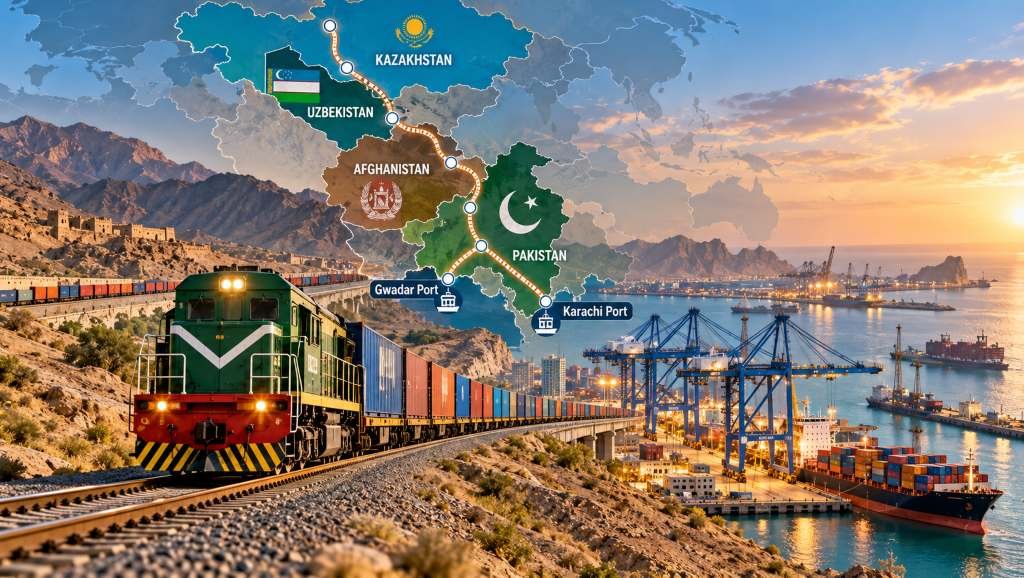
ISLAMABAD, Oct 25 (ABC): Emerging railway connectivity plans linking Central Asia with Pakistan through Afghanistan could create new opportunities for regional trade and increase cargo movement through Karachi and Gwadar ports. Experts believe the proposed connections could strengthen Pakistan’s position as a maritime gateway for landlocked Central Asian economies.
The proposed Kazakhstan-Uzbekistan-Afghanistan-Pakistan railway corridor, being explored under the Central Asia-South Asia (CASA) project, could eventually handle up to 10 million tonnes of cargo annually towards Pakistan’s seaports, according to Kazakh authorities.
However, the figure represents projected capacity rather than confirmed freight demand.
Kazakhstan, Uzbekistan and the United Arab Emirates signed a memorandum on September 30 to examine the technical and economic feasibility of the proposed railway route.
According to the Kazakh government, the three countries plan to assess railway infrastructure, logistics facilities and financing requirements.
They are also considering establishing a working group to examine the project’s technical, economic and financial aspects.
The initiative complements the Uzbekistan-Afghanistan-Pakistan railway project. The three countries signed a framework agreement in July 2025 to conduct a joint feasibility study.
Pakistan and Uzbekistan subsequently reaffirmed the Termiz-Kharlachi route and joint financing arrangements for the feasibility study.
Together, these initiatives could improve Central Asia’s access to international markets through Pakistan’s seaports. They could also create new opportunities for the country’s transport and logistics industry.
Better road and rail connectivity essential for trade growth
Mujtaba Arshad, Research Associate at the Centre of Excellence for CPEC, Pakistan Institute of Development Economics, told Wealth Pakistan that the proposed railway could benefit Pakistan’s logistics industry.
However, he stressed that transportation costs must remain competitive and cargo movement must be reliable.
Arshad explained that railway connectivity would continue to depend on road transport. Goods would still need to move between production centres, warehouses, railway terminals and seaports.
He warned that high fuel costs, complicated documentation and uncertainty in cross-border cargo movement could reduce the commercial advantages of a shorter transport route.
Therefore, Pakistan needed to improve highways connecting major freight terminals with Karachi and Gwadar ports.
He also recommended faster customs clearance, secure parking facilities and improved cargo-handling infrastructure.
According to Arshad, closer coordination among railway authorities, port operators and road transporters would help ensure smooth cargo movement.
Such improvements could strengthen the competitiveness of Pakistan’s transport network and encourage greater regional trade.
Pakistan’s transport industry sees new opportunities
Usama Haider, President of the Karachi chapter of the All Pakistan Driver and Cleaner Association, said the proposed railway connections could create significant opportunities for Pakistan’s transport and logistics industry.
Talking to Wealth Pakistan, he explained that the benefits would depend on reliable freight movement and commercially competitive transportation costs.
“A railway connection alone cannot guarantee increased trade unless there is sufficient freight demand and arrangements for uninterrupted cargo movement,” he said.
Haider noted that traders and logistics companies would evaluate the proposed corridor based on transportation costs, delivery times, border security and cargo reliability.
He said integrating railway and road transport systems would be essential for the corridor’s commercial success.
Even if railways carried most long-distance freight, trucks would remain necessary for transporting goods between railway terminals, warehouses, industrial areas and seaports.
Therefore, efficient cargo handling, reliable road connections and competitive freight charges would be just as important as the railway infrastructure.
The proposed corridor could offer Central Asian exporters another route to international markets through Pakistan’s ports.
This could increase demand for freight handling, warehousing, transportation and other logistics services.
For Pakistan, higher transit trade volumes could also support economic activity around transport terminals and port facilities.
However, the scale of these benefits would depend on actual cargo volumes and the proposed route’s competitiveness.
Border security and customs efficiency remain key challenges
Haider identified security conditions in Afghanistan, unpredictable border closures and lengthy customs procedures as major challenges.
He warned that these problems could increase transportation costs and discourage freight operators from using the proposed corridor.
To address these concerns, Pakistan should strengthen coordination among railway authorities, highway operators and the management of Karachi and Gwadar ports.
He also recommended improving logistics terminals and cargo-handling facilities to support efficient freight movement.
Furthermore, digital customs procedures, predictable transit regulations and shorter clearance times could reduce delays at borders and freight terminals.
These measures would help make the proposed railway corridor more attractive to regional traders and logistics companies.
Experts believe the emerging Central Asian railway plans could create valuable trade opportunities for Pakistan. However, turning these proposals into commercial success would require reliable transport connections, efficient border management and competitive freight services.
With improved infrastructure and closer regional coordination, Pakistan could strengthen its role as a transit and maritime trade gateway for Central Asian economies.