


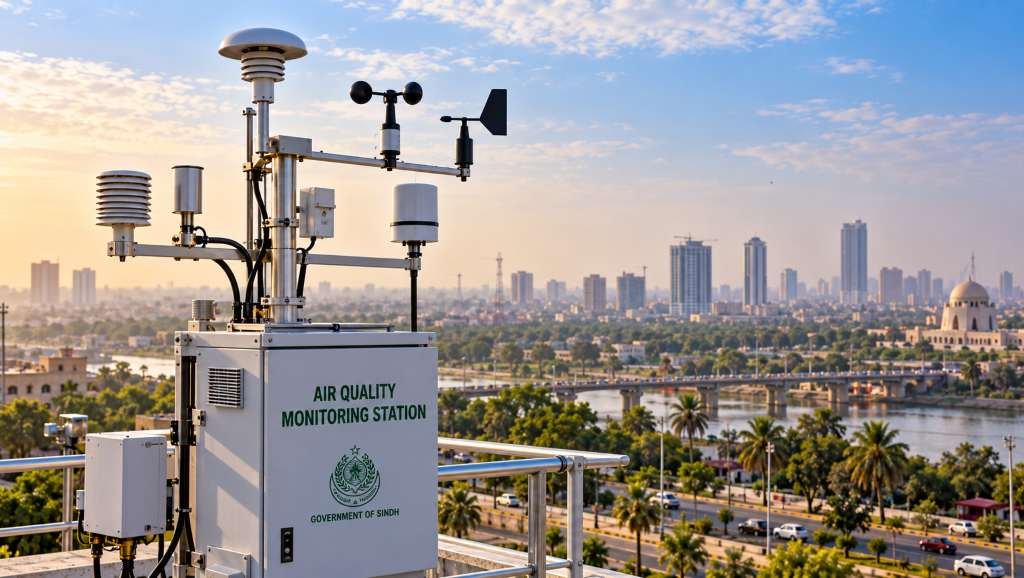
ISLAMABAD, Oct 26 (ABC): The Sindh government has proposed a $7 million project to establish air quality monitoring stations across 23 districts under the World Bank’s Country Partnership Framework (CPF) for Pakistan.
According to documents available with Wealth Pakistan, the proposed initiative, titled “Air Quality Monitoring Network for Air Quality Management Improvement in Sindh – 23 Districts,” aims to strengthen the province’s capacity to monitor air pollution, generate reliable real-time environmental data and support measures to improve air quality.
The project envisages the installation and operation of 23 continuous air quality monitoring stations. It also includes the development of a real-time monitoring network and associated technical support systems.
The estimated project cost stands at $7 million. Sindh’s Environment, Climate Change and Coastal Development Department (ECC&CDD) would serve as the lead implementing agency, while district administrations would participate as project partners.
Monitoring stations to measure major air pollutants
Under the proposed project, the monitoring stations would measure major air pollutants, including carbon monoxide (CO), nitrogen oxides (NO and NO₂), sulphur dioxide (SO₂), particulate matter (PM2.5 and PM10), suspended particulate matter (SPM) and ground-level ozone (O₃).
In addition, the network would record meteorological parameters to support a more comprehensive assessment of air quality conditions across Sindh.
The project also includes equipment calibration, data quality control, networking infrastructure and technical support systems. These measures aim to ensure reliable and continuous air quality monitoring.
According to the documents, Sindh has already initiated a Continuous Ambient Air Quality Monitoring System (CAAQMS) scheme in Karachi, Hyderabad and Sukkur.
However, the remaining districts still require monitoring infrastructure.
The proposed expansion would address these gaps by establishing a broader provincial network capable of generating consistent and reliable real-time pollution data.
Project to support climate commitments and public health
The documents identify improved monitoring of Pakistan’s Nationally Determined Contributions (NDCs) as another key objective of the initiative.
In particular, the project would support the tracking of commitments related to emissions reduction and climate change mitigation.
Reliable pollution data could help authorities develop emission-reduction strategies, strengthen environmental policies and assess progress towards national climate commitments.
The proposed network would also support public health risk assessments and improve early-warning capabilities through systematic monitoring of air pollutants.
With access to real-time information, relevant authorities could identify pollution trends, assess exposure risks and develop targeted measures for areas experiencing elevated pollution levels.
Such information could also help policymakers make more informed decisions about air quality management and environmental protection.
Long-term maintenance and technical capacity planned
The proposed project also focuses on maintaining the monitoring network beyond its initial installation.
According to the documents, the initiative includes arrangements for long-term maintenance and institutional capacity building.
These provisions aim to ensure that the monitoring stations remain operational and continue producing reliable environmental data.
The inclusion of calibration, data management and technical support requirements indicates that the project seeks to establish a sustainable monitoring system rather than simply procure and install equipment.
If implemented, the $7 million initiative could strengthen Sindh’s ability to monitor air pollution, improve environmental planning and support public health protection through reliable air quality information.