


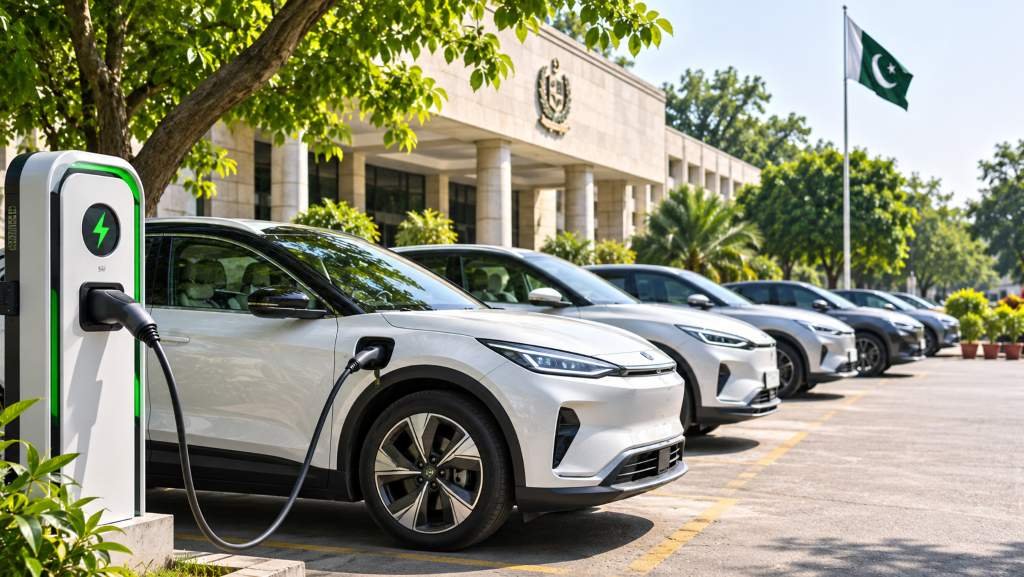
ISLAMABAD, Nov 2 (ABC): The government has planned a Green Government Fleet Project to gradually replace federal and provincial government vehicles with electric and other low-emission alternatives. The initiative aims to reduce fossil-fuel consumption, greenhouse gas emissions and exposure to fluctuations in fuel prices.
According to official documents available with Wealth Pakistan, the proposed project seeks to establish a scalable model for transitioning government vehicle fleets towards cleaner transportation.
The initiative would also demonstrate public-sector leadership in adopting environmentally sustainable transport technologies.
Under the proposed framework, the government would first conduct a comprehensive inventory of federal and provincial vehicle fleets.
The assessment would cover vehicle types, ages, mileage, fuel consumption and emissions to establish a baseline for future planning.
It would also identify vehicles suitable for replacement with electric or other low-emission alternatives and determine priority departments for phased implementation.
Electric vehicles and charging infrastructure planned
The project envisages the procurement and deployment of electric vehicles and other appropriate clean vehicles across government departments.
In addition, charging infrastructure would be installed at government offices, depots and other priority facilities to support the transition.
The government would incorporate green procurement standards and lifecycle-cost criteria into fleet replacement decisions.
These measures would help authorities select suitable vehicles and technologies while considering their long-term operating and maintenance costs.
The proposal also includes digital fleet-monitoring systems to track vehicle utilisation, energy and fuel consumption, maintenance requirements and greenhouse gas emissions savings.
Such systems would help government departments monitor fleet performance and assess the operational benefits of cleaner vehicles.
Training programmes for fleet managers, drivers and maintenance personnel are also planned to support the transition and strengthen operational capacity.
Federal and provincial agencies to coordinate implementation
Under the proposed arrangements, the federal government would provide policy direction through relevant ministries and divisions.
It would also identify priority departments and vehicles while coordinating institutional arrangements for implementing the project.
Government agencies would be responsible for vehicle deployment, operational data collection and fleet management.
Meanwhile, procurement and fleet-management entities would support the development of green procurement specifications and vehicle replacement plans.
Power-sector and electricity distribution entities would facilitate charging connections and assess electricity requirements at government facilities.
Vehicle manufacturers and charging-infrastructure suppliers would provide equipment, technical assistance and maintenance services.
Climate-related institutions would support the project’s alignment with national emissions-reduction objectives and monitor its environmental benefits.
The proposed implementation framework includes charging-infrastructure planning, phased procurement and deployment of clean vehicles, and commissioning of charging facilities.
Operational monitoring and staff training would also form part of the implementation process.
According to the documents, authorities would assess fuel consumption, operating costs and greenhouse gas emissions savings to verify the project’s performance.
The proposed initiative is intended to reduce government dependence on conventional fuels while supporting the gradual adoption of cleaner transportation technologies across the public sector.