


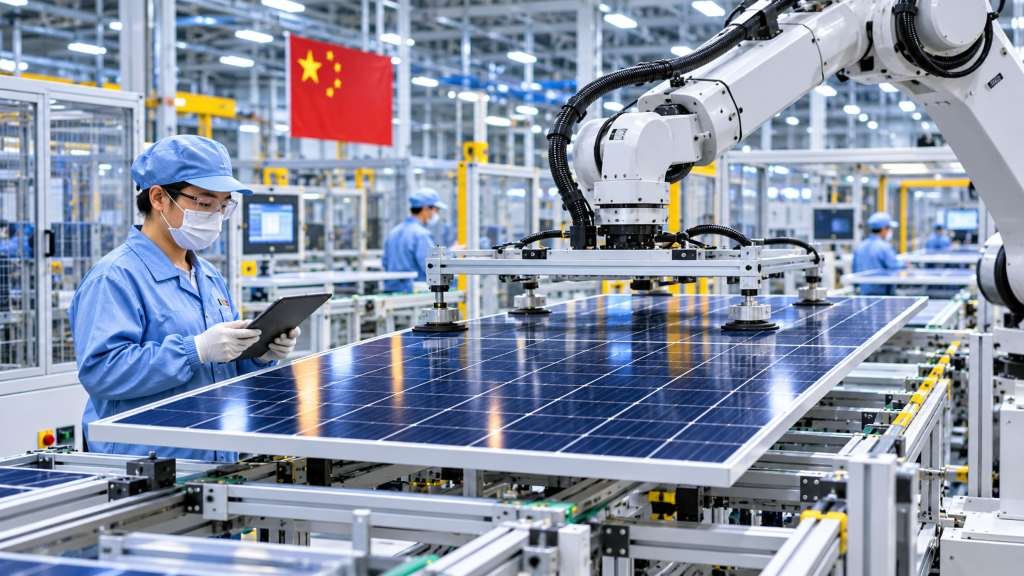
ISLAMABAD, Nov 3 (ABC): China’s proposed framework for managing exports of advanced solar manufacturing technologies signals a new phase in the global renewable energy industry. The initiative highlights the growing importance of technological innovation and international industrial cooperation while maintaining China’s role as a major supplier of solar products.
China’s Ministry of Commerce published the proposal in October as part of a wider revision of its technology export list, which also covers artificial intelligence and biotechnology.
The proposal covers 12 advanced solar manufacturing technologies. However, exports of finished solar panels would remain unaffected, allowing international markets to continue accessing Chinese solar products.
Under the proposed framework, China would prohibit exports of technologies used to manufacture perovskite and tandem solar cells, certain thin wafers and large-scale fluidised-bed polysilicon.
Meanwhile, mainstream solar cell technologies, including TOPCon, heterojunction (HJT) and XBC, would face restrictions rather than outright bans.
The ministry cited the growing use of advanced solar technologies in sensitive sectors, including aerospace and defence, as the primary reason for stricter oversight.
Public consultation will continue until November 15, after which authorities are expected to finalise the rules. Until the list is formally updated, exporters must register certain overseas technology transfers.
The proposed measures distinguish between advanced manufacturing knowledge and finished solar products. This approach would allow China to strengthen oversight of specialised technologies while continuing to supply international solar markets.
China’s solar manufacturing capacity supports global renewable energy expansion
China accounts for more than 80% of global solar manufacturing capacity at every stage of production, according to the Institute for Energy Economics and Financial Analysis (IEEFA).
Moreover, the country’s manufacturing capacity can meet nearly twice the global demand for solar products, highlighting its significant role in international renewable energy supply chains.
China’s manufacturing strength has helped expand global access to affordable solar technology.
According to UK-based energy think tank Ember, China’s solar exports reached a record 68 gigawatts in March, doubling from the previous month.
The increase came as high energy prices linked to the Iran conflict encouraged countries to accelerate solar energy adoption.
However, export trends have since moderated.
According to customs data cited by Reuters, China’s solar equipment exports declined 6.4% year-on-year in September. Exports were also down 9.5% during the year to date following the removal of an export tax rebate on April 1.
Meanwhile, the structure of international solar trade has continued to evolve.
Exports of solar cells and wafers overtook finished solar panels in October 2025 as more countries developed domestic module assembly operations using imported components.
These developments reflect the growing importance of specialised manufacturing technologies and international industrial cooperation in the solar energy sector.
Pakistan’s solar expansion unlikely to face immediate disruption
Muhammad Zaid Masood Khan, a PhD researcher at the National University of Sciences and Technology (NUST) and visiting researcher at the University of Science and Technology of China (USTC), told Wealth Pakistan that China’s competitive advantage extended beyond finished solar panels.
He explained that the country also possessed sophisticated manufacturing knowledge required to produce advanced solar technologies.
According to Khan, solar deployment in countries such as Pakistan would remain largely unaffected because the proposed measures do not cover finished panels.
Similarly, solar module assembly operations would face limited direct impact.
However, countries seeking to establish advanced solar manufacturing facilities would need to consider technology licensing requirements.
These requirements could be particularly relevant to production processes involving solar cells, wafers and polysilicon.
Khan said manufacturers might face additional licensing procedures for advanced technologies such as TOPCon.
Alternatively, they could consider established technologies such as PERC, depending on their manufacturing requirements and commercial objectives.
For Pakistan, he identified government-to-government cooperation and joint ventures under the China-Pakistan Economic Corridor (CPEC) as potential avenues for developing domestic solar manufacturing capabilities.
Such partnerships could support technology transfer, industrial development and the gradual expansion of local manufacturing expertise.
Advanced solar technologies create new opportunities for industrial cooperation
Tim Buckley, Director of Climate Energy Finance, a public-interest think tank, said the immediate commercial impact of China’s proposed measures was likely to remain limited.
He explained that some technologies covered by the proposal, including perovskite solar cells, were not yet ready for widespread commercial manufacturing.
Buckley also highlighted the challenges facing the global solar manufacturing industry.
According to him, solar module prices had remained below production costs for at least 18 months.
Meanwhile, substantial global manufacturing overcapacity meant additional module factories might not be commercially necessary for another two to three years.
“For countries like Australia and Pakistan, and most of Africa, it will be immaterial,” he said.
For Pakistan and other economies dependent on imported solar equipment, the distinction between finished products and manufacturing technologies remains important.
Continued access to Chinese solar panels could support renewable energy expansion without major immediate disruption.
However, countries seeking to develop advanced domestic manufacturing capabilities may need more structured technology partnerships and licensing arrangements.
China’s extensive manufacturing capacity and technological expertise could provide opportunities for cooperation in module assembly, equipment supply, technical training and industrial development.
Such cooperation would remain subject to applicable technology-transfer requirements under the proposed framework.
The measures also highlight the increasing strategic importance of advanced solar manufacturing knowledge as renewable energy industries expand worldwide.
As public consultation continues until November 15, the final rules will help determine how technology licensing develops alongside international solar trade.
For Pakistan, the evolving framework presents opportunities to strengthen renewable energy cooperation with China while exploring partnerships that could support domestic solar manufacturing and long-term industrial development.