


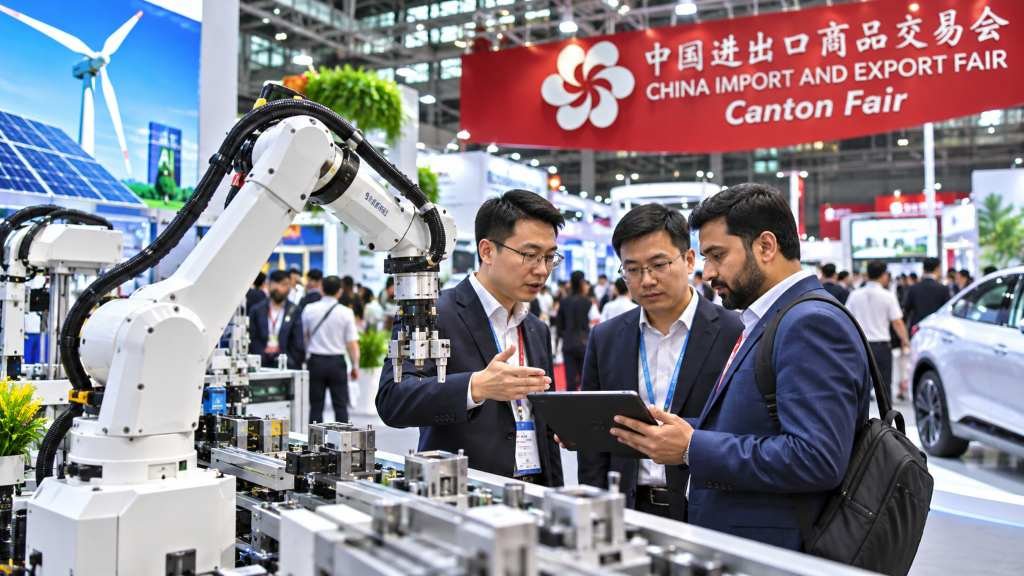
ISLAMABAD, Nov 2 (ABC): China’s growing emphasis on advanced manufacturing, artificial intelligence (AI) and green technologies is attracting international business interest. The 140th China Import and Export Fair, commonly known as the Canton Fair, is showcasing the country’s expanding technological capabilities and innovation-driven industrial development.
Marking its 70th anniversary, the fair reflects China’s evolving manufacturing model, with automation, digitalisation and sustainable production playing an increasingly important role in global trade.
According to media reports, the first phase concluded in Guangzhou with 189,000 overseas buyers from 214 countries and regions. This represented an increase of 13.3% over the corresponding phase of the previous spring session.
More than 12,000 Chinese companies participated in the first phase, including over 6,000 high-quality enterprises recognised for technological innovation and specialised products.
Across the fair, around 64% of exhibitors use technologies such as AI and the industrial internet. Meanwhile, new products account for 23.2% of exhibits, while green products represent 26%.
The event also featured 22 smart application scenarios and 16 AI applications. In addition, organisers planned more than 700 new product launch events, highlighting the growing integration of advanced technologies into manufacturing and international commerce.
Business and industry leaders said China’s industrial transformation was reshaping global supply chains and creating opportunities for developing economies, including Pakistan.
These opportunities include technology transfer, industrial partnerships, joint ventures and greater participation in higher-value manufacturing.
Canton Fair opens new opportunities for Pakistani businesses
Nosherwan Khalil Khan, President of the Rawalpindi Chamber of Commerce and Industry (RCCI), told Wealth Pakistan that the Canton Fair was an important platform for promoting international trade and strengthening business-to-business connections.
He said the fair also facilitated industrial cooperation by connecting companies with potential suppliers, technology providers and investment partners.
According to Khan, RCCI regularly facilitated the participation of its member companies in the fair, which takes place twice a year in spring and autumn.
This participation allows Pakistani businesses to explore international markets, identify emerging technologies and establish commercial relationships with potential partners.
Khan said China’s transition towards advanced manufacturing, AI, automation and green technologies was creating new opportunities for trade, technology transfer and joint ventures.
For Pakistan and other developing economies, these developments could help modernise industrial processes, improve productivity and enhance product quality.
Consequently, businesses could strengthen their export competitiveness and expand their participation in international supply chains.
He emphasised that Pakistani companies should use the Canton Fair for more than sourcing machinery and advanced technologies.
Instead, they should also establish strategic partnerships, attract investment, promote joint ventures and develop domestic manufacturing capabilities.
Khan highlighted the importance of supporting small and medium-sized enterprises (SMEs), which often face difficulties accessing modern machinery, technical expertise and affordable financing.
He said improved access to these resources, alongside stronger international market connections, could help SMEs compete more effectively.
Deeper Pakistan-China business collaboration could also diversify Pakistan’s export base, promote value addition and integrate local industries into global value chains.
Khan added that converting trade relationships into long-term industrial partnerships could accelerate industrial modernisation, generate employment and support a more sustainable, export-oriented economy.
Green technologies and innovation reshape industrial cooperation
Omais Khattak, President of the Islamabad Industrial Association, told Wealth Pakistan that China’s industrial transformation was changing global trade by shifting the emphasis from cost-based competition towards value addition and innovation.
He said the evolution of the Canton Fair demonstrated the growing importance of technology transfer, joint ventures and participation in high-value supply chains.
For developing economies seeking to expand industrial production, these partnerships could provide opportunities to acquire modern technologies and improve international competitiveness.
Khattak said Pakistan could capitalise on these developments by connecting its Special Economic Zones (SEZs) under the China-Pakistan Economic Corridor (CPEC) with Chinese SMEs.
He particularly highlighted opportunities involving Chinese companies exploring green and technology-driven industrial relocation.
According to Khattak, closer industrial cooperation could strengthen Pakistan’s domestic manufacturing capabilities while helping local enterprises adopt advanced production technologies.
Such cooperation could also improve industrial efficiency, reduce production costs and support the development of higher-value products.
He said promoting local production of high-tech components would be important for strengthening Pakistan’s industrial base.
Furthermore, upgrading manufacturing processes to meet global environmental, social and governance (ESG) requirements could help Pakistani exporters compete in international markets.
Khattak added that these improvements could support export diversification and strengthen Pakistan’s position in global supply chains.
Pakistan urged to pursue technology transfer and value addition
The Canton Fair’s increasing focus on advanced manufacturing, AI and sustainable technologies reflects China’s broader industrial transformation.
The participation of thousands of technology-oriented enterprises and the growing share of innovative and green products also highlight the changing nature of international manufacturing competition.
For Pakistan, business leaders said, the developments presented opportunities to strengthen industrial cooperation with China and move towards higher-value manufacturing.
However, realising these opportunities would require more than importing advanced machinery and equipment.
Pakistani businesses would need to pursue technology partnerships, develop technical expertise and improve domestic production capabilities.
Stronger cooperation between Pakistani manufacturers and Chinese technology companies could also help local industries adopt automation, digital manufacturing and environmentally sustainable production methods.
Business leaders emphasised that greater local value addition and closer integration into high-value global supply chains would be essential for converting these opportunities into lasting economic gains.
China’s growing focus on technological innovation and green manufacturing could therefore support deeper industrial cooperation with Pakistan, particularly through joint ventures, technology transfer and investment in modern production facilities.