


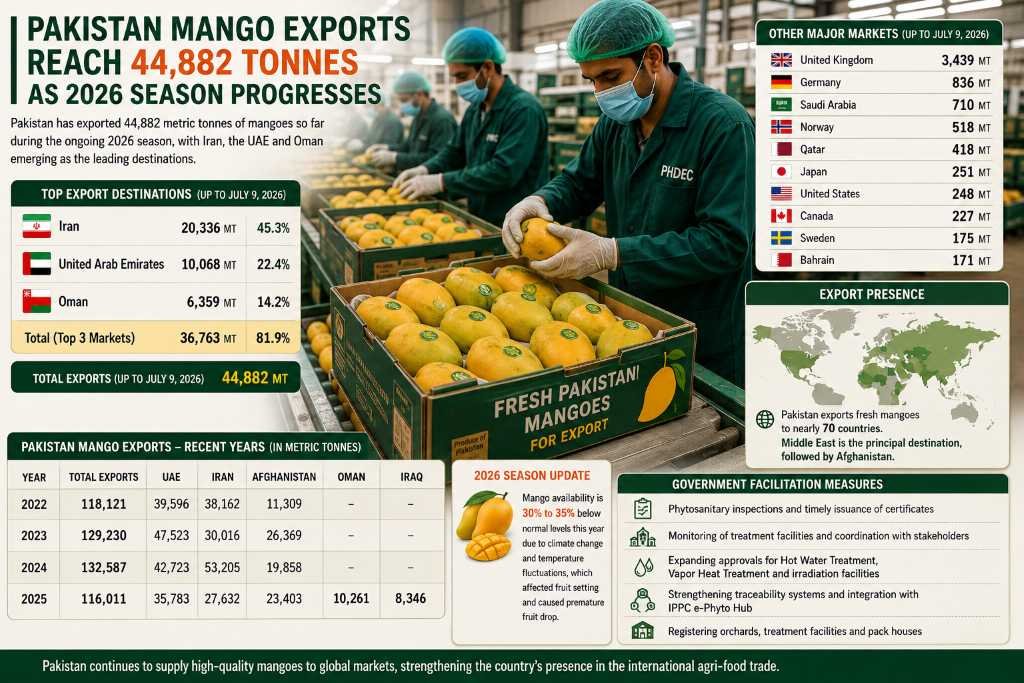
LAHORE, Aug 10 (ABC): Pakistan has exported 44,882 metric tonnes of mangoes so far during the ongoing 2026 season, with Iran, the United Arab Emirates and Oman emerging as the leading destinations.
According to official documents available with Wealth Pakistan, Iran led Pakistan’s mango exports with shipments of 20,336 metric tonnes up to July 9. The UAE followed with 10,068 metric tonnes, while Oman received 6,359 metric tonnes.
Together, the three markets imported 36,763 metric tonnes, accounting for nearly 82% of Pakistan’s mango exports recorded during the period.
The 44,882 metric tonnes represent mid-season figures rather than the country’s full-season export performance. Mango harvesting and overseas shipments were still underway, and the final export volume is expected to rise as the season progresses.
High-value markets receive Pakistani mangoes
Pakistan also continued supplying mangoes to several high-value international markets. The United Kingdom received 3,439 metric tonnes up to July 9, while shipments to Germany reached 836 metric tonnes.
Saudi Arabia imported 710 metric tonnes, followed by Norway with 518 metric tonnes and Qatar with 418 metric tonnes.
Other destinations included Japan with 251 metric tonnes, the United States with 248 metric tonnes and Canada with 227 metric tonnes. Sweden received 175 metric tonnes and Bahrain 171 metric tonnes.
The documents show that Pakistan exports fresh mangoes to nearly 70 countries. The Middle East remains the principal destination, followed by Afghanistan.
The European Union, United Kingdom, Japan, South Korea, China, Australia, Canada and the United States are among important high-value markets. Exporters must meet specific phytosanitary import requirements to access these destinations.
Mango exports show strong international presence
Pakistan’s mango export performance in recent years demonstrates the sector’s capacity to supply substantial volumes to international markets.
Fresh mango exports stood at 118,121 metric tonnes in 2022. They increased by around 9.4% to 129,230 metric tonnes in 2023.
Shipments rose by another 2.6% to 132,587 metric tonnes in 2024, the highest level during the period covered by the documents. Exports subsequently stood at 116,011 metric tonnes in 2025.
Pakistan’s leading mango export destinations have also changed over the years. The UAE was the largest market in 2022, receiving 39,596 metric tonnes, followed closely by Iran with 38,162 metric tonnes.
The UAE retained the top position in 2023 as shipments increased to 47,523 metric tonnes. Iran received 30,016 metric tonnes during the year. Meanwhile, exports to Afghanistan more than doubled from 11,309 metric tonnes in 2022 to 26,369 metric tonnes in 2023.
Iran became the largest market in 2024, importing 53,205 metric tonnes. The UAE received 42,723 metric tonnes, while Afghanistan accounted for 19,858 metric tonnes.
In 2025, the UAE again emerged as the leading destination with imports of 35,783 metric tonnes. Iran followed with 27,632 metric tonnes and Afghanistan with 23,403 metric tonnes. Oman received 10,261 metric tonnes, while shipments to Iraq reached 8,346 metric tonnes.
Climate pressures affect 2026 season
The 2026 mango export season is progressing despite lower fruit availability.
According to the Pakistan Horticulture Development and Export Company, mango availability is 30% to 35% below normal levels this year. Climate change and temperature fluctuations affected fruit setting and caused premature fruit drop.
The government continues to facilitate mango exports through phytosanitary inspections and timely issuance of certificates. It is also monitoring treatment facilities and coordinating with relevant stakeholders.
Other measures include expanding approvals for Hot Water Treatment, Vapor Heat Treatment and irradiation facilities. Authorities are also strengthening traceability systems and integrating with the International Plant Protection Convention’s e-Phyto Hub.
The government is also registering orchards, treatment facilities and pack houses to strengthen compliance with international phytosanitary requirements and facilitate Pakistan’s access to global mango markets.