


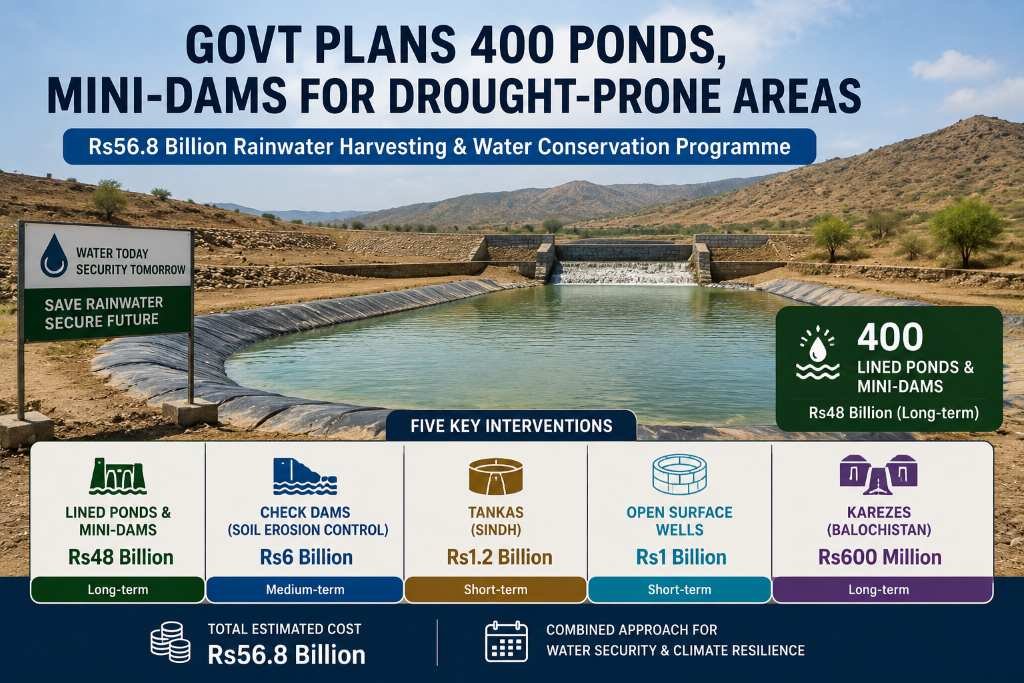
ISLAMABAD, Aug 19 (ABC): The government has proposed constructing 400 lined ponds and mini-dams in drought-prone areas at an estimated cost of Rs48 billion under a broader plan to expand rainwater harvesting and water conservation infrastructure.
According to documents available with Wealth Pakistan, the Ministry of Climate Change and Environmental Coordination has proposed five interventions with a combined estimated cost of Rs56.8 billion.
The proposed measures cover lined ponds and mini-dams, check dams, indigenous rainwater reservoirs, open surface wells and traditional karezes.
The government has divided the interventions into short-, medium- and long-term measures based on their proposed implementation timeframe.
Rs48bn proposed for ponds, mini-dams
The construction of 400 lined ponds and mini-dams represents the largest component of the proposed programme.
The ministry has estimated the intervention at Rs48 billion, accounting for around 85% of the total proposed expenditure of Rs56.8 billion.
Authorities have categorised the construction of ponds and mini-dams as a long-term measure.
These structures would help capture and store rainwater in drought-prone areas, increasing the availability of water during dry periods.
Check dams to reduce soil erosion
The ministry has also proposed Rs6 billion for the construction of check dams.
Authorities have placed the intervention in the medium-term category.
Check dams can slow the movement of rainwater, reduce soil erosion and support groundwater recharge while retaining water in areas affected by seasonal rainfall.
Another Rs1.2 billion has been proposed for the development of tankas in Sindh.
Tankas are indigenous rainwater reservoirs traditionally used to collect and store water in arid areas. The government has classified the proposed intervention as a short-term measure.
Surface wells, karezes also included
The proposals include Rs1 billion for the excavation of open surface wells in water-stressed areas.
The ministry has also placed this intervention in the short-term category.
In Balochistan, Rs600 million has been proposed for the excavation, lining and cleaning of karezes.
Karezes are traditional underground water channels that have historically supported communities and agriculture in arid areas of Balochistan. Authorities have categorised the proposed rehabilitation work as a long-term measure.
Together, the five interventions carry an estimated cost of Rs56.8 billion.
Under the proposed implementation timeframe, tankas and open surface wells fall in the short-term category. Check dams have been classified as a medium-term measure.
The 400 lined ponds and mini-dams, along with excavation, lining and cleaning of karezes, have been placed in the long-term category.
The proposed programme combines modern and traditional water-management approaches to improve rainwater harvesting, conserve available water and strengthen water security in drought-prone areas.