


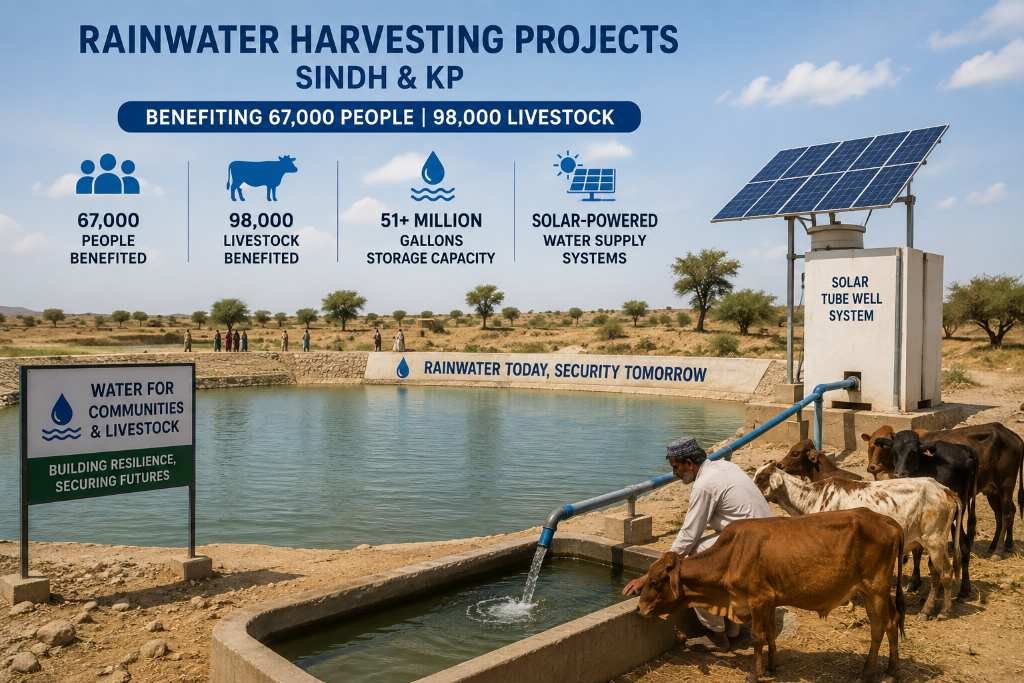
ISLAMABAD, Aug 19 (ABC): Rainwater harvesting projects in water-stressed areas of Sindh and Khyber Pakhtunkhwa are providing water access to around 67,000 people and 98,000 livestock through storage ponds, groundwater recharge and solar-powered supply systems.
According to documents available with Wealth Pakistan, the initiatives focus on drought-prone and water-scarce communities in the Thar Desert and Kohat-Hangu areas.
The projects aim to capture and store rainwater while strengthening groundwater resources. They also provide alternative water supplies for communities and livestock in areas where conventional water infrastructure remains difficult to establish.
Thar ponds store 35.21 million gallons
In the Thar Desert of Sindh, authorities have established a network of 10 rainwater harvesting ponds with a combined storage capacity of 35.21 million gallons.
The project is providing water access to approximately 46,000 people and 70,000 livestock.
Communities use the stored rainwater for domestic and livestock needs, providing an important alternative water source in the arid region.
The Thar initiative also includes a solar-powered tube well system. It supplies water to around 3,000 livestock through 48 tanks each day.
The combination of rainwater storage and solar-powered groundwater pumping aims to improve water availability while reducing dependence on conventional energy sources.
Kohat-Hangu projects benefit 21,000 people
In Khyber Pakhtunkhwa, rainwater harvesting ponds have been developed at seven sites across Kohat and Hangu with support from UNICEF.
These projects have a combined storage capacity of 16 million gallons and are benefiting around 21,000 people and 28,000 livestock.
The KP initiative extends beyond the storage of rainwater. It uses gabion structures and rainwater harvesting ponds to increase groundwater recharge and strengthen local water resources.
The programme also supports tube wells operated by the Public Health Engineering Department and dug wells used by local communities.
These interventions aim to strengthen existing water sources and improve their long-term sustainability.
Community-based water management expands
Together, the Thar and Kohat-Hangu projects have developed rainwater storage capacity of more than 51 million gallons.
The interventions reflect an increasing focus on decentralised and community-based water management in areas facing water scarcity.
Rainwater harvesting ponds can capture seasonal rainfall for later use, while groundwater recharge structures help replenish underground water resources.
Solar-powered pumping systems can further improve access to water in remote areas where electricity supplies remain limited.
The combination of rainwater harvesting, groundwater recharge and solar-powered water systems could provide a relatively low-cost model for improving water security in other water-stressed communities across Pakistan.