


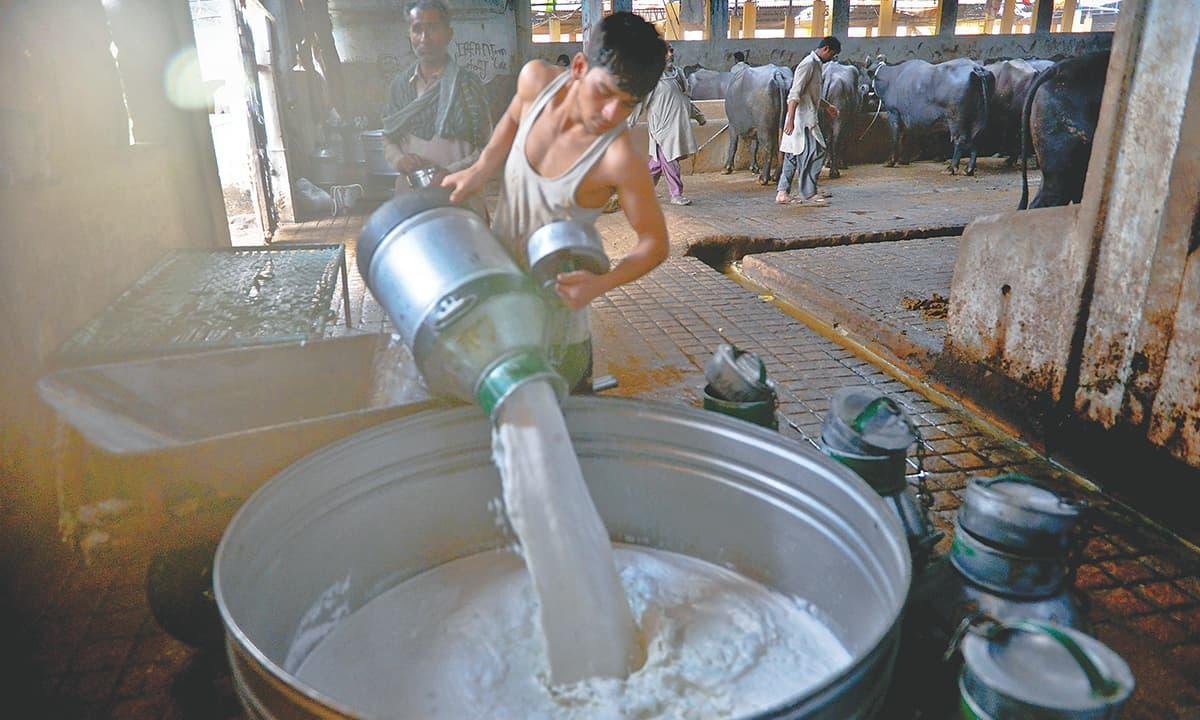
ISLAMABAD, May 3 (ABC): Milk production in Pakistan has increased by more than 80% over the past two decades, reflecting strong growth in the livestock sector.
According to official documents available with Wealth Pakistan, national milk output rose from 31.97 million tonnes in 2005-06 to 58.3 million tonnes in 2024-25, registering an increase of 82.3%. This growth highlights the expanding capacity of the livestock sector, a key pillar of the rural economy.
The growth in milk production has remained steady. Output crossed 40 million tonnes in 2013-14 and exceeded 50 million tonnes in 2020-21. It continued to rise in subsequent years, reaching 52.99 million tonnes in 2021-22, 54.71 million tonnes in 2022-23, and 56.47 million tonnes in 2023-24 before hitting the latest peak.
According to sector assessments, the sustained increase in milk production reflects improved livestock management, better feed availability, enhanced veterinary services, and rising demand for dairy products in urban and rural markets.
Pakistan is among the leading milk-producing countries. With milk output nearing 60 million tonnes, the country is strengthening its position in the global dairy sector.
According to the Pakistan Dairy Association, the dairy sector is emerging as a promising area for investment. It offers opportunities in farm productivity, milk collection, value-added processing, and export-oriented buffalo dairy products.
The dairy sector plays a vital role in livelihoods, food security, and nutrition. It supports millions of people directly and indirectly linked with dairy farming and related activities.
The Pakistan Dairy Association estimates that there are 8 to 10 million dairy farms in the country. Around 50 to 60 million people are associated with dairy farming, while nearly 8 million rural families are engaged in livestock production.
Livestock contributes around 35 to 40% of the total income of rural families involved in the sector. This makes animal husbandry a major source of household earnings and rural development.
According to the 7th Agricultural Census of Pakistan, the population of major milk-producing animals increased significantly between 2006 and 2024, supporting the rise in milk production.
Cattle numbers rose to 55.86 million in 2024 from 29.56 million in 2006, showing an increase of around 89%. Buffalo population grew to 47.74 million from 27.33 million, marking a rise of about 75%.
Goat population increased to 95.83 million from 53.79 million, up nearly 78%. Sheep numbers also climbed to 44.59 million from 26.49 million, showing growth of about 68%.
The rise in milk-producing animals indicates stronger livestock capacity, wider rural participation, and better prospects for dairy output, value addition, and food security.
Punjab remains the largest hub for cattle and buffalo populations in the country. It hosts 26.97 million cattle and 29.56 million buffaloes, highlighting its central role in milk production.
Khyber Pakhtunkhwa also holds a significant share, with 13.51 million cattle and 22.49 million goats. This reflects the importance of mixed livestock farming in the province.
Sindh reported 11.21 million cattle and 13.46 million buffaloes, showing its strong contribution to the dairy sector.
Balochistan leads in sheep population with 18.81 million animals. It also has 22.89 million goats and 0.77 million camels, indicating strength in small ruminants and arid-zone livestock systems.
Goats remain the most numerous livestock category at 95.83 million. They are followed by cattle at 55.86 million, buffaloes at 47.74 million, and sheep at 44.59 million, reflecting the diversity of Pakistan’s livestock base.