


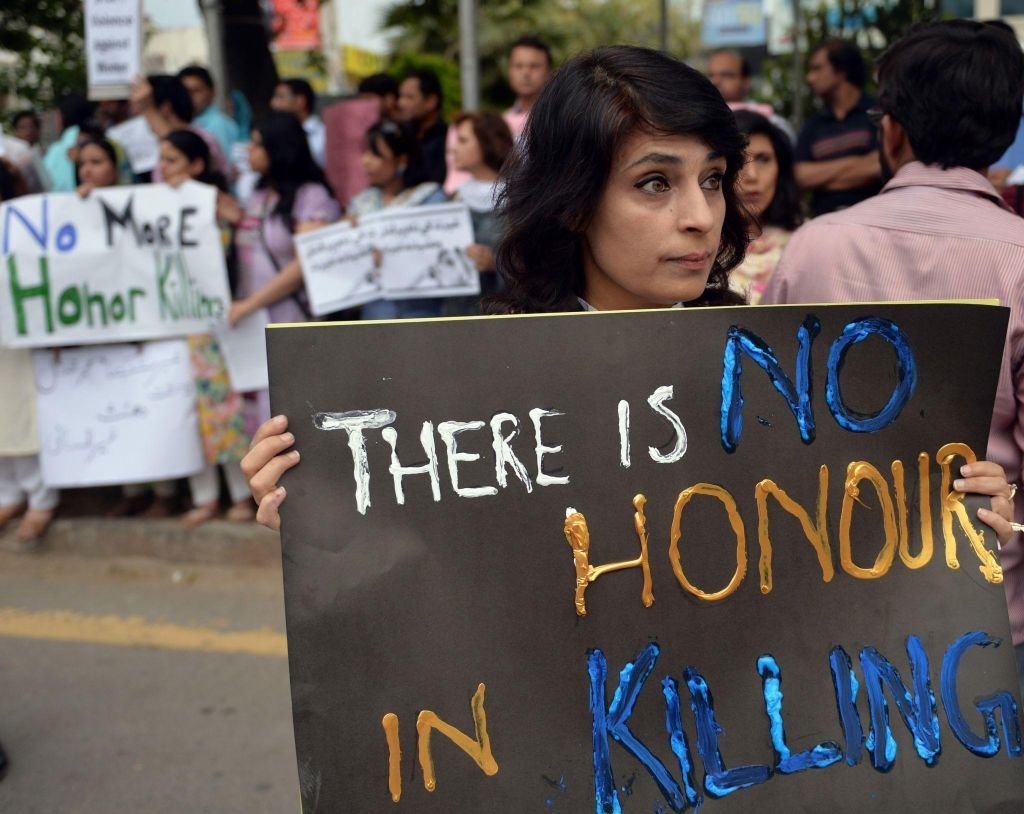
Every day, social media in Pakistan carries yet another tragic headline — a daughter, sister, or young woman killed in the name of “honour.” Yet one question remains largely unanswered: why are these crimes almost always committed against women? Why do we rarely hear of men being killed in the name of honour?
So-called honour killings continue to persist across Pakistan, particularly in regions such as Khyber Pakhtunkhwa, Sindh, and Balochistan. In some communities, deeply rooted cultural beliefs restrict women’s freedom and confine them to rigid social roles. Within such mindsets, a woman’s choices — especially regarding marriage — are often seen as a threat to family honour.
The scale of the problem is alarming. In 2024 alone, around 405 women were reportedly killed in the name of honour, with some estimates placing the number as high as 547. Between 2021 and 2024, approximately 1,553 such cases were documented across Pakistan. These figures, however, likely understate the true extent of the issue, as many incidents go unreported or are not properly investigated.
Beyond honour killings, violence against women remains widespread. Over the same period, nearly 74,000 cases of gender-based violence were recorded, including thousands of instances of domestic abuse, rape, and physical violence. In many cases, the perpetrators are not strangers but family members — the very individuals expected to provide protection.
This raises a deeper and more troubling question: why is “honour” tied almost exclusively to women’s actions? When men make similar choices, they are often forgiven or ignored. But when a woman chooses her partner or asserts her independence, she risks being labelled a source of shame — and, in extreme cases, punished with death.
Recent incidents highlight the brutality of this mindset. In April 2026, a 19-year-old girl, Khalida, was reportedly killed in Khairpur following a jirga decision. Surrounded by dozens of men, she had no voice, no power, and no opportunity to defend herself. Such parallel systems of justice continue to operate despite being unlawful, raising serious concerns about enforcement of the rule of law.
It is important to recognize that these practices have no basis in Islam. The teachings of the Holy Quran and the life of Prophet Muhammad emphasize dignity, justice, and kindness toward women. Islam grants both men and women the right to choose their spouses and strictly prohibits injustice and violence. The misuse of religion to justify honour-based crimes reflects a distortion of these teachings rather than their application.
Forced marriages further compound the problem. Many women are compelled to marry without consent, often leading to unhappy and abusive relationships. Denying women the right to choose their life partners not only violates their rights but also contributes to cycles of domestic violence and social instability.
The persistence of honour killings also reflects gaps in enforcement. While laws exist, their implementation remains inconsistent. Informal mechanisms such as jirgas continue to influence decisions in some areas, undermining the formal justice system.
Ultimately, this is not just a legal issue but a societal one. Until attitudes change, violence will continue. Honour cannot be defined by control over women’s lives, nor can it be preserved through fear and coercion.
A society that fails to protect its women fails to protect its humanity. And a society that kills its daughters in the name of honour has already lost its honour.