


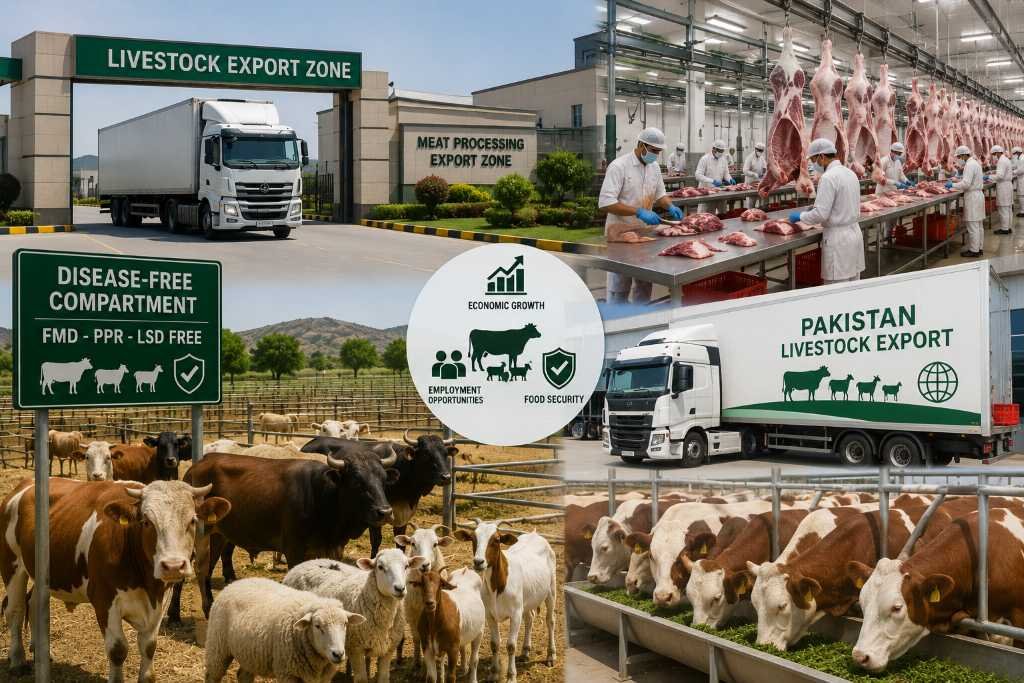
ISLAMABAD, May 25 (ABC): Pakistan plans to accelerate livestock exports by establishing dedicated meat processing export zones and disease-free compartments for major animal diseases as part of wider efforts to modernise one of the country’s fastest-growing economic sectors.
According to the Ministry of National Food Security and Research’s Year Book 2024-25, the government is also planning modern slaughterhouses aligned with international standards and introducing time-bound financial support schemes to attract investment and promote value-added livestock exports.
Pakistan targets livestock export growth through modernisation
The government is focusing on transforming the livestock sector through export-oriented reforms and technology-driven initiatives.
Breed improvement has emerged as an important component of the strategy. Plans include establishing nucleus herds, importing high-yield dairy, beef and mutton breeds, and introducing advanced genetic materials such as sexed semen, embryos and ova.
Officials believe these measures can increase productivity, create employment opportunities and strengthen national food security.
Animal husbandry continues to play a major role in Pakistan’s rural economy. More than eight million rural families are engaged in livestock production, with the sector contributing nearly 35% to 40% of household income in farming communities.
Livestock sector remains a key contributor to the economy
The livestock sector has strengthened its position as a major contributor to Pakistan’s agricultural economy.
According to the report, livestock accounted for 61.2% of agriculture’s value addition and contributed 14.7% to the country’s GDP during FY2024-25.
The sector also recorded steady growth during the past year.
Gross value addition increased from Rs5,587 billion in 2022-23 to Rs5,837 billion in 2023-24, reflecting a growth rate of 4.4%.
Livestock also contributed to foreign exchange earnings, accounting for around 2.9% of Pakistan’s total exports during FY2024-25.
Disease control strategy to support livestock trade
The government is pursuing a private sector-led development strategy supported by public policy interventions.
The strategy includes improvements in veterinary healthcare services, modern breeding methods, artificial insemination, balanced livestock nutrition and advanced reproductive technologies.
Officials are also focusing on controlling economically important diseases that affect productivity and trade.
These include Foot-and-Mouth Disease (FMD), Peste des Petits Ruminants (PPR), Lumpy Skin Disease (LSD) and Avian Influenza.
Disease-free compartments are expected to improve export certification standards and increase Pakistan’s competitiveness in international livestock markets.
Poultry industry maintains strong growth momentum
Pakistan’s poultry sector also continued its strong growth trend and remained an important segment of the broader livestock industry.
The industry generated employment for more than 1.5 million people nationwide and contributed gross value addition of Rs853 billion to the economy.
Over the last decade, Pakistan’s poultry sector recorded an average annual growth rate of 8.1%, helping the country become the world’s 11th-largest poultry producer.
The poultry industry currently contributes approximately 43.3% to Pakistan’s total meat production.
The government’s poultry development strategy focuses on disease prevention, production modernization, value-added processing and diversification of products.
Authorities have also introduced farmer-friendly policies to support both commercial and rural poultry farming.