


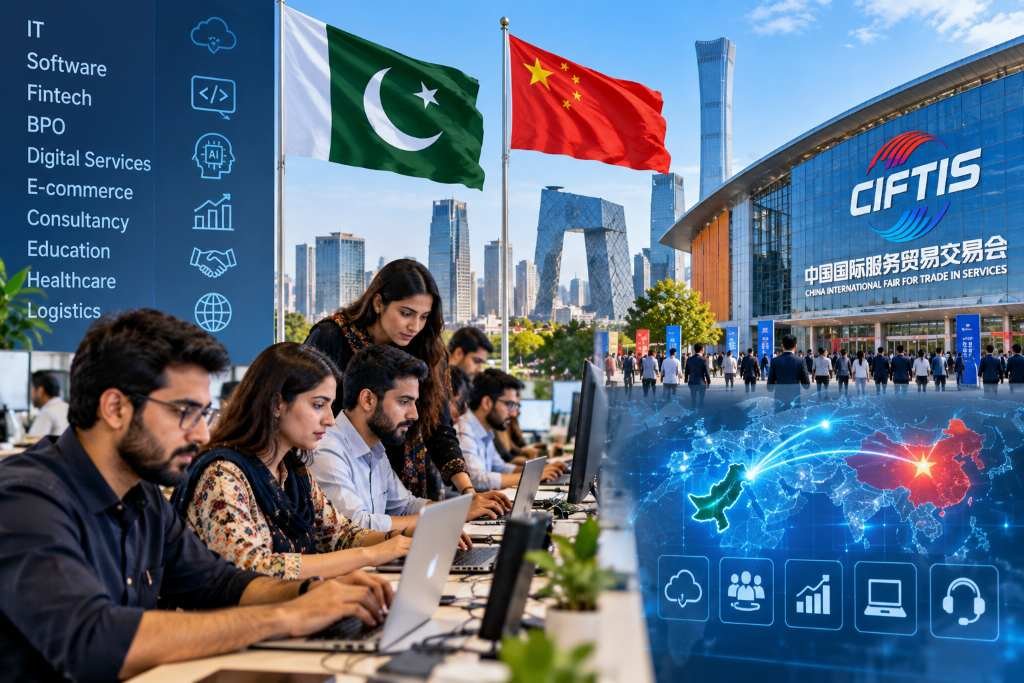
ISLAMABAD, Sept 25 (ABC): Pakistan needs to move beyond traditional merchandise exports and develop a dedicated strategy to tap China’s rapidly expanding services economy. Experts identified IT, business-process outsourcing, software, fintech and other knowledge-based services as potential new areas of bilateral trade.
The 2026 China International Fair for Trade in Services (CIFTIS), held in Beijing, achieved more than 1,200 outcomes and brought together over 1,800 exhibitors from China and abroad. The figures highlight the growing importance of services in global trade and value chains.
According to media reports, more than 470 Fortune Global 500 companies and industry-leading enterprises participated on site, while over 5,300 companies joined the event online. Participants from 90 countries, regions and international organisations took part in exhibitions, forums, conferences, business matchmaking and promotional activities.
The five-day fair showcased developments across a broad range of services. These included information and communication technology, fintech, digital and intelligent healthcare, smart education, energy conservation and environmental protection.
Services emerge as new trade opportunity
The scale and sectoral diversity of CIFTIS underline the expanding role of services in international trade. Services are also becoming an increasingly important part of global value chains, supporting production, design, management, logistics, distribution and digital operations.
Against this backdrop, experts believe Pakistan can use the growing Chinese services market to diversify its export base. It could also develop a stronger presence in knowledge- and technology-intensive sectors.
For Pakistan, they said, the focus should extend beyond participation in international exhibitions. Instead, the country needs institutional and commercial mechanisms to convert business contacts into sustained contracts, partnerships and investment.
Such an approach could add a new dimension to Pakistan-China economic cooperation. It could complement established trade and investment ties with greater collaboration in IT, digital services, business-process outsourcing and other knowledge-based sectors.
Pakistan has potential in IT, fintech, BPO
Talking to Wealth Pakistan, Federation of Pakistan Chambers of Commerce and Industry (FPCCI) President Atif Ikram Sheikh said China’s rapidly expanding services sector presented a significant opportunity for Pakistan to broaden its export base.
He said Pakistan had particular potential in IT and IT-enabled services, software development, fintech and digital marketing. Business-process outsourcing, professional consultancy, education, healthcare and logistics also offered opportunities.
“Pakistan’s key competitive advantages include a large and young talent pool, a growing IT and digital ecosystem, competitive operating costs, English-language capabilities, and increasing expertise in software, freelancing and technology-based services,” he said.
Sheikh said Pakistani companies could use these strengths to develop long-term partnerships with Chinese businesses. Their engagement, therefore, should not remain limited to participation in trade exhibitions.
However, he identified several areas requiring greater attention. These include awareness of the Chinese market, language and cultural differences, regulatory requirements, certification, local business networks and knowledge of Chinese procurement systems.
Pakistan also needs stronger institutional follow-up after international trade events, he said. Such follow-up could help convert business leads into commercial relationships.
“Pakistan should therefore move from an event-based approach to a structured services-export strategy,” Sheikh said.
He proposed targeted business-to-business matchmaking, sector-specific trade missions, dedicated facilitation desks and better market intelligence. He also suggested mechanisms to track business leads until they result in contracts.
In addition, Sheikh called for stronger cooperation with Chinese provinces and business associations, particularly in technology and emerging services. He also advocated greater support for joint ventures and local representation by Pakistani firms in China.
AI, digitalisation create new possibilities
Aadil Nakhoda, Research Fellow at the Centre for Business and Economic Research, Institute of Business Administration (IBA), Karachi, said China’s accelerating shift towards artificial intelligence and digitalisation could generate substantial demand for services.
These could include business-process outsourcing, data processing, IT-enabled services and other professional services.
He said the transformation could create new avenues for Pakistan-China cooperation in knowledge- and technology-based services. Potential areas include data management, software development, digital support, business-process services and environmental consulting.
Pakistani companies integrated into global value chains could also complement Chinese businesses by providing specialised services related to environmental management, sustainability and compliance. Such services could become increasingly relevant as Chinese companies expand in major international markets, including the European Union, he added.
Nakhoda said Pakistan’s large and relatively young workforce could provide a foundation for delivering cost-competitive and scalable services. The country’s growing pool of skilled professionals could further support Chinese companies as they expand their use of digital technologies and AI.
“There is considerable scope to facilitate Pakistani service providers’ participation in China’s expanding digital economy,” he said.
He suggested greater cooperation on standards recognition, regulatory coordination, licensing procedures and digital trade rules. These measures could make partnerships between Pakistani and Chinese firms easier.
Nakhoda also highlighted the potential role of local business networks, digital infrastructure and service platforms. These could help Pakistani companies integrate into China’s technology ecosystem and global value chains.
“I believe MoUs that involve harmonisation with Chinese standards, expanding trade facilitation and establishing localized infrastructure can help both countries in better IT service integration,” Nakhoda said.