


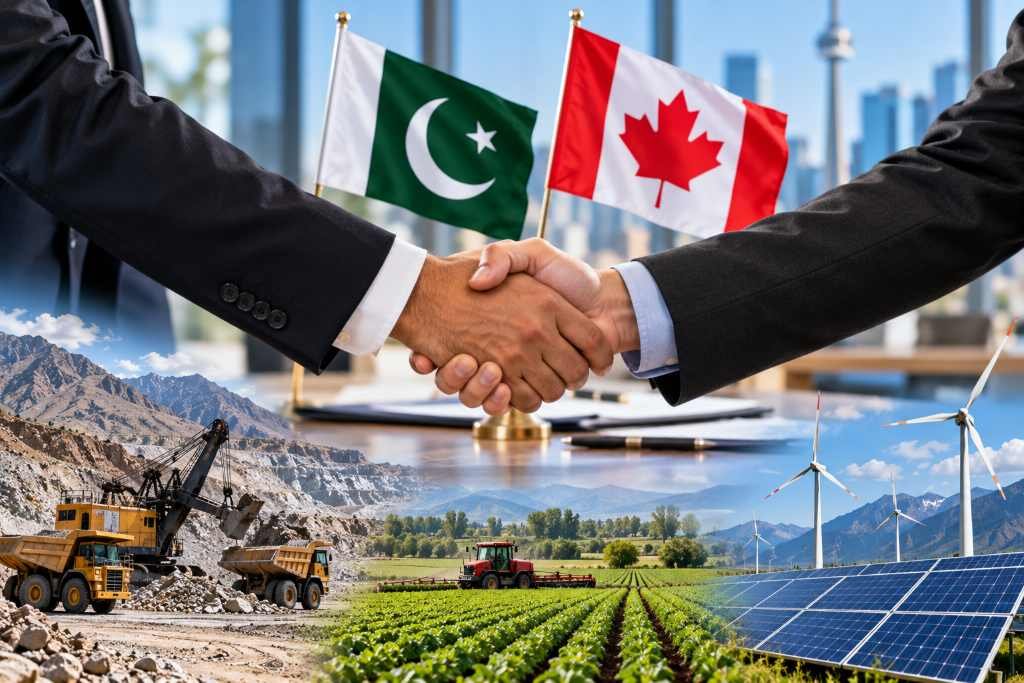
ISLAMABAD, Sept 26 (ABC): Pakistan needs greater regulatory predictability and a stronger pipeline of bankable projects to convert renewed economic engagement with Canada into long-term joint ventures. Experts see particular potential in mining, agriculture and renewable energy.
The issue has gained relevance as the two countries seek to deepen investment ties. Pakistan and Canada agreed on September 15 to accelerate negotiations on a Foreign Investment Promotion and Protection Agreement (FIPA), with another round expected in early October. They also identified mining, agriculture, clean energy and value-added industries as areas for greater cooperation.
Recent investment data point to growing Canadian interest. State Bank of Pakistan (SBP) data for August 2026 show Canada contributed around $50 million in net foreign direct investment. This made it the second-largest source that month after China.
Natural Resources Canada (NRCan), which tracks Canadian mining and mineral exploration assets, reported that 747 Canadian companies held C$240.6 billion in mining assets abroad in 2024. These assets were spread across 95 countries, highlighting the scale of internationally deployed Canadian mining capital.
This global footprint means Pakistan must compete with established mining jurisdictions for Canadian investment rather than rely on resource potential alone.
Regulatory predictability critical for investment
Speaking to Wealth Pakistan, Qaiser Abbas Qamar, Research Associate at Research and Development Solutions (RADS), Islamabad, said Pakistan’s central challenge was not a shortage of investment opportunities. Instead, it was the country’s ability to provide the regulatory and commercial predictability required by long-term investors.
Mining, agriculture and renewable-energy ventures often involve large upfront investments and long operating periods, he said. Therefore, stability in taxation and regulation, licensing procedures, contract enforcement, foreign-exchange availability and profit repatriation is critical to investment decisions.
Where projects require approvals from several agencies and timelines remain uncertain, even commercially attractive opportunities can become difficult to finance, Qamar added.
He said Pakistan should therefore move from broad investment promotion towards a more rules-based and time-bound system.
While concluding FIPA could provide greater certainty in bilateral investment, domestic reforms remained equally important.
Qamar called for clearly published approval requirements and processing timelines. He also proposed sector-specific frameworks covering mining licences and royalties, agricultural standards and renewable-energy arrangements.
More importantly, he said Pakistan needed to move from advertising investment potential to presenting Canadian companies with investment-ready projects.
Such projects should have feasibility studies, regulatory status, land requirements, financing needs and potential local partners identified before being marketed to international investors. Bilateral business forums could then connect those projects with Canadian companies, financiers and technology providers.
Mining projects need credible technical preparation
The need for project preparation is particularly evident in mining. Investors require reliable geological information and a clear route from exploration to commercial production.
Abdul Haq Mengal, Mining Engineer at the Balochistan Mineral Exploration Company (BMEC), told Wealth Pakistan that Pakistan needed to convert its mineral prospects into properly explored and technically credible projects.
International investors require dependable geological and exploration data before committing substantial capital, he said. They also need clarity on licensing, environmental approvals, land access, security arrangements and other government procedures.
Mengal said a clear pathway from an exploration licence through detailed exploration and feasibility studies to financing and mine development would reduce uncertainty. It would also strengthen investor confidence.
He added that joint ventures with Canadian companies should extend beyond mineral extraction.
Such partnerships could combine Pakistani mineral rights and local knowledge with Canadian capital, exploration expertise and technology. At the same time, they could support local processing, technical skills and downstream value addition.
Technology cooperation offers further opportunities
Omar Ashraf, an international trade and mining professional, told Wealth Pakistan that Canadian cooperation could also help address weaknesses in mineral testing, exploration technology and project evaluation.
He identified modern mineral-testing laboratories and advanced exploration technologies as areas where Canadian expertise could strengthen Pakistan’s mining ecosystem.
Ashraf also saw potential for partnerships at the small and medium-sized project level. In particular, opportunities could emerge where businesses move beyond excavation towards beneficiation, product development and marketing.
He said independent geological and technical evaluation would be important for establishing the commercial credibility of prospective projects. This could help turn them into bankable investment propositions.
For Pakistan, therefore, the next step is not simply to identify more sectors for Canadian investment but to make existing opportunities investable. Experts say predictable rules, credible technical preparation and commercially structured projects will determine whether renewed bilateral engagement translates into sustained joint ventures, technology transfer and greater domestic value addition.