


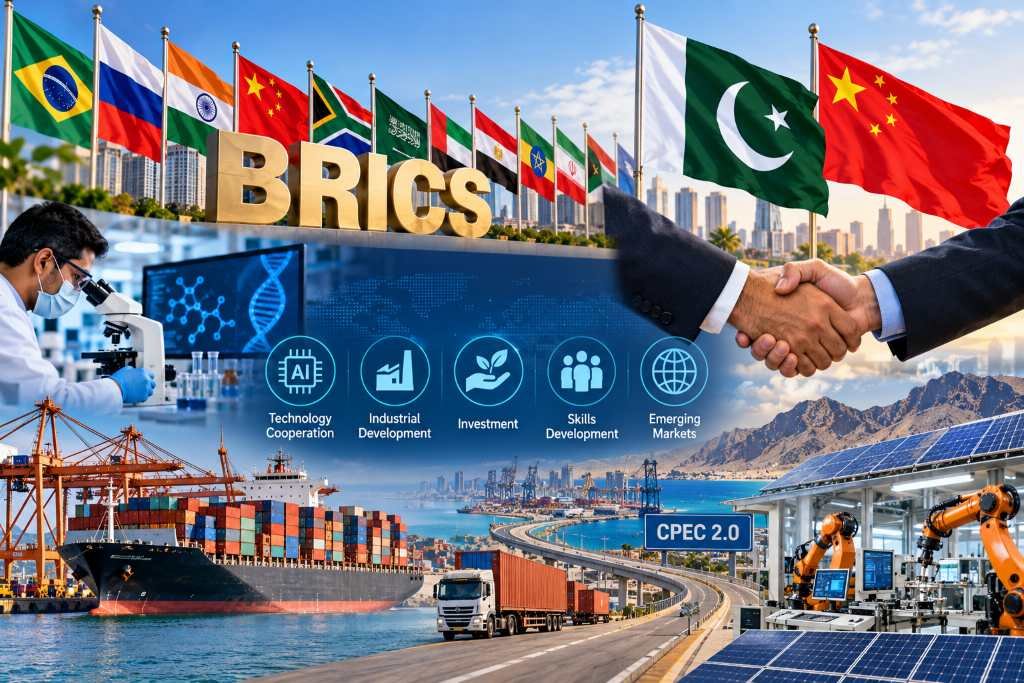
ISLAMABAD, Sept 28 (ABC): China’s “Greater BRICS” initiatives have opened new avenues that Pakistan could explore for cooperation in technology, industrial development, investment, skills and emerging markets. Experts are calling for relevant opportunities to be linked with CPEC 2.0.
Chinese President Xi Jinping presented five initiatives at the 18th BRICS Summit in New Delhi. They cover open-source and inclusive artificial intelligence, trade and investment facilitation, digital industries, intelligent manufacturing, and science and technology talent development.
The proposals include a BRICS AI open-source community and cooperation among special economic zones. They also cover a digital ecosystem cloud platform, support for smart factories, an engineer cultivation alliance and a youth exchange programme for technological innovation.
Experts say these mechanisms could reinforce CPEC 2.0 by supporting technology transfer, industrial production, export diversification and workforce development in Pakistan.
Although Pakistan is not a BRICS member, its strategic partnership with China provides scope to explore relevant cooperation opportunities, experts say. Pakistani universities, technology companies, industrial institutions and special economic zones could engage with relevant mechanisms and wider Global South networks.
Experts note that Pakistan can maximise the benefits of the Greater BRICS initiatives only by translating engagement into practical outcomes. These include technology partnerships, competitive industrial production, skilled employment, diversified exports and stronger integration with Global South markets.
Technology, industry offer immediate opportunities
Speaking to Wealth Pakistan, Haris Bilal Malik, Research Fellow at the China-Pakistan Study Centre of the Institute of Strategic Studies Islamabad, said the initiatives covered areas in which Pakistan urgently needed to upgrade its economy. These include technology, industrial productivity, investment, skills and export diversification.
Malik identified technology, industrialisation and market diversification as the three most immediate opportunities.
He said Pakistan should seek early engagement with the proposed AI community, digital ecosystem and technology-training programmes. The aim should be to connect its universities, start-ups and IT companies with wider international technology networks.
The proposed engineer cultivation alliance and youth exchanges were particularly relevant because of Pakistan’s large young population, he said. However, participation should focus on skills demanded by emerging industries rather than general academic exchanges.
On industrial cooperation, Malik said the proposed special economic zone partnership and smart-manufacturing programmes could reinforce CPEC 2.0. The second phase of CPEC places greater emphasis on industrial development.
“Pakistan should seek to connect its special economic zones with Chinese companies and wider BRICS supply chains, with the objective of technology transfer, local production and exports — not simply attracting investment,” he said.
Greater BRICS could support export diversification
Malik said Greater BRICS cooperation could also support Pakistan’s efforts to diversify exports towards emerging markets.
He noted that Pakistan’s exports to China reached $2.136 billion during the first seven months of 2026, representing year-on-year growth of 45.9%.
The second phase of the China-Pakistan Free Trade Agreement provided a foundation for further expansion, he said. China granted immediate tariff elimination to 313 priority product lines under the agreement, creating additional market-access opportunities for Pakistani exporters.
However, Malik stressed that market access alone would not be enough to increase exports.
Pakistan would need predictable regulations, efficient customs procedures and reliable energy supplies. Improved logistics, stronger investment protection and a more secure business environment would also be needed to attract production-oriented investment and translate market access into sustained exports, he said.
Pakistan urged to link opportunities with CPEC 2.0
Nabila Jaffer, Senior Research Analyst and Head of the China Programme at the Institute of Regional Studies Islamabad, said Greater BRICS sought to give stronger representation to the interests and development priorities of the Global South.
She said the initiatives could provide Pakistan with opportunities to deepen engagement with BRICS countries and pursue cooperation in sectors corresponding to its development requirements.
“With youth making up 60% of its population, alongside its ongoing modernisation efforts through CPEC, Pakistan has the potential to expand cooperation in artificial intelligence, innovation, supply-chain integration, smart industries and talent exchanges,” she said.
Jaffer said Pakistan should clearly identify the economic, technological and strategic strengths it could contribute. It should also communicate them effectively to China and other BRICS members.
Relevant government institutions, research organisations, universities and industry bodies should establish sustained engagement with emerging cooperation mechanisms, she added.
She also called for a coordinated strategy presenting Pakistan as a significant Global South economy with a large market, young population, untapped resources and access to regional trade routes.
Pakistan should connect Greater BRICS engagement with CPEC 2.0, she said. It could also position its industrial clusters, special economic zones and Gwadar as platforms for investment, production and regional connectivity.