


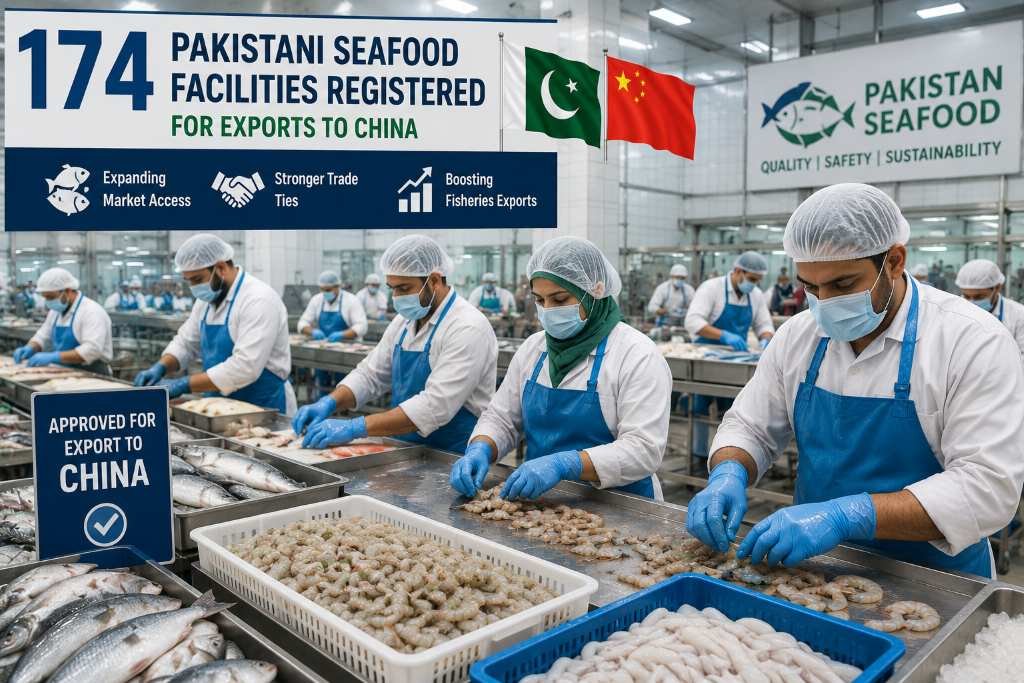
ISLAMABAD, June 15 (ABC): China has enlisted 174 Pakistani fish processing plants, expanding market access for the country’s fisheries sector and strengthening trade ties with one of Pakistan’s largest export destinations.
According to official documents available with Wealth Pakistan, China has become an increasingly important market for Pakistani seafood products as bilateral agricultural and food trade continues to grow.
China opens wider market access
The registration of 174 fish processing plants with the General Administration of Customs of China allows more Pakistani exporters to supply seafood products to the Chinese market under approved regulatory arrangements.
The development is expected to boost seafood exports and create new opportunities for processors and exporters across Pakistan.
Pakistan expands global seafood footprint
Pakistan has also improved access to other international seafood markets.
After the resumption of exports to the European Union, consignments of fish, cuttlefish and shrimp from four Pakistani companies successfully met all laboratory testing requirements at EU borders.
Official documents show that 11 Pakistani fish processing facilities are currently registered for exports to Saudi Arabia.
Meanwhile, authorities are processing the registration of 16 facilities for exports to Russia.
Fisheries sector supports livelihoods
Fisheries remain an important part of Pakistan’s economy and support thousands of livelihoods, particularly in coastal areas.
Besides marine fisheries, people engage in inland fishing activities in rivers, lakes, ponds and dams across the country.
Official data shows that the sector contributes 1.29 percent to agriculture and 0.30 percent to Pakistan’s gross domestic product.
During July-March FY2025-26, Pakistan produced 642,180 metric tonnes of fish. Marine fisheries contributed 427,180 metric tonnes, while inland waters produced 215,000 metric tonnes.
Government focuses on export growth
Federal and provincial fisheries departments are implementing several initiatives to improve sector performance and increase exports.
These measures include strengthening extension services, introducing modern fishing techniques, developing value-added seafood products and promoting fish consumption.
Authorities are also working to improve the socio-economic conditions of fishermen.
In addition, policymakers are reviewing the Deep-Sea Fishing Policy 2018 to align it with changing industry requirements and emerging export opportunities.