


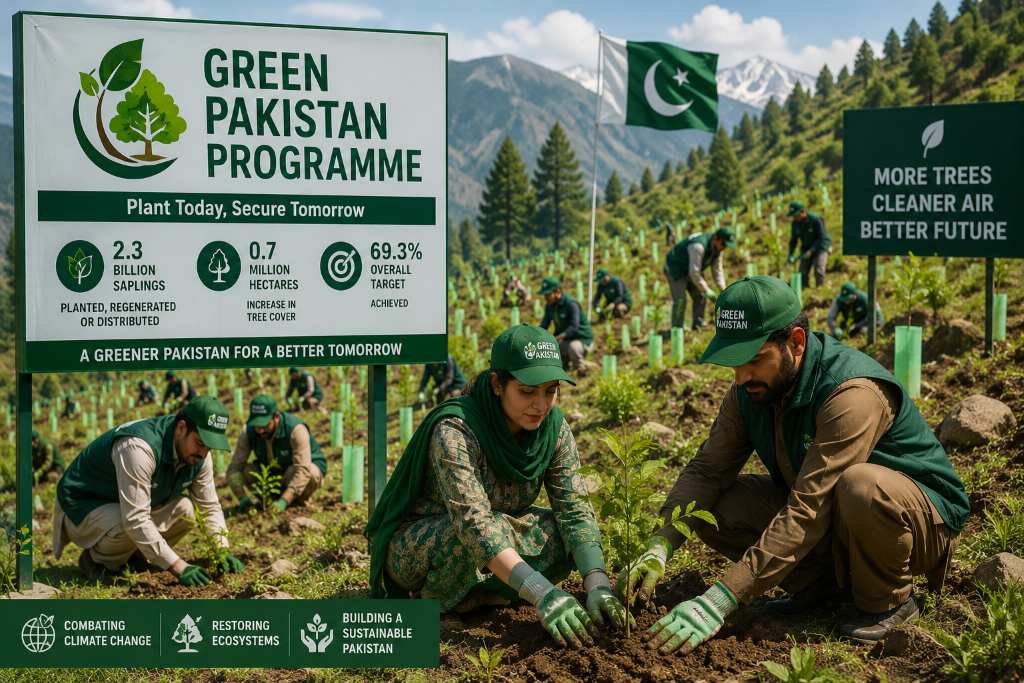
ISLAMABAD, June 14 (ABC): Pakistan has planted, regenerated, or distributed nearly 2.3 billion saplings under the Green Pakistan Programme, marking one of the country’s largest afforestation drives.
According to official data available with Wealth Pakistan, the programme remains a key part of Pakistan’s environmental strategy. It aims to address climate change, restore ecosystems, and improve environmental sustainability.
Afforestation drive expands tree cover
The data shows that by March 2026, authorities had planted, regenerated, or distributed a cumulative 2,283.3 million plants across the country.
The programme achieved 69.3 percent of its overall target and increased tree cover over nearly 0.7 million hectares. The initiative continues to support efforts to restore degraded land and improve ecosystem health.
Provinces report varying progress
During July-March FY2025-26, provinces and territories planted, regenerated, or distributed 30.5 million plants.
Performance against plantation targets reached 86 percent in Sindh. Punjab achieved 79 percent, while Khyber Pakhtunkhwa recorded 73 percent. Gilgit-Baltistan reached 62 percent of its target.
Azad Jammu and Kashmir achieved 34 percent, while Balochistan recorded 28 percent.
Forest resources remain under pressure
Pakistan’s total forest area stands at about 4.1 million hectares. Forests cover only 4.7 percent of the country’s total land area.
The survey estimates annual deforestation at around 11,000 hectares. The figures highlight continued pressure on the country’s forest resources.
Officials believe expanding forest cover can help reduce environmental degradation and strengthen climate resilience.
Trees play key role in climate adaptation
According to the report, increasing tree cover is essential for improving ecosystem health and conserving biodiversity.
Forests also help reduce soil erosion and strengthen Pakistan’s ability to adapt to climate change. The large-scale plantation campaign forms part of broader efforts to restore degraded landscapes and reduce climate-related risks.
Climate change drives policy focus
The Ministry of Climate Change and Environmental Coordination has carried out plantation activities in collaboration with provincial and territorial governments.
The report notes that climate adaptation and environmental protection have become major policy priorities in recent years. It cites the devastating floods of 2022 as a reminder of the need for stronger environmental management and ecosystem restoration.
Pakistan has also incorporated forestry and ecosystem restoration into its climate commitments and sustainable development goals. These efforts aim to support long-term environmental sustainability and improve resilience against future climate challenges.