


Gulsameen Nauhani
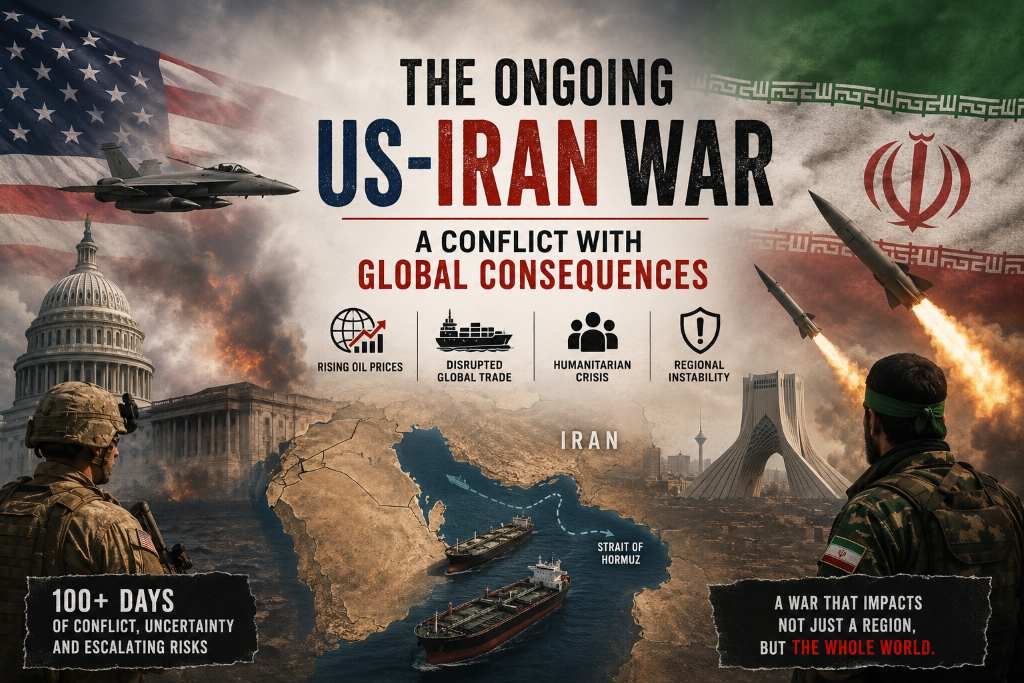
The war between Iran and the United States, which began on February 28, has now crossed the 100-day mark. What started as a confrontation over Iran’s nuclear programme has gradually evolved into a broader conflict involving shifting political and strategic objectives. Demands initially focused on curbing Iran’s uranium enrichment activities, but later expanded to include regional political arrangements such as participation in the Abraham Accords. Throughout this period, former US President Donald Trump pursued an aggressive approach toward the Iranian leadership.
Despite facing intense military pressure from both the United States and Israel, Iran has remained resilient. Many observers expected Tehran to succumb quickly to the combined military strength of its adversaries. Instead, Iran has demonstrated an ability to absorb significant losses, including the deaths of senior officials, while continuing to resist and retaliate. This resilience has surprised many who underestimated the country’s determination and military capabilities.
At the same time, Washington has repeatedly signalled its preference for negotiations as the ultimate path to ending the conflict. One ceasefire arrangement, reportedly facilitated by Pakistan, came into effect on April 8, 2026. On April 21, the United States unilaterally extended the ceasefire in an effort to promote long-term stability and facilitate the reopening of the Strait of Hormuz. However, the truce remains fragile, with ongoing tensions and accusations threatening its survival.
The current situation reflects a troubling contradiction. While diplomatic efforts continue, military operations have not fully ceased. Both sides continue to exchange strikes, raising doubts about the durability of any ceasefire agreement. The result is an uneasy and dangerous environment in which peace remains uncertain.
Beyond the battlefield, the consequences of this conflict have been felt across the globe. One of the most significant developments has been Iran’s threat to close the Strait of Hormuz, a strategic waterway through which a substantial share of the world’s oil supplies passes. Any disruption to this route immediately affects international markets, causing sharp increases in energy prices and placing additional pressure on import-dependent economies.
The impact extends far beyond fuel. Rising transportation and energy costs have contributed to inflation, disrupted agricultural and fertilizer shipments, and increased food prices worldwide. In an increasingly interconnected global economy, regional conflicts can no longer be viewed as isolated events. Their repercussions are felt far beyond the countries directly involved.
The United States has consistently maintained that Iran must either reach a negotiated settlement or face military consequences. Iran, however, has chosen resistance over compromise. This determination has further prolonged the conflict and reduced prospects for a quick resolution.
Recent developments illustrate the volatility of the situation. Reports indicate that an American AH-64 Apache helicopter was destroyed, prompting retaliatory strikes on Iranian military and surveillance facilities. Meanwhile, tensions involving Israel and Hezbollah continue to complicate the broader regional landscape. Statements by Israeli Prime Minister Benjamin Netanyahu have further intensified the rhetoric, highlighting the deep mistrust that continues to fuel hostilities.
History shows that wars rarely end when the fighting stops. Their consequences often linger for decades. The devastation caused by past conflicts, including the atomic bombings of Japan, serves as a reminder that the human cost of war can extend across generations. The current conflict in the Middle East is no exception. It has already produced significant loss of life and suffering, with casualties continuing to mount.
According to available figures, the combined impact of military operations has resulted in thousands of deaths across Iran, Lebanon and parts of the Gulf region. When Iranian territory or senior leaders come under attack, retaliatory strikes often target US military installations in Gulf countries, increasing the risk of casualties across multiple sovereign states and widening the scope of the conflict.
Perhaps the most tragic aspect of this war is its human toll. Among the injured are women, children and elderly civilians who have no direct role in the conflict. Reports of attacks affecting schools and residential areas have intensified concerns about civilian protection and adherence to international humanitarian law.
As matters stand, neither side appears willing to significantly scale back its objectives. The United States remains determined to secure its strategic goals, while Iran appears equally committed to resisting external pressure. Under such circumstances, a swift end to the conflict seems unlikely.
If the current trajectory continues, the Middle East may face prolonged instability, while the rest of the world will continue to bear the economic and humanitarian consequences. The longer this war endures, the greater the risk that its effects will extend far beyond the region, leaving a legacy of destruction that future generations will struggle to overcome.