


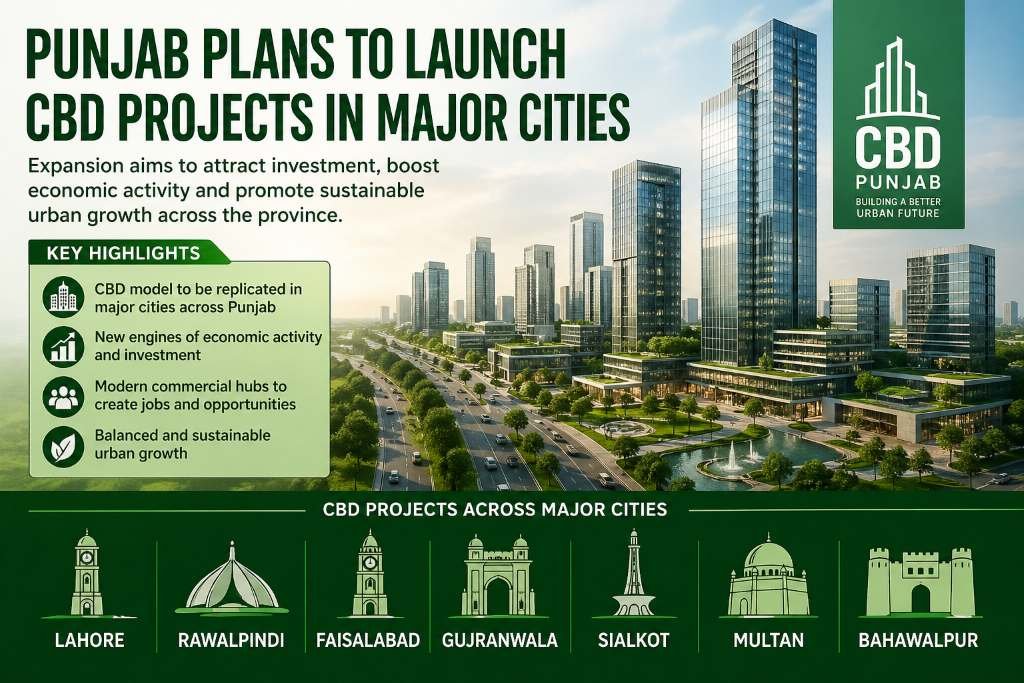
LAHORE, April 26 (ABC): The Punjab Central Business District Development Authority is planning to establish central business districts in major cities across the province, including Rawalpindi, Faisalabad, Gujranwala, Sialkot, Multan, and Bahawalpur. The move follows the successful launch of its flagship project in Lahore.
According to an interview with Wealth Pakistan, Chief Executive Officer Imran Amin said the authority is carrying out feasibility studies and strategic planning. He said the aim is to replicate the CBD model across Punjab after strong investor response in Lahore.
Expansion aims to boost investment and growth
The expansion aims to centralize economic activity and develop modern commercial hubs in key urban centers. It also seeks to attract both domestic and international investment. Moreover, the initiative is expected to promote balanced and sustainable urban growth across the province.
Amin said the establishment of a network of CBDs will create new engines of economic activity. He added that it will strengthen Punjab’s overall economic landscape and position the province as a leading investment destination in the region.
Lahore CBD projects gain momentum
Highlighting the flagship Lahore CBD project, Amin said several developments are shaping the city’s urban landscape. These include CBD Route 47, which is designed to improve connectivity and unlock commercial potential. In addition, CBD Walk will serve as a pedestrian-friendly lifestyle destination. Meanwhile, CBD Arena is planned as a major venue for events, entertainment, and business activities.
He said the Central Business District Punjab is progressing at full pace. Both infrastructure and vertical development are underway, which shows a shift from planning to execution.
To ensure high standards, the authority has engaged internationally recognized master planners. It has also attracted leading private developers to deliver premium projects within the district.
Experts highlight need for city-specific planning
Urban affairs experts support the rollout of CBDs in Lahore and other cities. However, they stress that the economic impact depends on local conditions. Speaking to Wealth Pakistan, Dr. Nasir Javed, former chief executive officer of the Punjab Urban Unit, said CBDs must align with city-specific value chains.
He said export-oriented textile services can drive growth in Faisalabad. Similarly, back-office and tech services can support development in Rawalpindi. He added that logistics and agri-processing can play a key role in Multan. If aligned properly, these sectors can improve productivity and increase formal economic activity.
Global examples offer key lessons
Dr. Javed said CBDs have played a central role in the growth of major cities in developed countries, especially in the United States. He noted that in cities like New York, Chicago, and San Francisco, CBDs developed over decades as hubs of finance, commerce, and governance.
He explained that their strength comes from deep labor markets, strong infrastructure, effective institutions, and global connectivity. He added that CBDs are not just clusters of office buildings but complete economic ecosystems.
For Pakistan, he said the key lesson is to go beyond physical development. He emphasized the need for mixed-use planning, efficient transport systems, regulatory transparency, and alignment with competitive economic sectors.