


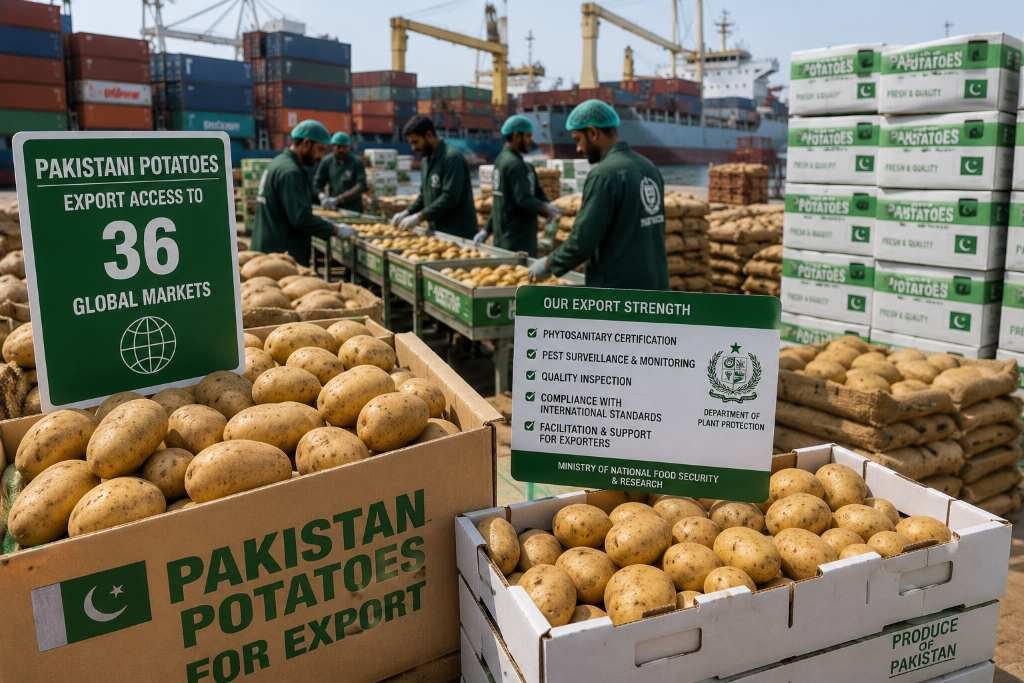
ISLAMABAD, Aug 12 (ABC): Pakistani potatoes currently have export access to 36 countries, with requirements ranging from routine phytosanitary certification to import permits and additional country-specific conditions.
According to official documents available with Wealth Pakistan, the Ministry of National Food Security and Research’s Department of Plant Protection (DPP) has compiled a Market Access and Sanitary and Phytosanitary (SPS) Compliance Matrix. The matrix covers 36 countries where Pakistani potatoes currently have export market access.
Of these markets, exporters can ship potatoes to 17 countries through routine phytosanitary certification without additional SPS conditions.
Another 10 countries require a valid import permit from the importing country’s authorities before the DPP can issue a phytosanitary certificate.
The remaining nine countries have specified additional import conditions. These include declarations on phytosanitary certificates, certification of pest-free production areas and disinfestation of packing materials and shipping containers. Exporters must also comply with other country-specific phytosanitary requirements.
Round-the-clock support for exporters
The DPP has deployed staff around the clock at major potato production, storage and processing clusters during the peak export season. These include Okara, Depalpur, Kasur and Pakpattan.
The department has also nominated a focal person to facilitate potato exports and address exporters’ grievances.
In addition, the DPP has strengthened coordination with National Plant Protection Organizations of importing countries. It is facilitating exporter registration, phytosanitary certification, pest surveillance and monitoring.
The department has also strengthened inspection and quarantine services. It continues to engage stakeholders to address market-access issues and ensure compliance with international phytosanitary standards.
Russia lifts ban on Punjab potatoes
The documents show that Russia had banned potato imports from Punjab over concerns about the alleged presence of Potato Tuber Moth and Tomato Wilt Virus.
The DPP subsequently engaged its Russian counterpart and provided scientific evidence supporting Pakistan’s phytosanitary system and pest-free status concerning the organisms of concern.
The two countries’ National Plant Protection Organizations also held bilateral consultations on the issue.
Following sustained technical and diplomatic engagement, Russian authorities accepted Pakistan’s technical justifications and supporting evidence. Russia consequently lifted the ban on potato imports from Punjab, restoring market access for Pakistani exporters.
Pakistan seeks additional markets
Pakistan is also pursuing opportunities to expand potato exports to additional international markets.
The documents state that the General Administration of Customs of China (GACC) has shown greater interest in value-added potato products. These include processed products such as potato chips and potato starch.
Such products face relatively simpler quarantine requirements and more efficient market-access procedures.
Cambodia has emerged as another positive market-access case. Pakistan submitted a market-access request in February 2026. Cambodian authorities granted access on February 28, 2026, and Pakistan subsequently circulated the decision among stakeholders.
Progress is also underway on access to the Vietnamese market. Pakistan submitted comments on Vietnam’s pest risk assessment in February 2026.
A response received in April showed that Vietnam’s Plant Production and Protection Department was working on potato market access on a priority basis, along with citrus and mango.
The documents show that Pakistan is also pursuing pest risk assessment or market-access engagement with Mexico, Japan, Argentina, Thailand, the Philippines and the European Union.
The DPP’s strategy combines country-specific SPS compliance, round-the-clock certification support and technical engagement with importing countries. It also provides a dedicated grievance-redressal mechanism to facilitate Pakistani potato exporters and expand their access to international markets.