


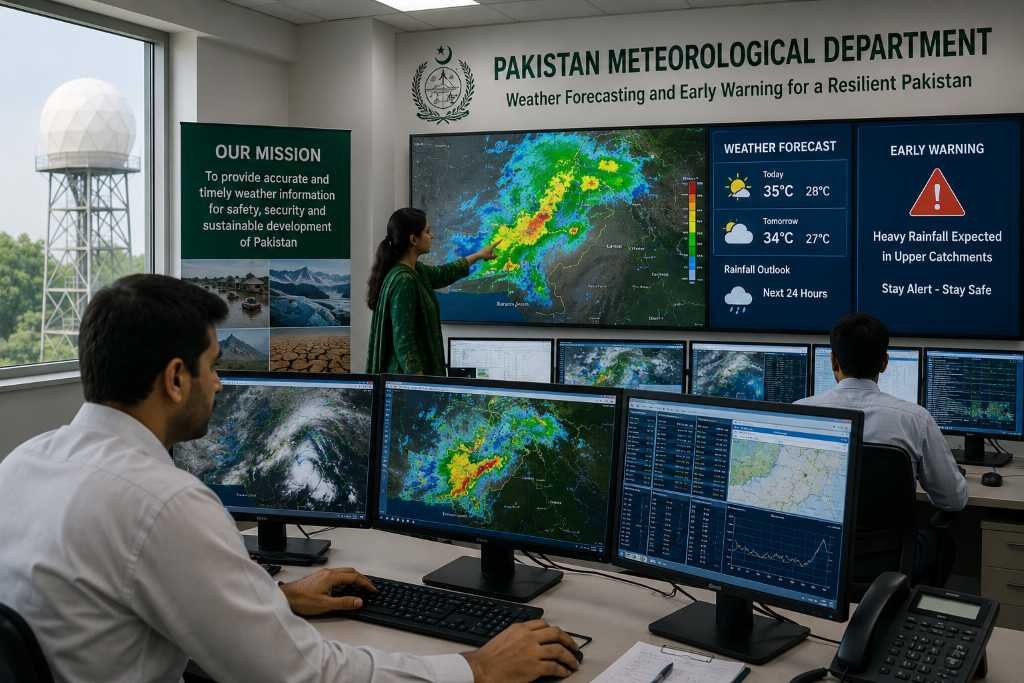
ISLAMABAD, Jul 05 (ABC): Pakistan plans to strengthen weather forecasting, disaster preparedness and climate resilience through a series of projects and policy initiatives.
According to the Annual Plan 2026-27, a copy of which is available with Wealth Pakistan, the government has allocated Rs1.6 billion to the Pakistan Meteorological Department (PMD). The funding will improve forecasting systems and strengthen disaster risk management.
Investment in forecasting infrastructure
The allocation includes Rs344 million for the proposed National Centre for Rainfall Enhancement. The centre will support water security, climate adaptation and agricultural productivity.
The government has also allocated Rs195 million for a weather surveillance radar in Multan and Rs5 million for a similar project in Sukkur. These projects will strengthen real-time weather monitoring and early warning systems.
In addition, the government has earmarked Rs1 billion for the Modernisation of Hydromet Services in Pakistan project. The initiative will upgrade hydrometeorological infrastructure, improve forecasting accuracy and strengthen climate-related data systems.
Climate resilience projects receive funding
The Ministry of Climate Change and Environmental Coordination is expected to receive Rs2.5 billion. Most of the funding will support forestry, biodiversity conservation, afforestation and ecosystem restoration.
Key initiatives include the Pakistan Climate Innovation and Green Growth Initiative. The programme will equip young people with green skills and support entrepreneurship through a Green Innovation Fund.
The government also plans to conduct a National Forest and Tree Cover Assessment. It will use remote sensing and machine learning technologies to improve forest monitoring and restoration planning.
Green initiatives and disaster preparedness
The government will also launch specialised projects under the Upscaling of Green Pakistan Programme. These include the Pollution Load Assessment Network for environmental monitoring in Islamabad, a Botanical Garden in the federal capital and conservation initiatives in the Margalla Hills National Park.
Furthermore, the plan promotes climate-smart agriculture, efficient water management, disaster risk reduction, green industrialisation, circular economy initiatives and domestic carbon market mechanisms. These measures aim to support sustainable economic growth while improving climate resilience.
Growing climate risks
The Annual Plan says Pakistan faces increasing exposure to climate-related disasters. Major floods in 2010, 2011, 2014, 2022 and 2025 caused extensive human and economic losses. They also damaged infrastructure and livelihoods across the country.
According to the World Bank’s 2022 report, Pakistan loses around $2 billion every year because of floods and earthquakes.
The report warns that cumulative losses could reach $250 billion by 2030 and $1.2 trillion by 2050. In a peak disaster year, damage in priority sectors could equal as much as 30% of GDP. The findings underline the urgent need to strengthen climate adaptation and disaster preparedness.