


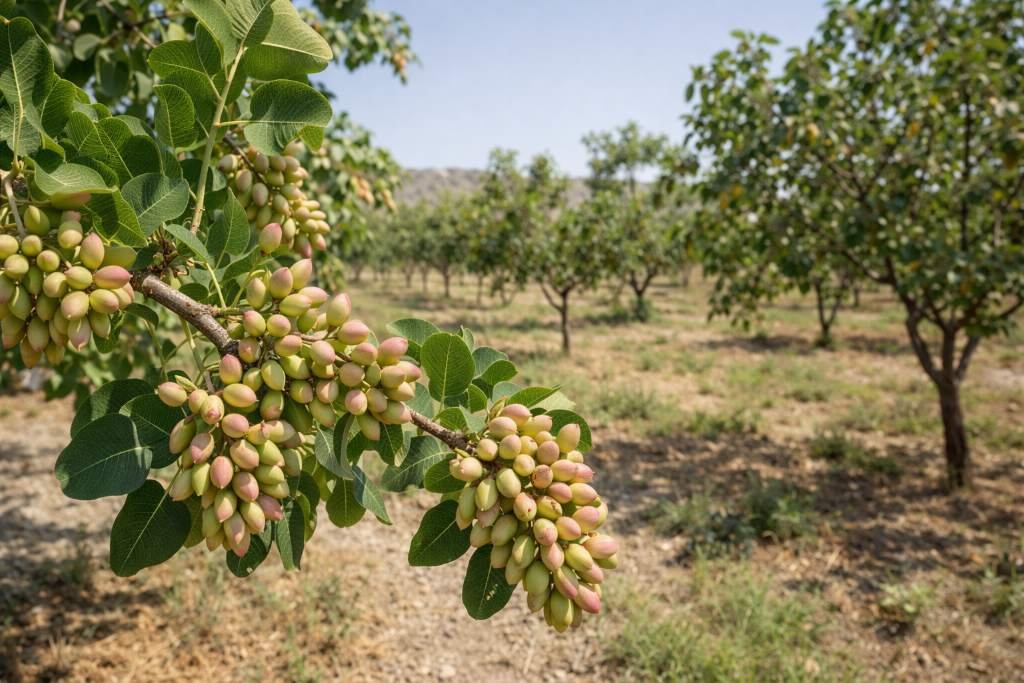

ISLAMABAD, March 13 (ABC): Cultivation of pistachio on a trial basis has started in Punjab’s Potohar region as researchers test whether the area’s climate suits this high-value nut crop.
“We have successfully grown pistachio plants, but the fruiting process is taking longer than expected,” Aqeel Feroz, Senior Scientist at the Barani Agricultural Research Institute (BARI), Chakwal, told Wealth Pakistan.
Experimental cultivation under way
Feroz said BARI has imported six pistachio varieties from California, one of the world’s major producers of this widely consumed nut.
He explained that pistachio cultivation remains at an experimental stage because the plants take several years to start bearing fruit.
The varieties currently under experimental cultivation at BARI include Napolitano, Larnaka, Sirora, 3C and Golden Hills.
“We have harvested only a few bunches of fruit so far. However, we want to see the plants fully laden before recommending commercial cultivation so that the crop becomes economically viable for growers,” Feroz said.
Research to identify suitable varieties
BARI scientists are conducting research to identify pistachio varieties that suit the agro-climatic conditions of northern Punjab.
“Pistachios traditionally grow in cooler and arid regions such as Balochistan. However, experimental cultivation is showing promise in the drier parts of Punjab,” he said.
According to him, a mature pistachio plant can produce around 15 to 20 kilograms of fruit. This yield could provide attractive returns for farmers.
Experts believe pistachio farming could become a valuable option for growers once commercial cultivation begins.
Growing demand and heavy imports
Pistachio consumption in Pakistan continues to rise because people widely use it as a premium dry fruit. It is commonly used in snacks, traditional desserts such as kheer and barfi, and bakery products.
Although pistachios grow in some parts of Balochistan, the country still relies heavily on imports.
Pakistan imported about 6.86 million kilograms of pistachios worth $8.96 million in 2024. Most imports came from Iran ($8.87 million) and the United States.
Local production could reduce import dependence
“With the changing geopolitical situation, importing pistachios from regional countries such as Iran and Afghanistan is becoming both difficult and expensive,” Muhammad Zeeshan, a dry fruit importer at Lahore’s Akbari Mandi, told Wealth Pakistan.
He said promoting local pistachio production would benefit the national economy.
Success stories from Balochistan
Horticulture experts say Balochistan and Upper Chitral in Khyber Pakhtunkhwa already offer encouraging examples of pistachio cultivation.
“About 12,000 hectares (30,000 acres) of land in Balochistan is under pistachio cultivation in upland areas stretching from Kalat to Quetta and Loralai divisions,” Prof Dr Shahjahan Shabbir Rana, a horticulture expert at the Balochistan University of Information Technology, Engineering and Management Sciences (BUITEMS), told Wealth Pakistan.
He said the Pakistan Agricultural Research Council (PARC) and the Balochistan Agricultural Research and Development Center (BARDC) jointly developed four pistachio varieties.
“Three new pistachio varieties have recently been registered,” Dr Rana said.
New varieties under research
Researchers have also introduced the UCB-1 hybrid cultivar from the United States to strengthen research and development efforts.
Dr Rana said wild varieties such as Pistacia Khinjuk are also under experimental cultivation.
Currently, pistachio production in Balochistan meets only a small portion of the country’s demand.
“Nevertheless, it remains promising in every respect, especially as imports from Iran and Afghanistan are becoming more expensive due to changing geopolitical dynamics,” he said.