


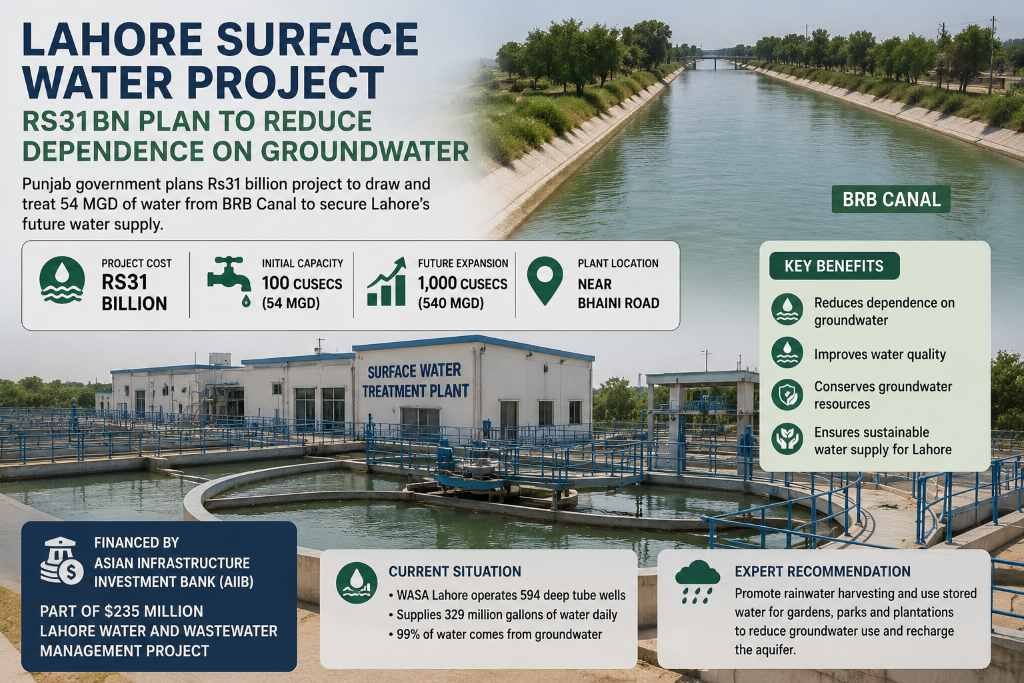
LAHORE, Aug 28 (ABC): The Punjab government has planned a Rs31 billion surface water project to reduce Lahore’s dependence on groundwater by drawing and treating 54 million gallons per day (MGD) from the BRB Canal.
The Water and Sanitation Agency (WASA) Lahore currently operates 594 deep tube wells across the city. These wells supply around 329 million gallons of water daily.
WASA officials said the Central Development Working Party (CDWP) has approved the project’s PC-I. The project will now go to the Executive Committee of the National Economic Council (ECNEC) for final approval.
“After getting the final nod, execution of the project will start,” WASA Lahore Vice-Chairman Chaudhary Shahbaz Ahmad told Wealth Pakistan.
Plant to initially supply 54 MGD
Ahmad said the Surface Water Treatment Plant (SWTP) would initially have a capacity of 100 cusecs, equivalent to 54 MGD.
WASA plans to establish the plant near Bhaini Road. In subsequent phases, its capacity would be expanded to 1,000 cusecs, equivalent to 540 MGD.
Ahmad, who is also a member of the Punjab Assembly, said the Asian Infrastructure Investment Bank (AIIB) would provide financial assistance for the project.
The SWTP forms part of AIIB’s $235 million financing package under the Lahore Water and Wastewater Management Project.
The broader programme aims to improve water quality and reduce pollution caused by untreated sewage. It also seeks to gradually shift Lahore’s water supply from groundwater towards surface water.
The project includes laying a trunk sewer from Larech Colony to Gulshan-e-Ravi. Authorities plan to use trenchless technology to reduce pressure on stormwater drains in central Lahore.
Lahore heavily dependent on groundwater
Pakistan’s major cities meet their water requirements through a combination of surface and groundwater resources.
Karachi and Islamabad rely heavily on surface water from rivers, canals and reservoirs. Lahore, however, has historically depended on groundwater extracted through tube wells.
“Cities like Karachi and Islamabad depend heavily on surface water schemes, while places like Lahore have relied on groundwater,” Dr Ghulam Zakir Hassan Sial, Director of the Irrigation Research Institute (IRI), Punjab, told Wealth Pakistan.
He said continued groundwater extraction had significantly lowered aquifer levels, particularly in Lahore.
According to Dr Sial, groundwater levels in parts of Punjab, including Lahore, are falling by three to five feet annually. Therefore, conserving and recharging the aquifer has become increasingly important.
Surface water to ease pressure on aquifer
Dr Sial said shifting part of Lahore’s water demand to treated surface water could substantially reduce pressure on groundwater resources.
“WASA Lahore currently obtains 99 per cent of its water from the aquifer to meet the needs of Lahorites,” he said.
Using treated canal water for drinking purposes would diversify Lahore’s water supply while conserving underground reserves, he added.
The planned project would therefore represent a significant shift in Lahore’s water management approach, which has traditionally relied heavily on tube wells.
Dr Sial said greater reliance on surface water could improve the long-term sustainability of the city’s water supply.
Rainwater harvesting can support recharge
He also identified rainwater harvesting as a practical way to improve urban water management and reduce unnecessary groundwater extraction.
Dr Sial suggested that WASA promote rainwater collection and use the stored water for gardens, parks and roadside plantations managed by the Parks and Horticulture Authority (PHA).
Such measures could reduce the use of groundwater for landscaping and other non-drinking purposes.
“Our groundwater budget is negative. We are drawing more water while recharging less,” he said.
He stressed that Lahore would still need aquifer recharge measures even after shifting part of its water demand to surface water.
Dr Sial acknowledged that surface water infrastructure requires significant initial investment. However, he said the long-term benefits could outweigh the costs by conserving groundwater and improving water security.
“The greater the use of treated canal water, the greater the chances of checking the decline in groundwater levels,” he said.