



Power plants generate 16,447 GWh from Thar coal in FY26

ISLAMABAD, Sept 16 (ABC): Power projects using Thar coal generated 16,446.521 gigawatt-hours (GWh) of electricity during FY2025-26, consuming 13.83 million tonnes of indigenous coal.
According to documents available with Wealth Pakistan, six power projects with a combined installed capacity of 3,960 megawatts (MW) used Thar coal either entirely or in combination with imported coal during the fiscal year.
Calculations based on the official figures show that the six plants consumed 13,834,293 tonnes of Thar coal during FY2025-26.
Block-I plant leads Thar coal generation
The 1,320MW Thar Coal Block-I Power Generation Company (Pvt.) Limited emerged as the largest generator using Thar coal. Located at Thar Block-I in Sindh, the plant generated 8,330.914 GWh while consuming 6,602,756 tonnes of indigenous coal.
The plant has an annual coal requirement of 7.6 million tonnes and meets 100% of this requirement from Thar coal.
Three projects associated with Thar Block-II also operated entirely on indigenous coal.
The 660MW Engro Powergen Thar Pvt. Ltd generated 3,816.539 GWh after consuming 3,434,627 tonnes of Thar coal. The plant has an annual coal requirement of 3.8 million tonnes.
The 330MW Thar Energy Limited generated 1,821.777 GWh using 1,630,550 tonnes of Thar coal. Meanwhile, the 330MW ThalNova Power Thar Ltd produced 1,824.147 GWh after consuming 1,627,985 tonnes.
Both 330MW plants have annual coal requirements of 1.9 million tonnes each and rely entirely on Thar coal.
Together, the four plants operating fully on Thar coal generated 15,793.377 GWh during FY2025-26. Their combined consumption reached nearly 13.30 million tonnes.
Thar coal also used in blended fuel
Two other power plants used Thar coal alongside imported coal during the fiscal year.
The 660MW Lucky Electric Power Company Limited at Port Qasim used a blend comprising 33% Thar coal and 67% imported coal. The documents attribute 627.934 GWh of its electricity generation to the Thar coal share, with consumption reaching 519,270 tonnes.
The documents further state that Lucky Electric has been regularly receiving Thar coal supplies from Sindh Engro Coal Mining Company (SECMC) since September 1, 2026. The supplies support operation of the power plant on base load.
Meanwhile, the 660MW Jamshoro Power Company Limited used Thar coal at a 20% share.
The documents record 25.210 GWh of electricity generation attributable to Thar coal at Jamshoro, with consumption of 19,105 tonnes.
Jamshoro conducted a heat-rate test on June 19, 2026, using a blend of 80% imported coal and 20% Thar coal. The figures for the plant cover the period from June 19 to June 30, 2026.
Electricity supplied to national grid
According to the documents, electricity generated by the listed power projects is supplied to the national grid. The system then dispatches the electricity to consumers across Pakistan according to demand and operational requirements.
The figures show that plants operating entirely on indigenous coal accounted for about 96% of the 16,446.521 GWh attributed to Thar coal during FY2025-26.
Pakistan Post to procure 1,691 mobile sets to improve service delivery

ISLAMABAD, Sept 15 (ABC): Pakistan Post is procuring 1,691 mobile sets for postmen as part of its efforts to improve postal service delivery and modernise operations across the country.
According to official documents available with Wealth Pakistan, Pakistan Post will procure the mobile sets through the Universal Postal Union’s Quality of Service Fund (UPU QSF).
The procurement forms part of several initiatives aimed at improving operational capacity and service delivery. Pakistan Post also plans to purchase 100 tri-cycles/loaders for General Post Offices (GPOs) and District Mail Offices (DMOs) through the UPU QSF.
2,761 post offices to be automated
Pakistan Post is also pursuing a major project to automate 2,761 post offices with support from the EXIM Bank of Korea.
The Central Development Working Party (CDWP) has approved the project, which is also included in the Public Sector Development Programme (PSDP) for FY2026-27.
The government is seeking the required funding through a Technical Supplementary Grant (TSG) in the Economic Coordination Committee (ECC).
Pakistan Post has already completed Phase I and Phase II of the automation project. It will execute Phase III once the required funds receive approval.
The project is scheduled for completion by December 2027.
Business plan also under development
Pakistan Post is also moving ahead with plans to hire a consultant for the development of its business plan.
According to the documents, the department has already finalised the Request for Proposal (RFP) for hiring the consultant.
The mobile sets, operational equipment and automation of post offices form part of Pakistan Post’s broader efforts to modernise its network and improve service delivery.
NHA plans rehabilitation of 171km flood-damaged highways in GB
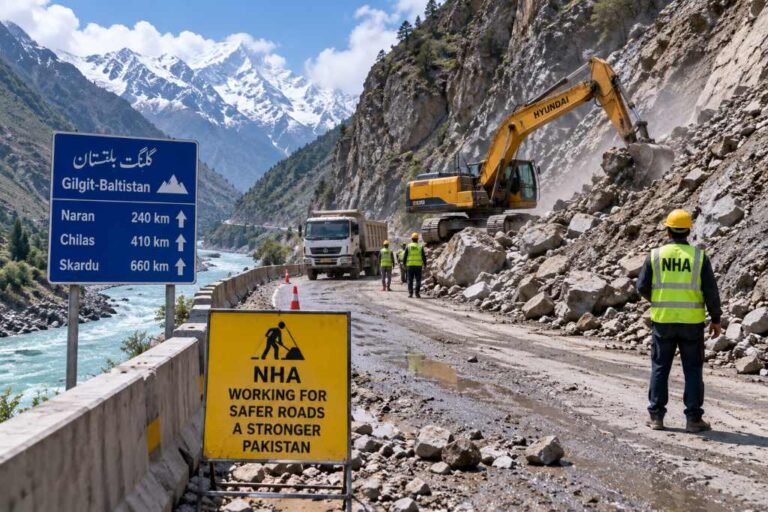
ISLAMABAD, Sept 13 (ABC): The National Highway Authority (NHA) has proposed rehabilitation of 171 kilometres of key highways in Gilgit-Baltistan following recent flash floods, landslides and glacial lake outburst floods (GLOFs) that damaged roads, bridges and other structures.
According to documents available with Wealth Pakistan, the proposed plan covers sections of the Mansehra-Naran-Jalkhad-Chilas (MNJC/N-15) and Karakoram Highway (KKH/N-35). It also includes protection works on the Jaglot-Skardu Road (S-1).
Under the plan, NHA proposes rehabilitation of a 54-kilometre section of the MNJC (N-15), from kilometre 186 to 240, through structural overlay.
The authority also plans to rehabilitate 117 kilometres of the KKH (N-35), from kilometre 350 to 467. In addition, the plan includes rigid pavement at Tattapani on the KKH.
Together, the proposed rehabilitation sections of N-15 and KKH cover 171 kilometres.
Protection works planned on Jaglot-Skardu Road
NHA has also proposed slide shelters on the Jaglot-Skardu Road. Meanwhile, the authority is processing routine maintenance contracts for the KKH and S-1 for financial year 2026-27.
The documents detail damage to the three road links caused by recent flash floods, landslides and GLOFs.
On the KKH, mudflow and landsliding affected the section between kilometre 426 and 427 at Gini. Maintenance teams have since cleared the slide under a routine maintenance contract.
The Jaglot-Skardu Road suffered damage to several bridges and other structures. Floodwaters completely washed away a bridge at kilometre 16+200, forcing authorities to divert traffic through an alternative route.
At kilometre 21+850, floodwaters scoured and damaged bridge abutments. Traffic is using one lane, while NHA is preparing the design for protection works at the site.
Another bridge at kilometre 25+250 suffered damage and overtopping. Authorities subsequently launched a Bailey bridge to maintain connectivity.
A structural expert has also inspected the affected site and collected the required data. NHA is preparing the design for permanent works.
Landslides hit several sections of N-15
The MNJC (N-15) also suffered mudflows, landslides and boulder falls at several locations.
Mudflow, landsliding and boulders affected the section between kilometre 216 and 217 near Lushi. Similar incidents occurred at kilometres 214, 217 and 222.
The section between kilometre 228 and 229 also suffered mudflow, landsliding and boulder falls. Maintenance teams have cleared the affected slides under routine arrangements.
The proposed programme combines structural rehabilitation with measures to improve protection against future damage. It includes rehabilitation of substantial sections of N-15 and KKH, rigid pavement at Tattapani and slide shelters on the Jaglot-Skardu Road.
NHA is also preparing permanent works for damaged structures where temporary arrangements currently maintain road connectivity.
Pakistan developing national open-source education data platform

ISLAMABAD, Sept 13 (ABC): Pakistan is developing a national open-source education data platform under a foreign-funded project aimed at strengthening inclusive and responsive education across the country.
According to documents available with Wealth Pakistan, the government is implementing the platform under the Actions to Strengthen Performance for Inclusive and Responsive Education Program – Technical Assistance (ASPIRE-TA). The project has achieved 55% physical progress and 42% financial progress.
The documents list the implementation of functional provincial and national open-source data platforms among the project’s major activities. A national open-source data platform is also among the key benefits expected upon completion.
Teacher training, digital learning in focus
The project also includes an assessment of teacher training programme uptake and its potential impact on pedagogical practices. It aims to improve teaching practices for digital learning.
Another component focuses on developing curricula for climate change and environment for living. The project also provides logistical support for participation in international assessments in either literacy or numeracy.
Knowledge-sharing events and capacity-building activities form part of the programme. In addition, the project supports national-level research on assessments, foundational literacy and quality education.
Foundational literacy, out-of-school children targeted
The project aims to support the implementation of foundational literacy and reduce learning poverty. It also seeks to decrease the number of out-of-school children.
Participation in an international assessment is expected to provide comparative diagnostics and help evaluate education outcomes against international benchmarks.
The programme also envisages the development and implementation of a wellness and nutrition policy.
Another planned initiative is the establishment of an Out-of-School Children Challenge Fund, which forms part of the project’s broader efforts to improve access to education.
Overall, the ASPIRE-TA project combines education data, teacher development, curriculum improvement, research and international assessments to support evidence-based planning and improve the quality and inclusiveness of Pakistan’s education system.
14 new bridges built, 16 repaired in Sindh’s flood-hit areas
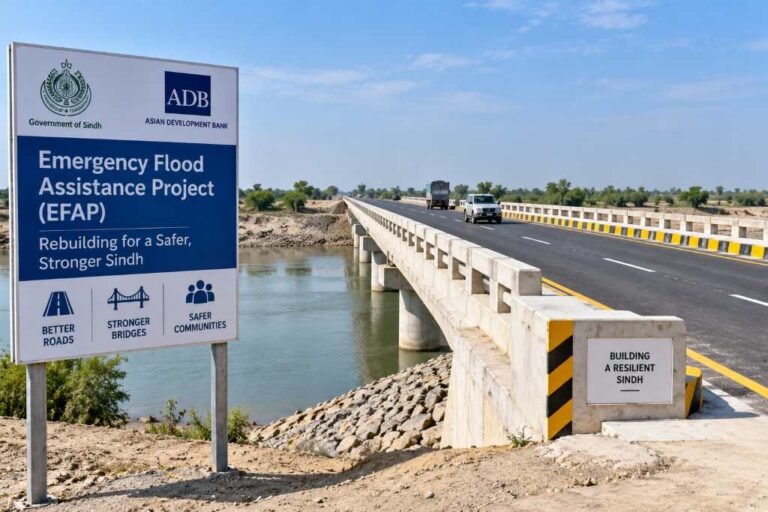
ISLAMABAD, Sep 12 (ABC): Sindh has made significant progress in restoring flood-damaged road infrastructure, completing 14 out of 17 new bridges and repairing 16 out of 24 bridges under a major rehabilitation project.
According to documents available with Wealth Pakistan, the Sindh component of the Asian Development Bank (ADB)-financed Emergency Flood Assistance Project (EFAP) covers the rehabilitation of roads, bridges and culverts damaged by floods.
The project brief shows that contractors have blacktopped 732 kilometres of the 829 kilometres of roads included in the revised project scope. The road network comprises 41 roads divided into 17 packages, with nine packages now substantially complete.
Bridges, culverts record major progress
The project has also made substantial progress on bridges and drainage infrastructure. Of the 17 new bridges planned, contractors have completed 14, including the Tangwani Bridge in Kashmore district.
They have also completed repairs to 16 of the 24 bridges covered by the project.
Meanwhile, contractors have completed 920 of the 996 new culverts planned under the project. They have also repaired 461 of the targeted 505 culverts.
Project cost revised to Rs60.05bn
The Executive Committee of the National Economic Council (ECNEC) originally approved the project on December 6, 2022. At that stage, the project carried a total cost of Rs48.4 billion, equivalent to $220 million.
The original financing included an ADB share of Rs43.974 billion, or $199.9 million. The Sindh government was to contribute Rs4.425 billion, equivalent to $20.1 million.
The Central Development Working Party (CDWP) recommended a revised PC-I to ECNEC on February 6, 2026. The revised project carries a total cost of Rs60.053 billion, equivalent to $212.20 million.
Under the revised financing plan, ADB will provide Rs52.067 billion, or $183.98 million. The Sindh government’s share stands at Rs7.986 billion, equivalent to $28.21 million.
Road rehabilitation scope expanded
Under the original framework, the project aimed to rehabilitate 400 kilometres of roads. This target was outlined in ADB’s Project Administration Manual issued in November 2022.
Subsequently, an ADB field mission finalised 849 kilometres of roads for rehabilitation. The revised PC-I now covers 829 kilometres.
With 732 kilometres already blacktopped, the project has completed asphalt-wearing work on about 88% of the road length covered by the revised scope.
Chinese firm to upgrade four SEPCO grid stations

ISLAMABAD, Sept 11 (ABC): A Chinese company will upgrade four Sukkur Electric Power Company (SEPCO) grid stations from 66kV to 132kV under a $40 million Asian Development Bank (ADB)-supported power project.
According to documents available with Wealth Pakistan, the project covers grid stations at Radhan, Thari Mir Wah, Nara-II and Padidan.
SEPCO has awarded the grid-station conversion package, identified as SEPCO-EPC-001, to Chinese company M/s Jiangsu Ankura Intelligent Electric Co., Ltd. The contract carries a value equivalent to $11.728 million.
The contract value comprises a foreign-currency component of $6.612 million and a local-currency component of Rs1,432.444 million.
Initial project activities underway
SEPCO and the contractor signed the agreement on February 4, 2026. Project progress details show that the advance payment for the foreign-currency component has already been disbursed.
Meanwhile, the contractor is proceeding with letter of credit processing, design submissions and soil-investigation activities.
The conversion of the four grid stations from 66kV to 132kV forms part of a broader programme of SEPCO investments. The Asian Development Bank is supporting the programme through ADB Loan No. 4567-PAK, which carries financing of $40 million.
AMI, feeder upgrades also included
The programme includes several other packages aimed at strengthening SEPCO’s electricity distribution infrastructure.
According to the documents, SEPCO plans to procure 1,200 APMS units and implement an Advanced Metering Infrastructure (AMI) project involving 50,000 units. Another package covers the bifurcation of 40 11kV feeders.
The programme also provides project implementation consultancy services for the grid-station component. Separate consultancy services will support the AMI, APMS and 11kV feeder bifurcation components.
Together, these investments cover grid-station upgrades, advanced metering and feeder improvements as part of the ADB-supported programme to strengthen SEPCO’s power distribution infrastructure.
Govt plans flood protection for 15.76m people, additional 12.8 MAF water storage
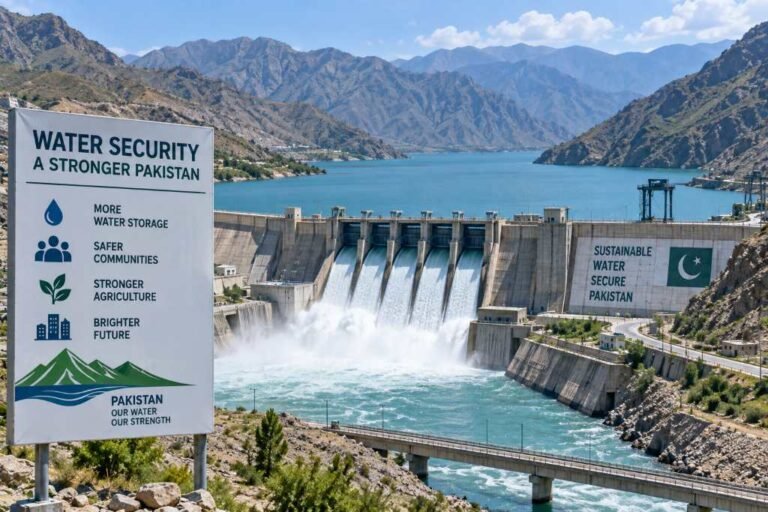
ISLAMABAD, Sept 10 (ABC): The government’s water-sector development programme aims to protect around 15.76 million people from floods and add 12.8 million acre-feet (MAF) of water storage. The programme covers dams, irrigation infrastructure, urban water supply and flood management.
According to a document available with Wealth Pakistan, the Public Sector Development Programme (PSDP) 2026-27 includes 35 water-sector projects. These projects carry a total cost of Rs2.102 trillion and had a throw-forward of Rs880.267 billion as of July 1, 2026. The government has allocated Rs74.920 billion for them in 2026-27.
Major dams to expand water storage
Under Uraan Pakistan, the government aims to substantially increase surface-water storage capacity. The framework sets a target of raising storage by 10 MAF, from a 2023-24 baseline of 13.5 MAF to 23.5 MAF by 2029.
The development programme includes large, medium and small dams. It covers 21 projects, including Diamer-Basha Dam, Mohmand Dam, Nai Gaj Dam and Naulong Dam.
Together, the planned interventions are expected to add 12.8 MAF of storage capacity. The document projects total storage of 26.3 MAF after these interventions, compared with the 13.5 MAF baseline.
The additional capacity is expected to improve per-capita water availability. It will also provide more water for irrigation, industrial and domestic needs.
Irrigation upgrades target lower water losses
The programme also aims to improve water availability at the farmgate by reducing conveyance losses by 33%. It targets an increase in farmgate water availability from 63.5 MAF to 84.2 MAF.
Major irrigation works include the remodelling and lining of Pat Feeder and completion of the remaining works of Kachhi Canal Phase-I. Other projects include Chashma Right Bank Canal and the revised Kaitu Weir Irrigation and Power Project Component-I of Kurram Tangi Multipurpose Dam.
The planned interventions will replace old irrigation infrastructure and develop a 1.59-million-acre command area. The government also aims to increase water-use efficiency from the 40% baseline to 70% by 2029.
For Karachi, the programme includes the 260 MGD Phase-I of the Greater Karachi Bulk Water Supply Scheme K-IV. It also covers improvements to the Kalri Baghar Feeder and Keenjhar Lake.
The planned works include plain cement concrete lining of Kalri Baghar Feeder Upper Phase-I. The K-IV project will supply an additional 260 million gallons of water per day to Karachi. This will raise the city’s overall water supply from 650 MGD to 910 MGD.
Real-time monitoring planned for Indus Basin
The government also plans to install a telemetry system at 27 sites across the Indus Basin. State-of-the-art equipment will provide real-time flow measurements at key locations and barrages.
The programme also includes a data centre and client workstations for key stakeholders. The system will provide round-the-clock information on river flows, gate openings and water levels.
Expected outcomes include expanding the culturable command area to 20 million acres and reducing conveyance losses. The programme also aims to reclaim land affected by waterlogging and salinity and increase crop production.
Flood measures to protect 15.76m people
Flood resilience forms another major component of the water-sector programme. The Integrated Flood Risk Management Plan covers implementation of the National Flood Protection Plan and the updated Flood Protection Sector Project-III.
It also includes a JICA-supported project to enhance flood management in the Indus Basin. In addition, the programme covers restoration of flood damage to the Kachhi Canal up to 323.47 kilometres.
The government plans 166 flood-protection schemes, 457 telemetry stations and five regional forecasting centres. The programme also covers watershed management, research, institutional strengthening and capacity building.
According to the document, these measures will provide flood protection to around 15.76 million people. They will also protect 2.276 million houses and 8.05 million acres of agricultural land.
Other assets identified for protection include 76 schools, 331 kilometres of metalled roads and 64 villages. The programme also covers 223 tube wells, 80 miles of irrigation canals and 12 basic health units.
In addition, the document lists 3,825 farm families among the beneficiaries and envisages reclamation of 121 acres of land.
Under the broader water-security goal, the government seeks to increase the water sector’s share in PSDP allocations. The document shows a baseline share of 10.52%, a 2029 target of 18% and a broader goal of increasing the sector’s allocation share by 20% by 2030.
Karak, Lakki Marwat oil output rises 16%, gas production 20% in 2025-26

ISLAMABAD, Sept 9 (ABC): Oil production from fields in Khyber Pakhtunkhwa’s Karak and Lakki Marwat districts increased by about 16% in 2025-26, while gas output rose nearly 20%, driven largely by a sharp surge in production from the Makori Deep field.
According to year-wise production data available with Wealth Pakistan, five fields produced a combined 6.73 million barrels of oil during 2025-26. This compares with 5.78 million barrels in 2024-25, representing an increase of about 16.4%.
Gas production from the five fields rose by about 19.7% to 72,126.32 million cubic feet (MMcf). A year earlier, the fields had produced 60,265.44 MMcf. Oil and Gas Development Company Limited (OGDCL) and MOL operate the fields covered by the data in Karak and Lakki Marwat.
Nashpa remains largest oil producer
OGDCL’s Nashpa field in Karak remained the largest oil producer among the five fields. It produced 3.73 million barrels in 2025-26, up from 3.41 million barrels a year earlier. However, production remained below the 3.95 million barrels recorded in 2023-24.
MOL’s Makori East field in Karak ranked second, producing 1.99 million barrels during 2025-26. The field produced 2.04 million barrels in 2024-25 and 2.75 million barrels in 2023-24.
Makori Deep recorded the most significant increase. Oil production at the MOL-operated Karak field surged to 0.77 million barrels from just 0.01 million barrels in 2024-25. Its output stood at 0.08 million barrels in 2023-24.
In Lakki Marwat, OGDCL’s Bettani field produced 0.23 million barrels in 2025-26. This was down from 0.30 million barrels a year earlier and 0.34 million barrels in 2023-24.
Meanwhile, MOL’s Manzalai field in Karak produced 0.01 million barrels during the year. Its production stood at 0.03 million barrels in 2024-25 and 0.04 million barrels in 2023-24.
Makori Deep leads surge in gas output
Gas production showed a similar trend, with Nashpa retaining its position as the largest producer. Its output increased to 33,152.48 MMcf in 2025-26 from 27,121.58 MMcf in the preceding year.
Makori East remained the second-largest gas producer, with output of 25,175.41 MMcf. This was marginally higher than 25,130.91 MMcf in 2024-25 but below the 28,647.26 MMcf recorded in 2023-24.
Makori Deep posted the sharpest increase in gas production. Output surged to 8,695.09 MMcf in 2025-26 from only 115.09 MMcf a year earlier. The field had produced 912.74 MMcf in 2023-24.
In contrast, Bettani’s gas production declined to 3,305.05 MMcf from 4,367.47 MMcf in 2024-25. Manzalai also recorded a decline, with production falling to 1,798.29 MMcf from 3,530.40 MMcf.
Output remains below 2023-24 level
Despite the strong year-on-year recovery, combined production remained below the levels recorded two years earlier. The five fields produced 7.16 million barrels of oil and 74,852.08 MMcf of gas in 2023-24.
The data shows that Makori Deep and Nashpa drove much of the recovery in 2025-26. Makori Deep recorded a sharp increase in both oil and gas production, while Nashpa also posted higher output.
At the same time, production from Bettani and Manzalai continued to decline. Makori East remained broadly stable in gas production but recorded a slight decline in oil output.