




Govt plans $615m initiative to avoid 80m tonnes of CO₂ emissions
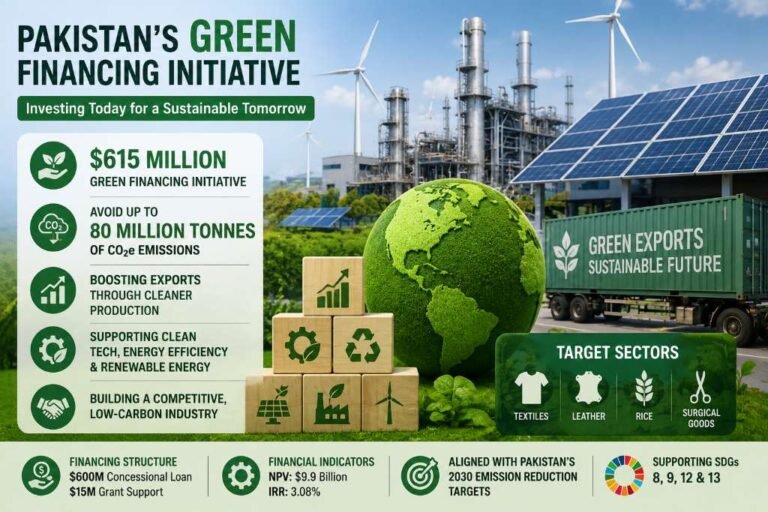
ISLAMABAD, May 17 (ABC): Pakistan is planning a $615 million green financing initiative to improve export competitiveness and reduce carbon emissions. The programme aims to avoid up to 80 million tonnes of carbon dioxide equivalent (CO₂e) emissions during its implementation period while helping industries adopt cleaner production methods.
According to documents available with Wealth Pakistan, the initiative is titled Enhancing Green Export Capacity Through Green Financing. EXIM Bank is leading the programme in collaboration with local financial institutions. International development financing arrangements will also support the project.
Programme targets key export industries
According to the document, the programme will focus on major export sectors, including textiles, leather, rice, and surgical goods. Authorities want to help these industries meet international environmental requirements while improving their global competitiveness.
The initiative will also support industries in complying with the European Union’s Carbon Border Adjustment Mechanism (CBAM). At the same time, it aims to promote broader industrial decarbonisation across the country.
Financing package combines loans and grants
The financing package will follow a blended finance structure. It will include $600 million in concessional lending and $15 million in grant support.
The initiative will help exporters adopt clean technologies and energy-efficient production systems at lower borrowing costs. It will also provide technical assistance for upgrading machinery and introducing renewable energy solutions.
Authorities plan to implement the programme across the country. Participating financial institutions and development finance mechanisms will deliver support to the targeted sectors.
Supporting climate goals and industrial growth
According to the document, the project aligns with Pakistan’s 2030 emission reduction targets. It also aims to strengthen the position of Pakistani exporters as international environmental standards continue to evolve.
The programme will use financing for machinery replacement and clean-energy upgrades. These measures aim to improve energy efficiency and lower industrial emissions.
The investment structure follows a blended debt model with foreign exchange cover. The project’s financial indicators include a net present value (NPV) of $9.9 billion and an internal rate of return (IRR) of 3.08%.
Programme linked with sustainable development goals
The initiative also supports Sustainable Development Goals (SDGs) 8, 9, 12, and 13. In addition, the programme identifies skilled industrial employment as one of its expected outcomes.
The initiative forms part of broader efforts to strengthen sustainable industrial practices and support Pakistan’s transition toward lower-carbon economic growth.
Punjab ramps up flood prevention drive ahead of monsoon
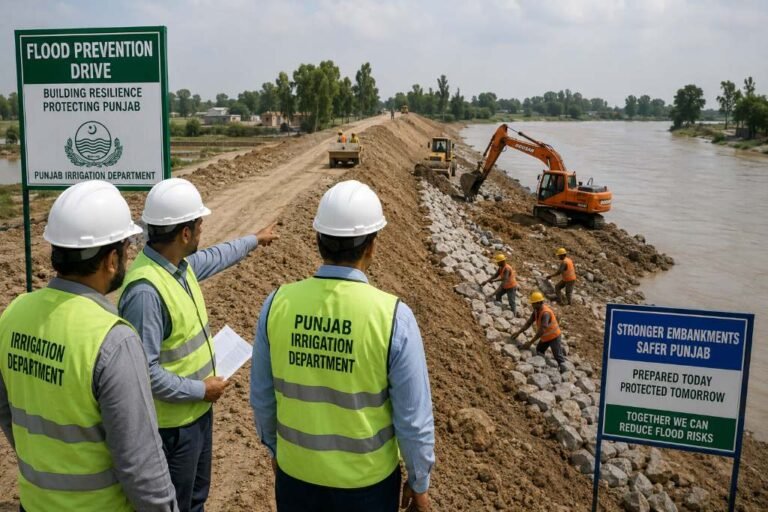
LAHORE, May 17 (ABC): The Punjab Irrigation Department has intensified preparations for the upcoming monsoon season by starting pre-flood inspections across the province. The initiative covers spurs, embankments, canal headworks, and other flood protection structures. Authorities aim to reduce flood risks and strengthen preparedness before heavy rains arrive.
Designated inspection teams are carrying out the assessments with support from allied departments and law enforcement agencies. The teams are checking the condition of existing structures and identifying weak points that need urgent repairs.
“The structures, if found damaged or weak, are being repaired and strengthened immediately in the light of the inspection teams’ recommendations,” said Dr. Ghulam Zakir Hassan Sial, Director of the Irrigation Research Institute (IRI), Punjab, while talking to Wealth Pakistan.
Ongoing repair and strengthening efforts
Dr. Sial said authorities continue to conduct structural audits of spurs and embankments along Punjab’s rivers. He said the department is giving priority to early repairs because quick action can reduce flood risks during the upcoming monsoon season, which usually begins in mid-June.
He said authorities want to avoid a repeat of the severe flood situation witnessed in 2025. According to him, stronger protective structures can help reduce damage and improve the province’s ability to handle high water flows.
Punjab faced severe flooding during August and September last year after heavy monsoon rains and upstream water releases from India caused the Ravi, Chenab, and Sutlej rivers to overflow.
The floods affected more than 3.9 million people across Punjab. Thousands of villages in 28 districts came under water. The disaster forced large-scale evacuations and disrupted daily life. The floods also claimed 48 lives and became one of the province’s worst flooding events in decades.
Innovative flood management measures
Dr. Sial said the IRI introduced innovative flood management measures during the 2025 floods. He said the institute successfully diverted around 12,000 acre-feet of floodwater for Managed Aquifer Recharge (MAR) through the Old Mailsi Canal at Islam Headworks on the Sutlej River.
He said the initiative converted a crisis into an opportunity for groundwater replenishment. Authorities also constructed 144 recharge wells inside the canal bed. These wells support long-term water sustainability and help improve underground water reserves.
Lahore flood protection work gains pace
Meanwhile, the Ravi Urban Development Authority (RUDA) has accelerated work on flood protection infrastructure to protect Lahore’s housing societies from possible flooding by the River Ravi.
“The 46-kilometer-long embankments are being constructed on both banks of the Ravi to protect Lahorites from floods,” RUDA spokesperson Sher Afzal Butt told Wealth Pakistan.
He said the authority is constructing protection structures from Ravi Syphon to Jhok Forests. Under the project, authorities will expand the riverbed to at least one kilometer in width. The wider river channel will help manage water flow during peak flood conditions.
Last year, Lahore witnessed its first major flooding from the Ravi River in nearly four decades. Heavy monsoon rains and significant upstream water releases caused the situation and raised concerns about urban flood risks.
Government preparing relief and rescue plans
The Punjab government has also started work on an integrated flood management plan for the upcoming monsoon season. The plan aims to combine recommendations and technical input from different departments to improve coordination and strengthen preparedness.
“Preparations for relief and rescue operations are also underway to cope with any flooding during the upcoming monsoon season,” a spokesperson for the Provincial Disaster Management Authority (PDMA) Punjab told Wealth Pakistan.


Pakistan targets zero-waste economy by 2050
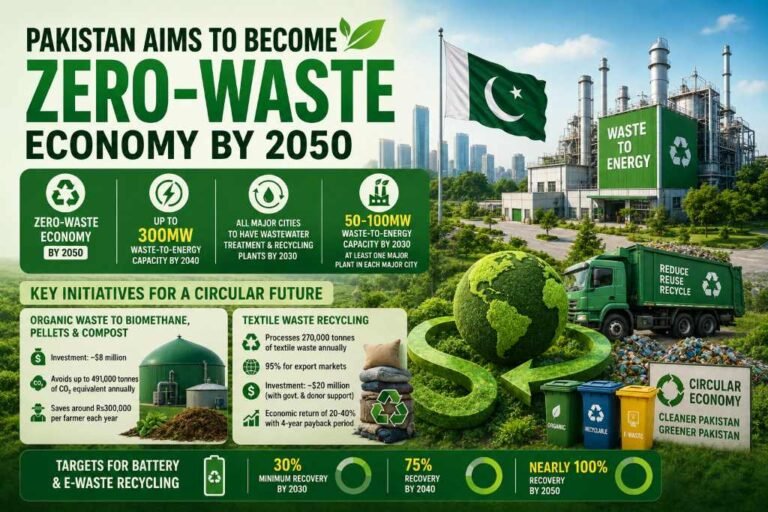
ISLAMABAD, May 10 (ABC): Pakistan aims to become a zero-waste economy by 2050 under a new circular economy strategy outlined in an official document available with Wealth Pakistan.
The strategy also targets installation of up to 300 megawatts of waste-to-energy capacity by 2040. Officials plan to install 50-100 MW of waste-to-energy systems by 2030, with at least one major plant in every major city.
The document outlines a transition towards a resource-efficient system focused on reuse and recycling. It also sets a target to equip all major cities with functional wastewater treatment and recycling plants by 2030.
At the centre of the strategy is the goal to build a circular economy that maximises resource efficiency, reduces waste, and converts used materials into new economic value streams.
As part of the transition, Pakistan plans to establish its first industrial-scale lithium-ion battery recycling facility by 2027.
The strategy also sets targets for recycling electric vehicle batteries and e-waste. Pakistan aims to recover and recycle at least 30% of end-of-life batteries and e-waste by 2030, 75% by 2040, and nearly full recovery by 2050.
The document states that Pakistan’s transition to a climate-resilient and resource-efficient economy requires major changes in the use of materials, water, and energy across sectors.
It notes that rapid urbanisation, industrial expansion, and growing environmental pressures have made the traditional “take-make-dispose” model unsustainable.
According to the document, adopting a circular economy can help reduce waste, extend resource lifecycles, and convert environmental challenges into economic opportunities.
Among the major initiatives, Biowaste Energy Ventures Ltd. plans to convert organic waste into biomethane, pellets, and compost. The project aims to reduce dependence on imported RLNG and lower methane emissions.
The project involves an investment of around $8 million. It is expected to avoid up to 491,000 tonnes of CO2 equivalent emissions annually while generating savings of nearly Rs300,000 per farmer each year.
Another initiative focuses on textile waste recycling. The project aims to process 270,000 tonnes of textile waste annually into products such as rugs and cushions, with 95% of production meant for export markets.
The textile recycling initiative requires an estimated investment of $20 million with support from the government and development partners. The document projects an economic return of 20-40% with a payback period of four years.
The document describes these projects as part of broader efforts to support green investment and strengthen Pakistan’s transition towards a sustainable circular economy.
Over Rs580m utilized under KP rural uplift project in FY2025-26
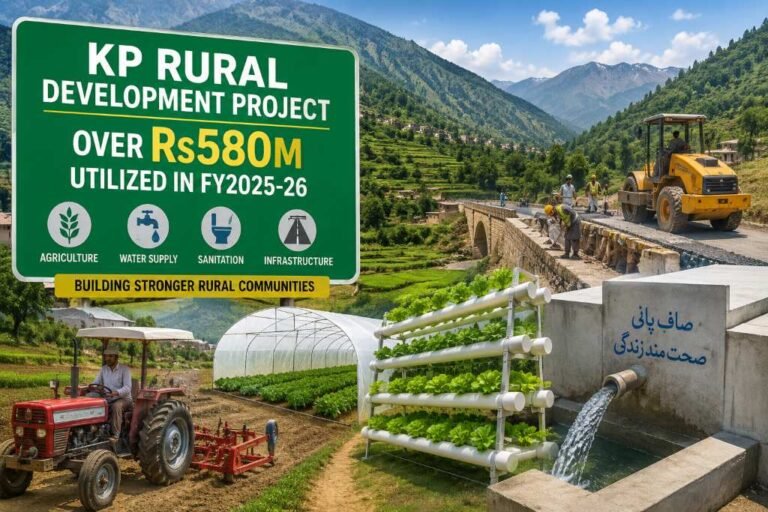
ISLAMABAD, May 09 (ABC): The Khyber Pakhtunkhwa government has utilized over Rs580 million during Fiscal Year 2025-26 under the World Bank-funded KP Rural Investment and Institutional Support Project. The project aims to improve rural infrastructure, public services, and institutional capacity in the merged districts.
According to official documents available with Wealth Pakistan, the total cost of the project is Rs109.9 billion. The Agriculture, Irrigation, Public Health Engineering (PHED), Communication & Works (C&W), and Local Government departments are implementing the project.
The documents show that cumulative spending under the project reached Rs707 million by June 2025. For FY2025-26, the government allocated Rs4.2 billion for the initiative. Out of this amount, Rs580.46 million has already been utilized, showing a release rate of 12.29 percent. The project will continue until June 2031.
Under the Agriculture Department, authorities are promoting modern farming practices in rural areas. The department is also improving private-sector agricultural services to support farmers and increase productivity.
So far, officials have distributed 168 agricultural machines to support on-farm processing and value addition businesses. Authorities have also completed 145 rainwater harvesting and soil erosion control structures to strengthen water conservation efforts.
The project has introduced modern farming technologies in remote districts. Around 310 walk-in tunnel systems and 213 vertical farming units have been installed to help farmers improve crop yields and support year-round cultivation.
Project management and monitoring systems are now operational. The government has established the Project Coordination and Management Unit (PCMU), while monitoring and evaluation firms have also been hired to ensure transparency and efficient implementation.
In the Communication and Works sector, authorities have approved five out of 14 infrastructure schemes planned on state-owned land. The remaining schemes are under approval and PC-1 preparation.
The government is also pursuing land acquisition for 18 additional sites in coordination with the Finance Department, Senior Member Board of Revenue (SMBR), and district administrations.
Under the Public Health Engineering Department, consultants have been hired for the design and supervision of sanitation schemes. Officials are currently preparing 32 projects, including 13 drinking water supply schemes and 19 sanitation projects.
The Bajaur rehabilitation project has already received approval from the Provincial Development Working Party (PDWP). Meanwhile, planning documents are being prepared for projects in Mohmand, Khyber, Kurram, and Orakzai districts.
Authorities are also revising sanitation planning and financing models. Updated cost estimates will be included after the final designs are completed.
Pakistan targets 95% renewable electricity by 2040
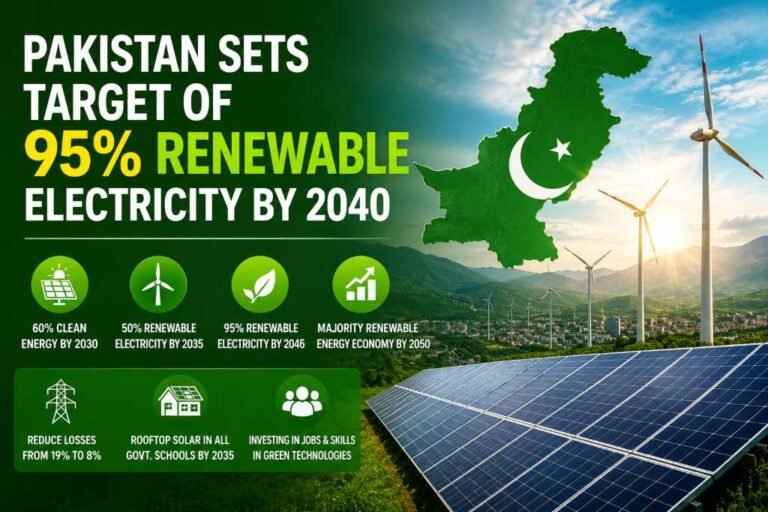
ISLAMABAD, May 09 (ABC): Pakistan aims to generate 95% of its electricity from renewable sources by 2040, according to an official document available with Wealth Pakistan.
The document sets a long-term roadmap to transform Pakistan into a majority-renewable energy economy by 2050. It also targets a 60% clean energy share by 2030 and 50% renewable electricity generation by 2035.
Under the plan, Pakistan will phase out or convert 14,000 megawatts of fossil fuel-based power plants by 2035. The strategy also seeks to cut transmission and distribution losses from 19% to 8%.
The roadmap targets 100% electricity access across the country. It also includes rooftop solar systems in all government secondary schools by 2035.
The document says Pakistan will invest in small businesses and entrepreneurs to create jobs and build skills in solar, wind, and hydrogen technologies.
Pakistan contributes only about 1% to global greenhouse gas emissions. Its per-capita emissions stand at 2.3 tonnes of CO2 equivalent. However, the country faces major economic pressure due to reliance on imported fossil fuels.
This dependence has strained foreign exchange reserves and widened the balance of payments gap. It has also contributed to circular debt exceeding Rs1.66 trillion in the power sector.
The document notes that volatile global fuel prices and currency fluctuations have increased electricity generation costs. These pressures have led to higher consumer tariffs and financial inefficiencies, including payments for underutilised capacity.
The shift to local renewable energy sources is critical for Pakistan. Solar, wind, hydro, and biomass can reduce import dependence, lower power costs, and improve energy security. These sources can also cut emissions and air pollution.
According to the document, Pakistan needs major investment in large-scale renewable projects, energy storage systems, and grid modernisation. These investments will help ensure system reliability as the country moves toward transport electrification.
Citing an April 2025 report, the document says Pakistan imported 17 gigawatts of solar power systems in 2024. This was double the previous year’s level. The report ranked Pakistan as the world’s third-largest importer of solar panels.
The surge in imports was driven by rising electricity tariffs and falling solar panel prices.