


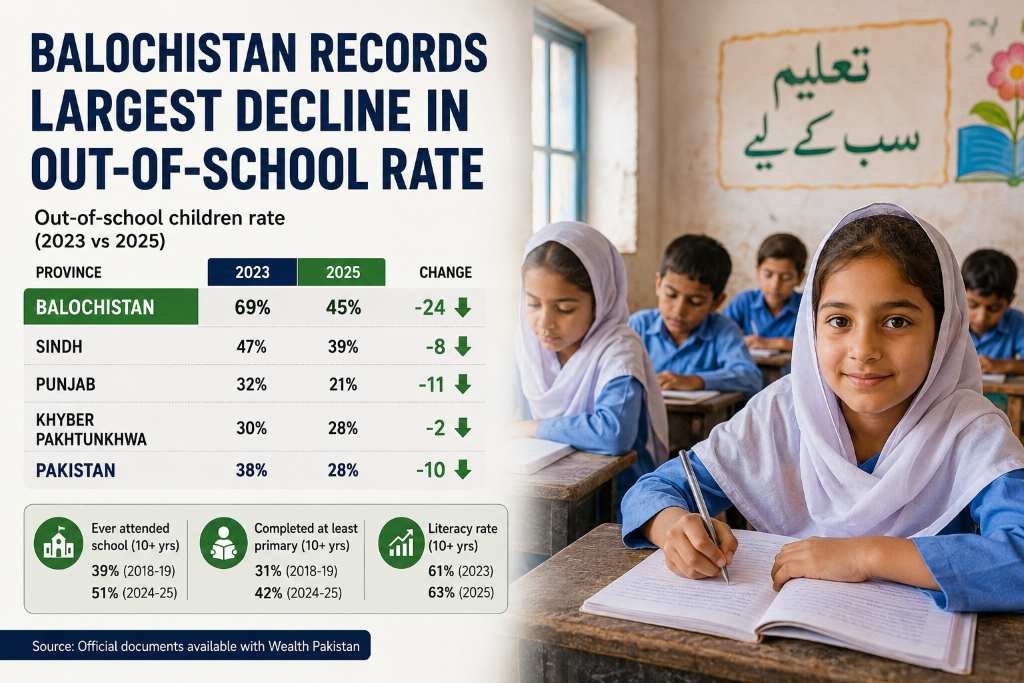
ISLAMABAD, June 18 (ABC): Balochistan recorded the largest reduction in the proportion of out-of-school children among Pakistan’s provinces, with the rate falling from 69% in 2023 to 45% in 2025.
National out-of-school rate declines
According to official documents available with Wealth Pakistan, school participation improved across the country during the period under review. The national out-of-school children rate declined from 38% in 2023 to 28% in 2025.
The documents show that the rate among boys fell from 35% to 25%. Among girls, it dropped from 42% to 31%.
Punjab reduced its out-of-school rate from 32% to 21%. Sindh lowered the rate from 47% to 39%, while Khyber Pakhtunkhwa recorded a decline from 30% to 28%.
Balochistan leads improvement
Balochistan achieved the most significant progress among all provinces. The province reduced its out-of-school children rate by 24 percentage points between 2023 and 2025.
The improvement also reflected broader gains in education access. The share of people aged 10 years and above who had ever attended school increased from 39% in 2018-19 to 51% in 2024-25.
Male attendance rose from 52% to 66%. Female attendance increased from 24% to 34%, showing improved access to education across the province.
Educational attainment improves
Balochistan also recorded strong progress in educational attainment. The share of people aged 10 years and above who completed at least primary education increased from 31% in 2018-19 to 42% in 2024-25.
This represented the largest relative improvement among the provinces during the period.
According to the documents, school enrollment indicators also improved. At the primary level, the Gross Enrollment Rate (GER) reached 59%. Enrollment at the middle and matric levels stood at 43% and 40%, respectively.
Female participation in education continued to increase across different levels.
Literacy rate shows progress
The documents indicate that the nationwide decline in out-of-school children reflects continued efforts to expand access to education and increase school participation.
Pakistan’s literacy rate for people aged 10 years and above improved from 61% to 63% during the review period. Higher literacy levels among women and rural populations also contributed to the overall improvement.