


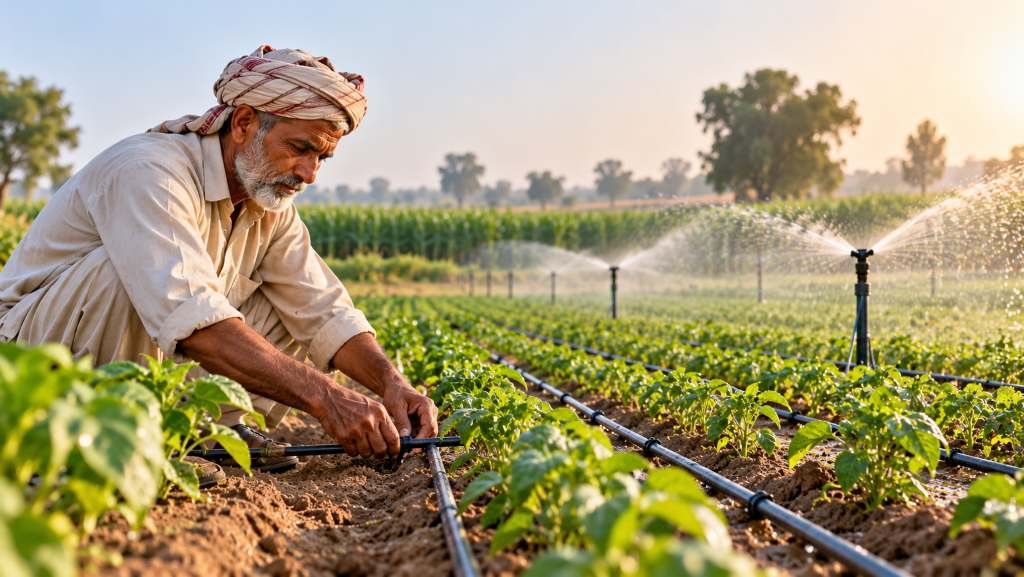
ISLAMABAD, Oct 15 (ABC): Water experts have urged Punjab farmers to gradually shift from traditional flood irrigation to more efficient methods, including drip and sprinkler systems, to conserve dwindling water resources and cope with erratic rainfall and rising temperatures caused by climate change.
They also recommended improving existing irrigation practices to reduce water losses while keeping costs manageable for farmers.
Flood irrigation remains widely used across Pakistan despite having an overall efficiency rate of less than 45%. Experts believe better water management and the gradual adoption of modern irrigation techniques could help conserve water and sustain agricultural production.
Dr Ghulam Zakir Hassan Sial, Director of the Irrigation Research Institute (IRI), Punjab, said farmers should not abandon flood irrigation overnight. Instead, they should adopt more efficient practices in phases, considering their financial capacity and crop requirements.
Talking to Wealth Pakistan, he explained that flood irrigation involved relatively low initial costs. However, poor management could lead to excessive water application, runoff, waterlogging and soil salinity.
He recommended laser land levelling, proper irrigation scheduling and furrow irrigation as practical steps to improve existing systems before investing in more expensive technologies.
Dr Sial said farmers should introduce drip and sprinkler irrigation where the economic and technical benefits justified the investment. Financial assistance, technical training and maintenance facilities could also encourage wider adoption.
He stressed that farmers should assess the total cost of irrigation systems over their useful life rather than focusing only on installation expenses.
“For low-margin crops such as wheat, improving existing flood irrigation may be the most practical starting point, while drip irrigation may be economically attractive for suitable orchards and high-value crops,” he explained.
He also warned that excessive reliance on tubewells could accelerate groundwater depletion, particularly when extraction exceeded natural or artificial replenishment.
Climate-smart farming can reduce water demand
Water experts have called for greater emphasis on water stewardship, watercourse lining, rainwater harvesting, groundwater recharge and responsible water reuse to address growing water scarcity.
Sohail Ali Naqvi, Director of Water Resources at WWF-Pakistan, said improving irrigation efficiency alone would not ensure sustainable water conservation. Farmers also needed to adopt climate-smart cropping practices.
Talking to Wealth Pakistan, he said rotating cereals with legumes, including mung bean, chickpea and lentil, could improve soil health and reduce water requirements.
Similarly, farmers in water-scarce regions could reduce the area under water-intensive crops such as rice and sugarcane. They could also adopt heat- and drought-tolerant varieties to minimise climate-related losses.
Naqvi highlighted the importance of timely sowing in protecting crops from rising temperatures. He said sowing wheat by mid-November could help crops avoid terminal heat, particularly during El Niño years.
Over the next five to 10 years, Pakistan should expand nature-based solutions, climate-informed irrigation practices, laser land levelling and watercourse lining, he suggested.
He also called for improved water management in urban and industrial areas. Cities and industries should increase water reuse, promote rainwater harvesting, reduce leakage and strengthen groundwater management.
“These are practical interventions that can be expanded through systems we already have,” he said.
Naqvi stressed that Pakistan should treat groundwater as a strategic national resource rather than an unlimited reserve.
Farmers encouraged to adopt smarter irrigation practices
Aamir Mushtaq, Deputy Director of the Water Management Department, Punjab, said farmer training in smart irrigation techniques was essential to reducing water losses.
He explained that farmers should schedule irrigation according to crop water requirements and soil moisture levels instead of applying water unnecessarily.
Mushtaq also highlighted Alternate Wetting and Drying (AWD) for paddy rice. He said the technique could reduce irrigation requirements when properly managed.
He recommended Direct-Seeded Rice (DSR) as another alternative to conventional transplanted rice, noting that it could significantly reduce water consumption.
According to the experts, Punjab needs a balanced approach that combines affordable improvements to traditional irrigation with the gradual adoption of modern technologies.
They stressed that better irrigation management, climate-resilient crops and responsible groundwater use would be crucial to conserving water and sustaining agricultural production across Pakistan.